


C. elegans toxicant responses vary among genetically diverse individuals
- PMID: 35995124
- PMCID: PMC9573778
- DOI: 10.1016/j.tox.2022.153292
C. elegans toxicant responses vary among genetically diverse individuals
Abstract
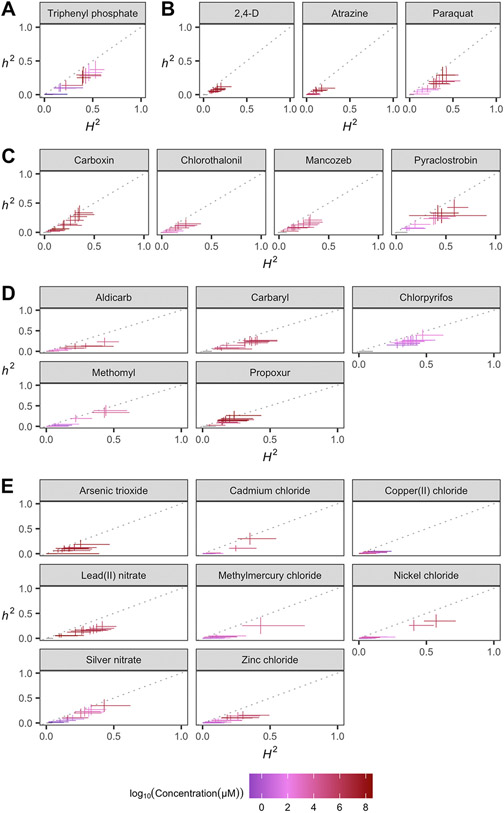
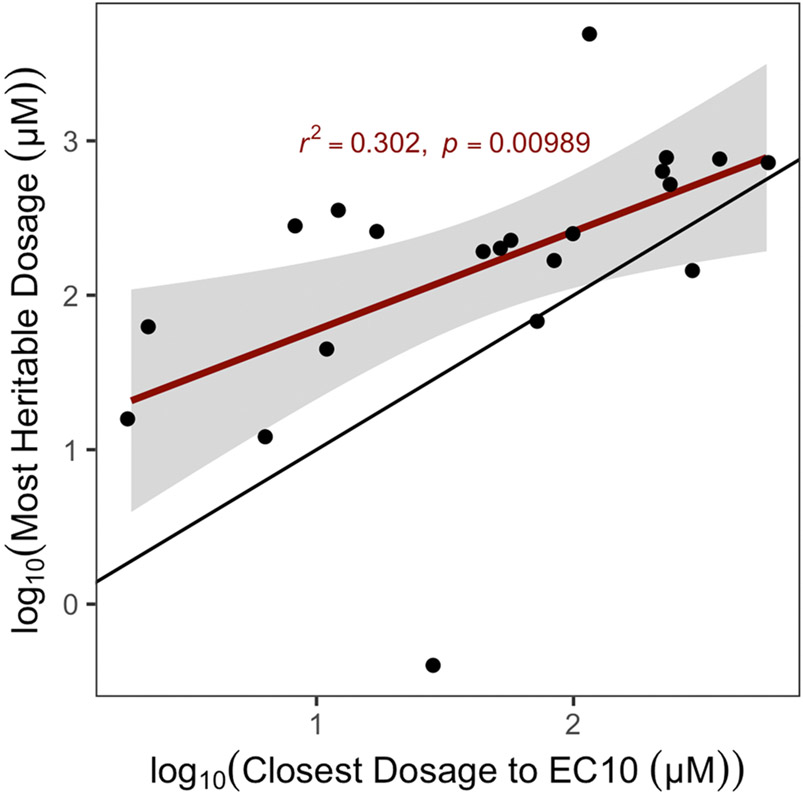
The genetic variability of toxicant responses among indisviduals in humans and mammalian models requires practically untenable sample sizes to create comprehensive chemical hazard risk evaluations. To address this need, tractable model systems enable reproducible and efficient experimental workflows to collect high-replication measurements of exposure cohorts. Caenorhabditis elegans is a premier toxicology model that has revolutionized our understanding of cellular responses to environmental pollutants and boasts robust genomic resources and high levels of genetic variation across the species. In this study, we performed dose-response analysis across 23 environmental toxicants using eight C. elegans strains representative of species-wide genetic diversity. We observed substantial variation in EC10 estimates and slope parameter estimates of dose-response curves of different strains, demonstrating that genetic background is a significant driver of differential toxicant susceptibility. We also showed that, across all toxicants, at least one C. elegans strain exhibited a significantly different EC10 or slope estimate compared to the reference strain, N2 (PD1074), indicating that population-wide differences among strains are necessary to understand responses to toxicants. Moreover, we quantified the heritability of responses (phenotypic variance attributable to genetic differences between individuals) to each toxicant exposure and observed a correlation between the exposure closest to the species-agnostic EC10 estimate and the exposure that exhibited the most heritable response. At least 20% of the variance in susceptibility to at least one exposure level of each compound was explained by genetic differences among the eight C. elegans strains. Taken together, these results provide robust evidence that heritable genetic variation explains differential susceptibility across an array of environmental pollutants and that genetically diverse C. elegans strains should be deployed to aid high-throughput toxicological screening efforts.
Keywords: C. elegans; Dose-response; Genetics; High-throughput assay; Natural variation.
Copyright © 2022 The Authors. Published by Elsevier B.V. All rights reserved.
Conflict of interest statement
Declaration of Competing Interest The authors declare that they have no known competing financial interests or personal relationships that could have appeared to influence the work reported in this paper.
Figures
References
-
- Abdo N, Xia M, Brown CC, Kosyk O, Huang R, Sakamuru S, Zhou Y-H, Jack JR, Gallins P, Xia K, Li Y, Chiu WA, Motsinger-Reif AA, Austin CP, Tice RR, Rusyn I, Wright FA, 2015. Population-based in vitro hazard and concentration-response assessment of chemicals: the 1000 genomes high-throughput screening study. Environ. Health Perspect 123, 458–466. - PMC - PubMed
Publication types
MeSH terms
Substances
Grants and funding
LinkOut - more resources
Full Text Sources
