. 2022 Aug 22;13(1):4853.
doi: 10.1038/s41467-022-32260-w.

Evolution of longitudinal division in multicellular bacteria of the Neisseriaceae family

Affiliations

Evolution of longitudinal division in multicellular bacteria of the Neisseriaceae family

Sammy Nyongesa et al. Nat Commun. .

Abstract

Rod-shaped bacteria typically elongate and divide by transverse fission. However, several bacterial species can form rod-shaped cells that divide longitudinally. Here, we study the evolution of cell shape and division mode within the family Neisseriaceae, which includes Gram-negative coccoid and rod-shaped species. In particular, bacteria of the genera Alysiella, Simonsiella and Conchiformibius, which can be found in the oral cavity of mammals, are multicellular and divide longitudinally. We use comparative genomics and ultrastructural microscopy to infer that longitudinal division within Neisseriaceae evolved from a rod-shaped ancestor. In multicellular longitudinally-dividing species, neighbouring cells within multicellular filaments are attached by their lateral peptidoglycan. In these bacteria, peptidoglycan insertion does not appear concentric, i.e. from the cell periphery to its centre, but as a medial sheet guillotining each cell. Finally, we identify genes and alleles associated with multicellularity and longitudinal division, including the acquisition of amidase-encoding gene amiC2, and amino acid changes in proteins including MreB and FtsA. Introduction of amiC2 and allelic substitution of mreB in a rod-shaped species that divides by transverse fission results in shorter cells with longer septa. Our work sheds light on the evolution of multicellularity and longitudinal division in bacteria, and suggests that members of the Neisseriaceae family may be good models to study these processes due to their morphological plasticity and genetic tractability.


Conflict of interest statement

The authors declare no competing interests.

Figures

Fig. 1
Fig. 1. Core genome-based phylogeny of rod-shaped, coccoid and MuLDi Neisseriaceae.
The best evolutionary model for each partition was found by IQ-TREE version 1.6.3 and maximum-likelihood phylogenetic analysis was also performed using IQ-TREE using 10,000 ultrafast bootstrap replicates. Above the name of each species, scanning electron microscopy images display their morphology. Dark and light blue: coccoid Neisseriaceae; green: rod-shaped Neisseriaceae; red: multicellular longitudinally dividing (MuLDi) Neisseriaceae. Coccoid lineages 1 and 2 are indicated in blue. MuLDi lineages 1 and 2 are indicated in red. N.: Neisseria; U.: Uruburuella; S.: Simonsiella; A.: Alysiella; K.: Kingella; C.: Conchiformibius; S.: Snodgrassella; V.: Vitreoscilla; E.: Eikenella; C.: Crenobacter. Crenobacter spp. served as out-group. In the absence of electron microscopy images, species’ morphology was defined as rod-shaped based on the reference strain describe in refs. for K. negevensis, for K. bonacorsii, for K. denitrificans, for E. longiqua and E. haliae, for Crenobacter luteus, for C. cavernae, for C. sedimenti, for C. intestine.
Fig. 2
Fig. 2. Ultrastructural analysis of four oral cavity symbionts belonging to the Neisseriaceae.
Schematic representations and electron microscope images of a N. elongata, b A. filiformis, c S. muelleri and d C. steedae. Rightmost panels display extracted sacculi (peptidoglycan) of respective Neisseriaceae. P proximal (host-attached) region of the cell, D distal region of the cell, OM outer membrane, PG peptidoglycan, CM cytoplasmic membrane. Scale bars correspond to 1 µm. The results are representative of at least three independent analyses.
Fig. 3
Fig. 3. Epifluorescence and confocal microscope-based PG insertion pattern in A. filiformis.
a Phase contrast image (left panel), corresponding epifluorescence image (middle panel) and enlarged selected regions (white frames in right panel) of A. filiformis consecutively labeled with HADA, BADA and TADA for 30 min, 15 min and 15 min, respectively. Asterisks point at newly completed septa and arrowheads point to nascent septa. Scale bars are 5 µm (middle panels) and 1 µm (right panels). b Septal fluorescence of HADA, BADA and TADA was plotted onto the long axis for two representative A. filiformis cells. Source data are provided as a Source Data file. c Schematic representation of A. filiformis growth mode. d Confocal images of A. filiformis consecutively labeled with HADA, BADA and TADA for 30 min, 15 min and 15 min, respectively. Asterisks point at newly completed septa and arrowheads point at nascent septa in a filament (left panel). Fluorescence emitted by a newly completed septum (septum 1 in white box in left panel) and by an incoming septum (septum 2 in white box in left panel) were rotated by 90° and are displayed in the middle and the right panels, respectively. Scale bar is 1 µm. e Schematic representation of A. filiformis growth mode. D distal, P proximal. The results are representative of at least three independent analyses.
Fig. 4
Fig. 4. Epifluorescence and confocal microscopy-based PG insertion pattern in S. muelleri and C. steedae.
Phase contrast images (left panels), corresponding epifluorescence images (middle panels) and enlarged selected regions (right panels; the white frames indicate the selected regions) of S. muelleri (a) labeled with HADA, BADA and TADA for 1 h, 30 min and 30 min, respectively and of C. steedae (b) labeled with HADA, BADA and TADA for 1 h, 45 min and 45 min, respectively. Scale bars are 5 µm (middle panels) and 1 µm (right panels). c For two representative S. muelleri septa (septum 1 and septum 2, left and right panel), fluorescence of HADA, BADA and TADA was plotted onto the long axis. Scale bars are 5 µm (left and middle panel) and 1 µm (right panel). Source data are provided as a Source Data file. d Schematic representation of S. muelleri and C. steedae growth mode. e Confocal images of one C. steedae filament labeled with HADA, BADA and TADA for 1 h, 45 min and 45 min, respectively (top panels). Top left panel displays the filament from which the three septa shown in the bottom panels belong to. Middle panel shows the same filament rotated by 30° of which an enlarged region of interest (white frame) is shown in the top right panel; arrowheads point to nascent septa, asterisks to newly completed ones. Bottom panels: three septa at consecutive septation stages (septa 1–3 in top left panel) were rotated by 90° and ordered from the youngest to the oldest (left, middle and right panel, respectively). D distal, P proximal. Scale bars are 5 µm (left upper corner) and 1 µm. f Schematic representations of C. steedae septation mode (top view in left panel, side view in right panel). The results are representative of at least three independent analyses.
Fig. 5
Fig. 5. Comparative genomics and transcriptomic of rod-shaped and MuLDi Neisseriaceae.
a Phylogenetic tree of Neisseriaceae species (left) and table displaying the distribution, within the family, of putatively inserted (left) or deleted (middle) genes. In addition, selected genes known to be involved in cell growth and/or division are shown (right). Individual genes were considered to be present when they had a sequence similarity ≥60% relative to N. elongata [an e-value cut-off of 1e−10 has also been applied in TBLASTN version 2.7.1 (Altschul et al.). Present genes are indicated with S. muelleri locus_tag (such as RS00570 for BWP33_RS00570). All other genes are indicated with N. elongata locus_tag (such as RS02740 for NELON_RS02740). The putative encoded protein associated with each gene are also specified. The green and black squares indicate genes that are present or absent, respectively. HP hypothetical protein. b Weblogo of the amino acid sequences, of the 7 proteins displaying amino acid permutations rod-shaped or for MuLDi, detected with amino acid permutations between rod-shaped and MuLDi Neisseriaceae. c Volcano-plot: p value is plotted against fold change calculated using DeSeq2. Red and green points correspond to transcripts that are less or more abundant in MuLDi as compared to rod-shaped Neisseriaceae, respectively. Source data and statistics are provided as a Source Data file. d STRING association analysis. ftsA, ftsI and murE from the dcw cluster are highlighted. In red are transcripts that are less abundant in MuLDi Neisseriaceae and in green are transcripts that are more abundant in MuLDi as compared to rod-shaped Neisseriaceae.
Fig. 6
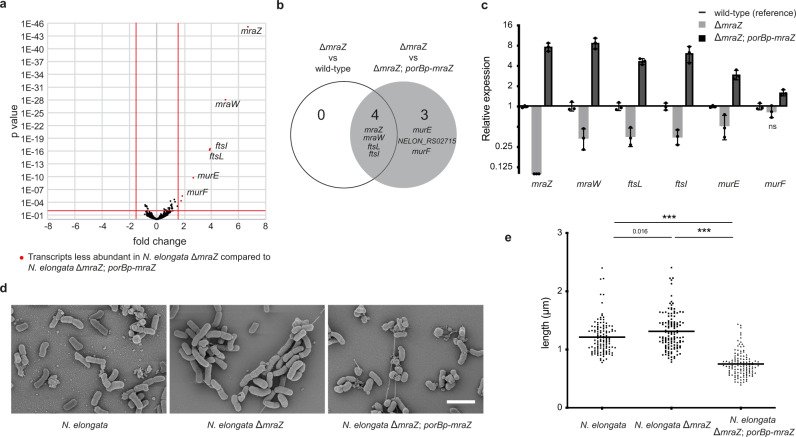
Fig. 6. Downregulation of the dcw cluster in N. elongata ΔmraZ.
a Volcano plot of RNAseq analysis of an N. elongata ΔmraZ and complemented. p value is plotted against fold change and were calculated using DeSeq2. Red points represent genes upregulated in MraZ-overexpressing N. elongatamraZ; porBp-mraZ – i.e., mraZ under the control of the strong and constitutive porB promoter), as compared to N. elongata ΔmraZ. b Venn diagram showing genes (mraZ, mraW, ftsL and ftsI) upregulated in N. elongata wild-type as compared to N. elongata ΔmraZ. c Transcript abundance of dcw cluster genes measured by qRT-PCR in N. elongata expressing or not expressing MraZ. Data represent mean (n = 3 biologically independent samples ± SD) and are representative of three independent experiments. Statistical test used was Unpaired t test with Welch’s correction by comparing ΔmraZ to the parental wild-type and the ΔmraZ; porBp-mraZ to the parental ΔmraZ (ns not significant). d Scanning electron microscopy of N. elongata expressing or not expressing MraZ. Scale bar is 2 µm. e Median cell length measurements of N. elongata expressing or not expressing MraZ (n = 120 biologically independent cells). Data are presented with the median and are representative of at least two independent experiments. Statistical test used was One-way ANOVA, with Bonferroni’s multiple comparisons test (***p < 0.001). Source data and statistics are provided as a Source Data file (for a, c and e).
Fig. 7
Fig. 7. Recapitulation of MuLDi-specific genetic changes in the rod-shaped Neisseriaceae N. elongata.
a Scanning Electron Microscopy of N. elongata (rpsL*) wild-type (left panels) or harboring multiple deletions (Δdgt, ΔgloB, ΔmraZ, ΔrapZ, right panels), with or without the mreBNe/merBSm allelic exchange, with or without the addition of cdsA-amiC2. The results are representative of at least three independent analyses. b N. elongata (rpsL*) wild-type (left) or harboring the mreBNe/merBSm allelic exchange and cdsA-amiC2 (right) and c median length of the septum (n = 170 biologically independent cells) and of the cell axis perpendicular to the septum (n = 340 biologically independent cells) in N. elongata (rpsL*), wild-type (left) or harboring the mreBNe/merBSm allelic exchange and cdsA-amiC2 (right). Data are presented with the median and are representative of at least two independent experiments. Statistical test used was Unpaired Two-Tailed T test (***p < 0.001). Source data and statistics are provided as a Source Data file. d Schematic representation of a septating wild-type (rpsL*) N. elongata (left) and of N. elongata harboring the mreBNe/merBSm allelic exchange and cdsA-amiC2 (right). Scale bar is 1 µm.

References

    1. Kieft, T. L. & Simmons, K. A. Allometry of animal-microbe interactions and global census of animal-associated microbes. Proc. R. Soc. B Biol. Sci. 282, 20150702 (2015). - PMC - PubMed
    1. Whitman WB, Coleman DC, Wiebe WJ. Prokaryotes: the unseen majority. Proc. Natl Acad. Sci. USA. 1998;95:6578–6583. doi: 10.1073/pnas.95.12.6578. - DOI - PMC - PubMed
    1. Bulgheresi S. Bacterial cell biology outside the streetlight. Environ. Microbiol. 2016;18:2305–2318. doi: 10.1111/1462-2920.13406. - DOI - PMC - PubMed
    1. Buskermolen JK, et al. Development of a full-thickness human gingiva equivalent constructed from immortalized keratinocytes and fibroblasts. Tissue Eng. - Part C. Methods. 2016;22:781–791. doi: 10.1089/ten.tec.2016.0066. - DOI - PMC - PubMed
    1. Kosten, I. J., Buskermolen, J. K., Spiekstra, S. W., De Gruijl, T. D. & Gibbs, S. Gingiva equivalents secrete negligible amounts of key chemokines involved in langerhans cell migration compared to skin equivalents. J. Immunol. Res. 2015, 627125 (2015). - PMC - PubMed

Publication types