Establishment and Evaluation of Dual HDAC/BET Inhibitors as Therapeutic Options for Germ Cell Tumors and Other Urological Malignancies
- PMID: 35999659
- PMCID: PMC9630828
- DOI: 10.1158/1535-7163.MCT-22-0207
Establishment and Evaluation of Dual HDAC/BET Inhibitors as Therapeutic Options for Germ Cell Tumors and Other Urological Malignancies
Abstract
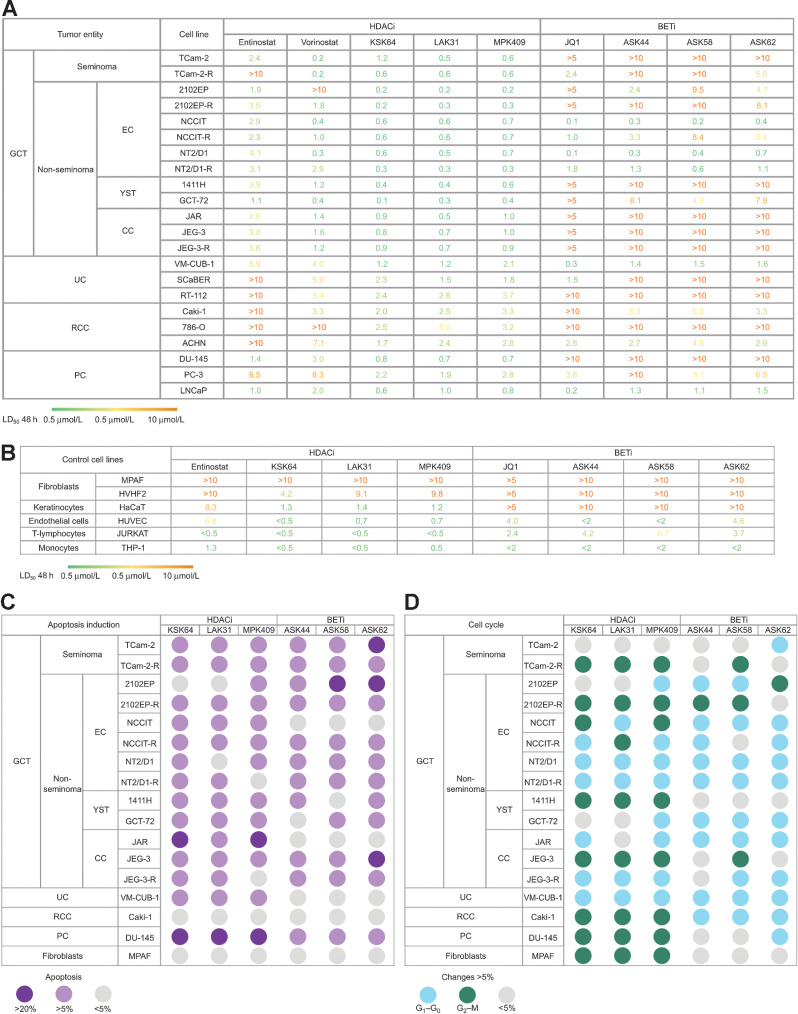
Urological malignancies represent major challenges for clinicians, with annually rising incidences. In addition, cisplatin treatment induced long-term toxicities and the development of therapy resistance emphasize the need for novel therapeutics. In this study, we analyzed the effects of novel histone deacetylase (HDAC) and bromodomain and extraterminal domain-containing (BET) inhibitors to combine them into a potent HDAC-BET-fusion molecule and to understand their molecular mode-of-action. Treatment of (cisplatin-resistant) germ cell tumors (GCT), urothelial, renal, and prostate carcinoma cells with the HDAC, BET, and dual inhibitors decreased cell viability, induced apoptosis, and affected the cell cycle. Furthermore, a dual inhibitor considerably decreased tumor burden in GCT xenograft models. On a molecular level, correlating RNA- to ATAC-sequencing data indicated a considerable induction of gene expression, accompanied by site-specific changes of chromatin accessibility after HDAC inhibitor application. Upregulated genes could be linked to intra- and extra-cellular trafficking, cellular organization, and neuronal processes, including neuroendocrine differentiation. Regarding chromatin accessibility on a global level, an equal distribution of active or repressed DNA accessibility has been detected after HDAC inhibitor treatment, questioning the current understanding of HDAC inhibitor function. In summary, our HDAC, BET, and dual inhibitors represent a new treatment alternative for urological malignancies. Furthermore, we shed light on new molecular and epigenetic mechanisms of the tested epi-drugs, allowing for a better understanding of the underlying modes-of-action and risk assessment for the patient.
©2022 The Authors; Published by the American Association for Cancer Research.
Figures


References
-
- Sung H, Ferlay J, Siegel RL, Laversanne M, Soerjomataram I, Jemal A, et al. Global cancer statistics 2020: GLOBOCAN estimates of incidence and mortality worldwide for 36 cancers in 185 countries. CA Cancer J Clin 2021;71:209–49. - PubMed
-
- Berney DM, Looijenga LHJ, Idrees M, Oosterhuis JW, Rajpert-De Meyts E, Ulbright TM, et al. Germ cell neoplasia in situ (GCNIS): evolution of the current nomenclature for testicular pre-invasive germ cell malignancy. Histopathology 2016;69:7–10. - PubMed
-
- Oosterhuis JW, Looijenga LHJ. Testicular germ-cell tumours in a broader perspective. Nat Rev Cancer 2005;5:210–22. - PubMed
-
- Oing C, Giannatempo P, Honecker F, Oechsle K, Bokemeyer C, Beyer J. Palliative treatment of germ cell cancer. Cancer Treat Rev 2018;71:102–7. - PubMed
Publication types
MeSH terms
Substances
LinkOut - more resources
Full Text Sources
Molecular Biology Databases