


A Letter to Your Care Providers: Implementation and Analysis of a Letter-based Advance Care Planning Initiative for Gynecologic Oncology Patients
- PMID: 36001237
- PMCID: PMC9400569
- DOI: 10.1007/s13187-022-02214-3
A Letter to Your Care Providers: Implementation and Analysis of a Letter-based Advance Care Planning Initiative for Gynecologic Oncology Patients
Abstract
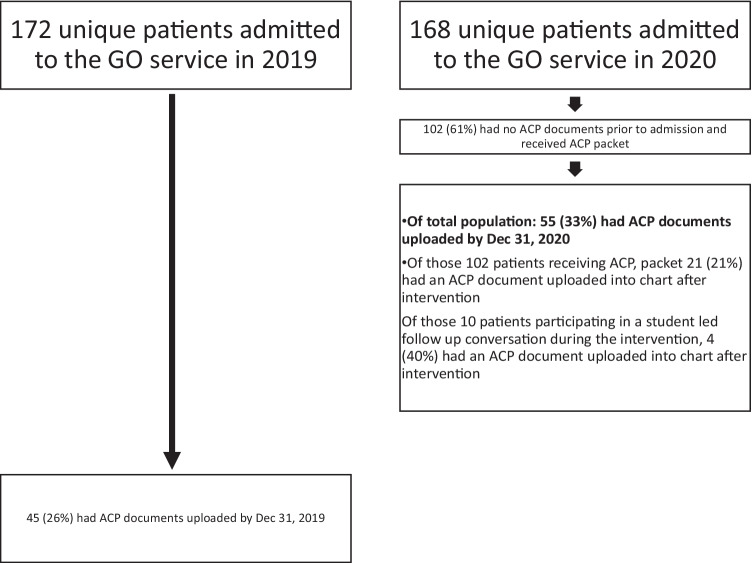
To determine the impact of a letter-based advance care planning (ACP) healthcare improvement (HI) initiative on rates of ACP conversations and documentation among gynecologic oncology (GO) inpatients. An HI initiative was implemented from January to December 2020 to improve ACP documentation among GO inpatients. Patients admitted to the GO service were given ACP packets with a letter-based ACP worksheet. GO inpatients who were interested in learning more about ACP were visited by medical students trained to lead ACP conversations. ACP documentation rates in the EMR (electronic medical record) pre- and post-intervention were evaluated. Descriptive statistics were calculated. Associations between sociodemographic characteristics and ACP documentation were analyzed using logistic regression. There were 172 patients admitted in 2019 (pre-implementation cohort). Of these, 45/172 patients (26%) had an advance directive (AD) documented in their electronic medical record (EMR). Following the implementation of the ACP HI in 2020, 55/168 patients (33%) had an AD documented in their EMR. This was a 7% absolute increase and 27% relative increase from pre-intervention AD documentation rates. Increasing age was associated with an increased likelihood of having an AD in the chart (p = 0.004). Married women were less likely to have an AD in their chart (p = 0.05). An HI utilizing a letter-based ACP packet given to GO inpatients improved AD documentation in the EMR. This HI offers a unique method for introducing ACP to patients. More work is needed to improve the occurrence and documentation of ACP conversations.
Keywords: Advance care planning; Advance directives; Cancer; Gynecologic cancer; Gynecologic oncology; Palliative care.
© 2022. The Author(s) under exclusive licence to American Association for Cancer Education.
Conflict of interest statement
The authors certify that we have no affiliations with or involvement in any organization or entity with any financial interest (such as honoraria; educational grants; participation in speakers’ bureaus; membership, employment, consultancies, stock ownership, or other equity interest; and expert testimony or patent-licensing arrangements), or non-financial interest (such as personal or professional relationships, affiliations, knowledge or beliefs) in the subject matter or materials discussed in this manuscript.
Figures
References
-
- Sudore RL, Heyland DK, Lum HD, Rietjens JAC, Korfage IJ, Ritchie CS, Hanson LC, Meier DE, Pantilat SZ, Lorenz K, Howard M, Green MJ, Simon JE, Feuz MA, You JJ. Outcomes that define successful advance care planning: a Delphi panel consensus. J Pain Symptom Manage. 2018;55:245–255.e248. doi: 10.1016/j.jpainsymman.2017.08.025. - DOI - PMC - PubMed
-
- Ashana DC, Chen X, Agiro A, Sridhar G, Nguyen A, Barron J, Haynes K, Fisch M, Debono D, Halpern SD, Harhay MO. Advance care planning claims and health care utilization among seriously ill patients near the end of life. JAMA Network Open. 2019;2:e1914471. doi: 10.1001/jamanetworkopen.2019.14471. - DOI - PMC - PubMed
-
- National Comprehensive Cancer Network (2021) Practice guidelines in oncology: palliative care (version 2.2021). National Comprehensive Cancer Network. https://www.nccn.org/professionals/physician_gls/pdf/palliative.pdf. Accessed February 2021
Publication types
MeSH terms
Grants and funding
LinkOut - more resources
Full Text Sources
