. 2022 Aug 26;8(34):eabq1456.
doi: 10.1126/sciadv.abq1456. Epub 2022 Aug 24.

Magnetic soft robotic bladder for assisted urination

Affiliations

Magnetic soft robotic bladder for assisted urination

Youzhou Yang et al. Sci Adv. .

Abstract

The poor contractility of the detrusor muscle in underactive bladders (UABs) fails to increase the pressure inside the UAB, leading to strenuous and incomplete urination. However, existing therapeutic strategies by modulating/repairing detrusor muscles, e.g., neurostimulation and regenerative medicine, still have low efficacy and/or adverse effects. Here, we present an implantable magnetic soft robotic bladder (MRB) that can directly apply mechanical compression to the UAB to assist urination. Composed of a biocompatible elastomer composite with optimized magnetic domains, the MRB enables on-demand contraction of the UAB when actuated by magnetic fields. A representative MRB for a UAB in a porcine model is demonstrated, and MRB-assisted urination is validated by in situ computed tomography imaging after 14-day implantation. The urodynamic tests show a series of successful urination with a high pressure increase and fast urine flow. Our work paves the way for developing MRB to assist urination for humans with UABs.


Figures
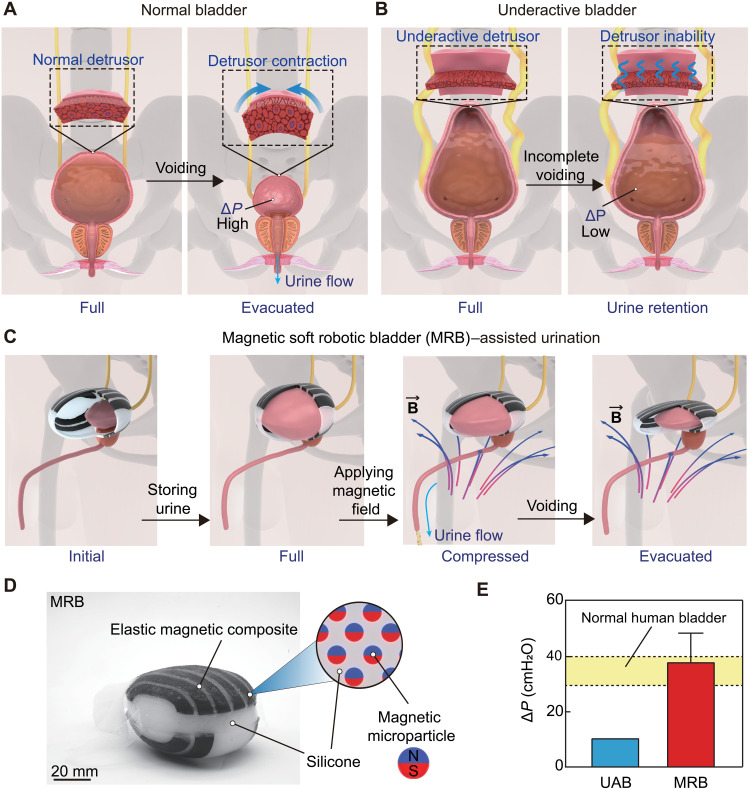
Fig. 1.
Fig. 1.. MRB for assisted urination of a UAB.
(A) Schematic of the complete voiding process of a normal bladder. The detrusor contracts the bladder at the full state and increases the pressure inside the bladder, denoted as ΔP. (B) A UAB (often in a Christmas tree shape) is characterized by underactive detrusor muscles with reduced ΔP and incomplete voiding with urine retention. (C) Schematic illustration of MRB-assisted urination. (D) The MRB is composed of pure silicone and magnetic composites, i.e., hard magnetic microparticles dispersed in the silicone matrix. N and S denote as north and south pole of magnet microparticle, respectively. (E) MRB can increase the pressure inside the UAB by 30 to 40 cmH2O, which is comparable to the required value for voluntary urination of a normal bladder in humans.
Fig. 2.
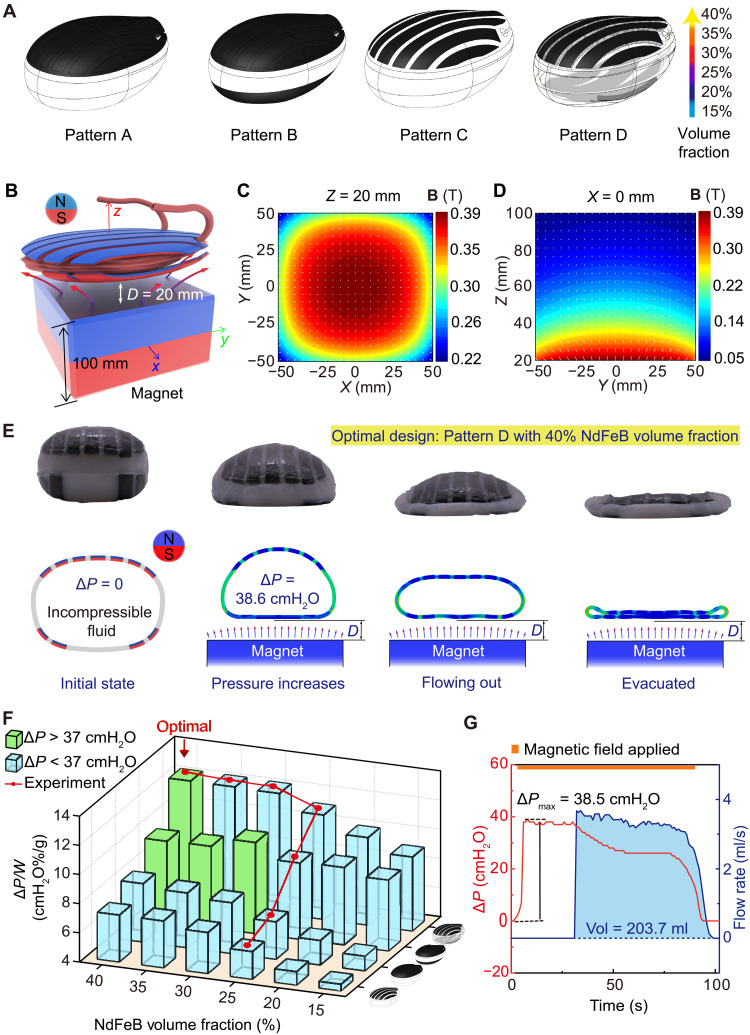
Fig. 2.. Model-guided design, optimization, and experimental validation of MRB.
(A) Illustration of four magnetic patterns: top surface fully covered by magnetic composites (pattern A), both top and bottom surface fully covered by magnetic composites (pattern B), seven composite strips on the top surface (pattern C), and seven composite strips on the top surface and four strips on the bottom surface (pattern D). Each pattern has six NdFeB volume fractions (15, 20, 25, 30, 35, and 40%). (B to D) Magnetic flux direction and density distributions on an XY plane at Z = 20 mm and a YZ plane at X = 0 mm produced by a cubic magnet (NdFeB, n52, width 10 cm, residual magnetic flux density Br = 1.4 T). (E) Experimental and finite element simulation results in the deformation of the optimized MRB in magnetic-assisted urination. The minimal distance between MRB and magnet (denoted as D) is 20 mm. (F) Simulated and experimental results of the maximum normalized pressure increase ΔP/W of 24 MRBs. MRBs that achieve ΔP > 37 cmH2O are labeled with green, while others are labeled with blue. (G) Ex vivo experimental results of the urodynamic test of the optimized MRB.
Fig. 3.
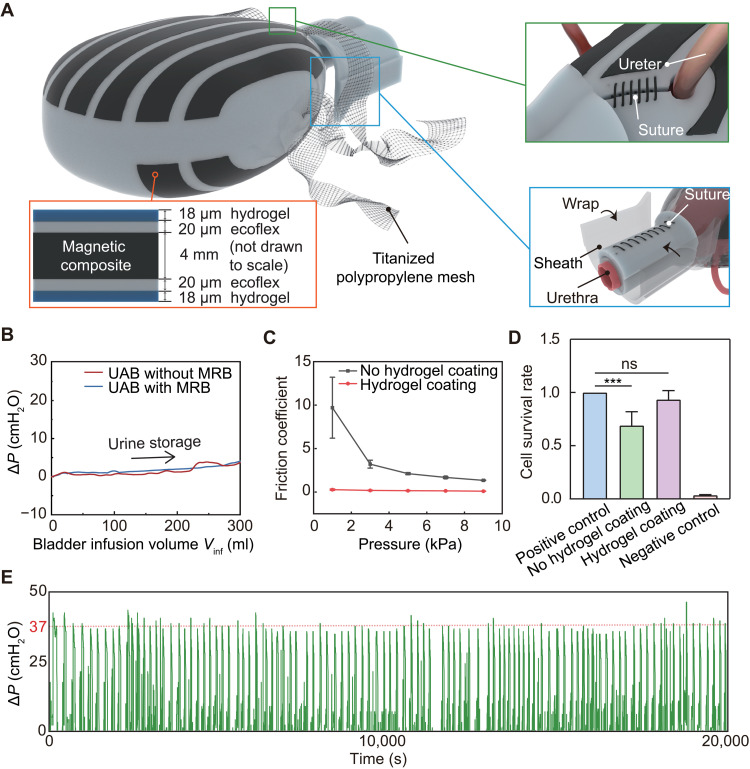
Fig. 3.. Implantation feasibility (fixation, biocompatibility, and repeatability) of MRB.
(A) A titanized polypropylene mesh is used to bind the MRB with pelvic fascia. Two holes at the posterior are reserved for ureters (green box). A neck sheath is used to wrap up the urethra to prevent the bladder from sliding out of the MRB (blue box). The cross-sectional view of the magnetic composite shows that the MRB is coated with a thin layer of hydrogel (~18 μm) (orange box). (B) Comparison of pressure increase ΔP during the urine storage for UABs with and without MRB. (C) Comparison of the friction coefficient of magnetic composites with and without hydrogel coating. (D) Toxicity test of the MRB. No statistical difference (ns) is observed between the positive control (culture medium only) and MRB with hydrogel coating. ***P < 0.05. (E) Measurement of the pressure increase ΔP inside the UAB in 20,000 s by cyclicly filling the UAB and MRB-assisted voiding, which corresponds to 1000 cycles of simulated urination.
Fig. 4.
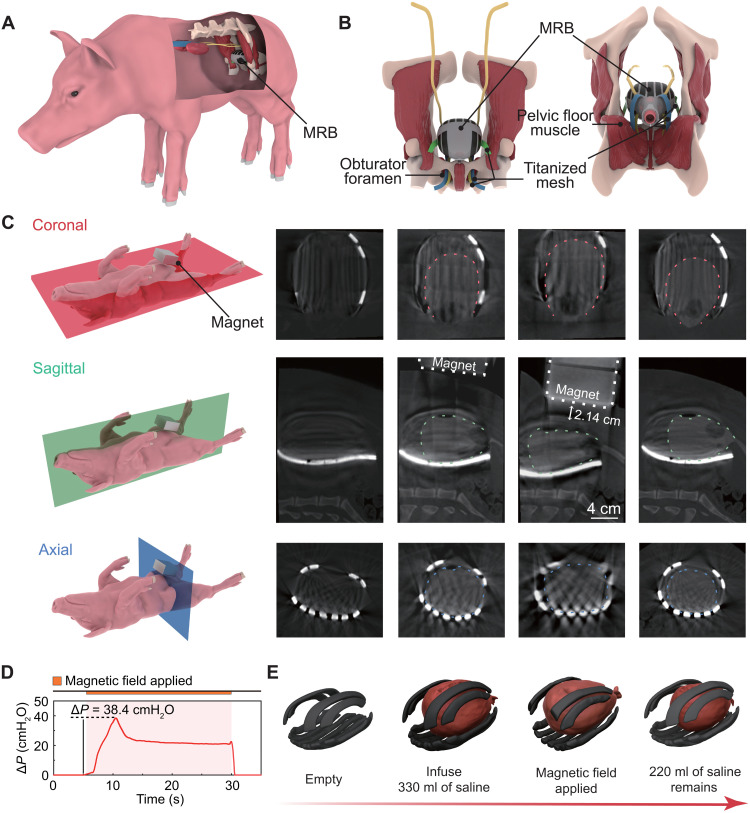
Fig. 4.. In vivo CT images of the MRB-assisted urination of a UAB porcine model after 14-day implantation.
(A) Schematic of the implanted MRB in a UAB porcine model. (B) Anatomical diagram of MRB fixation. (C) In vivo video urodynamic images of the implanted MRB. From left to right, four columns represent different states of assisted urination: empty state, infusion with saline, the magnetic field applied, and after compression. The dashed lines indicate the bladder boundary. The minimal actuation distance is measured as 2.14 cm. (D) Corresponding pressure increase ΔP during the video urodynamic test. (E) 3D reconstructed model of the UAB and magnetic composites from corresponding columns of the image in (C).
Fig. 5.
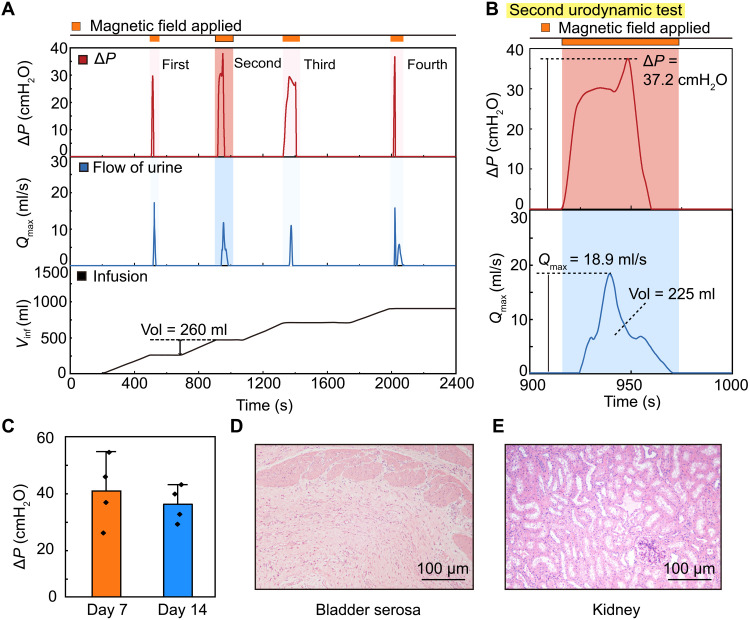
Fig. 5.. In vivo urodynamic characterization and long-term biocompatibility of a UAB porcine model implanted with MRB.
(A) Representative urodynamic curves of ΔP, maximum urine flow rate (Qmax), and bladder infusion volume (Vinf) as a function of time during four cycles of MRB-assisted voiding process. (B) Magnified view of ΔP and Qmax of the second urodynamic test in (A). (C) Pressure increase ΔP on POD 7 and 14. (D and E) Hematoxylin and eosin staining of porcine bladder serosa and kidney, respectively.

References

    1. Aoki Y., Brown H. W., Brubaker L., Cornu J. N., Daly J. O., Cartwright R., Urinary incontinence in women. Nat. Rev. Dis. Primers. 3, 17042 (2017). - PMC - PubMed
    1. Hautmann R. E., Hautmann S. H., Hautmann O., Complications associated with urinary diversion. Nat. Rev. Urol. 8, 667–677 (2011). - PubMed
    1. Mahfouz W., Al Afraa T., Campeau L., Corcos J., Normal urodynamic parameters in women. Int. Urogynecol. J. 23, 269–277 (2012). - PubMed
    1. Wyndaele J.-J., Normality in urodynamics studied in healthy adults. J. Urol. 161, 899–902 (1999). - PubMed
    1. Uren A. D., Cotterill N., Harding C., Hillary C., Chapple C., Klaver M., Bongaerts D., Hakimi Z., Abrams P., Qualitative exploration of the patient experience of underactive bladder. Eur. Urol. 72, 402–407 (2017). - PubMed