


Cysteine Cathepsins in Breast Cancer: Promising Targets for Fluorescence-Guided Surgery
- PMID: 36002710
- PMCID: PMC9971096
- DOI: 10.1007/s11307-022-01768-4
Cysteine Cathepsins in Breast Cancer: Promising Targets for Fluorescence-Guided Surgery
Abstract
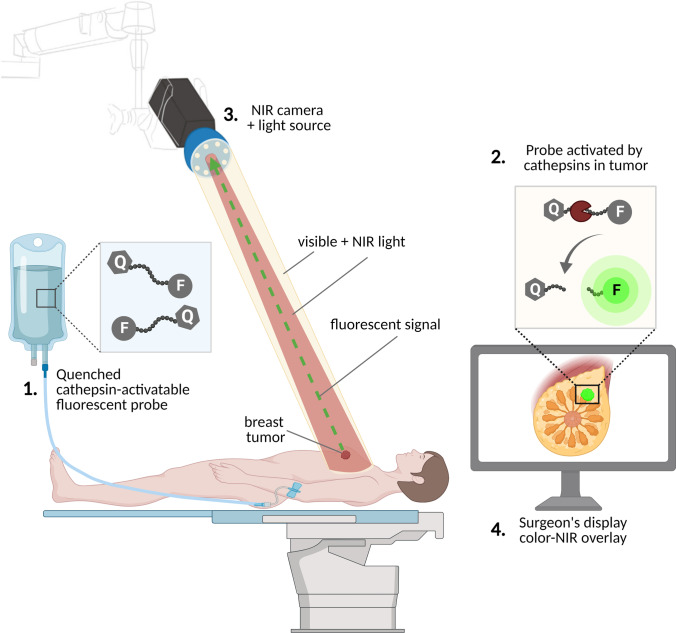
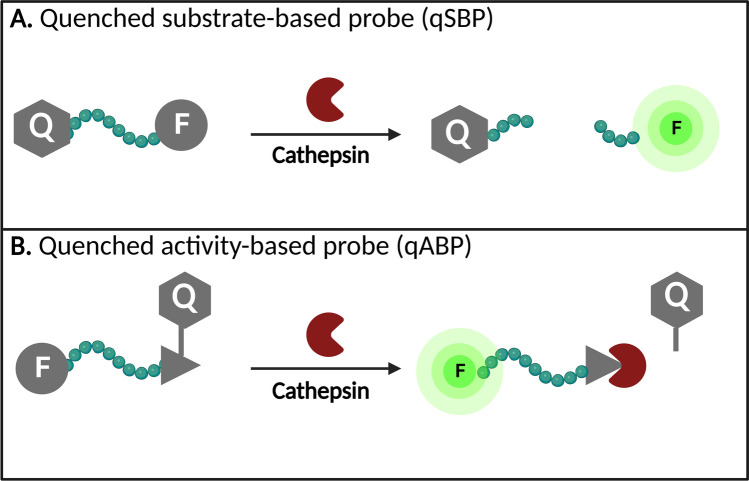
The majority of breast cancer patients is treated with breast-conserving surgery (BCS) combined with adjuvant radiation therapy. Up to 40% of patients has a tumor-positive resection margin after BCS, which necessitates re-resection or additional boost radiation. Cathepsin-targeted near-infrared fluorescence imaging during BCS could be used to detect residual cancer in the surgical cavity and guide additional resection, thereby preventing tumor-positive resection margins and associated mutilating treatments. The cysteine cathepsins are a family of proteases that play a major role in normal cellular physiology and neoplastic transformation. In breast cancer, the increased enzymatic activity and aberrant localization of many of the cysteine cathepsins drive tumor progression, proliferation, invasion, and metastasis. The upregulation of cysteine cathepsins in breast cancer cells indicates their potential as a target for intraoperative fluorescence imaging. This review provides a summary of the current knowledge on the role and expression of the most important cysteine cathepsins in breast cancer to better understand their potential as a target for fluorescence-guided surgery (FGS). In addition, it gives an overview of the cathepsin-targeted fluorescent probes that have been investigated preclinically and in breast cancer patients. The current review underscores that cysteine cathepsins are highly suitable molecular targets for FGS because of favorable expression and activity patterns in virtually all breast cancer subtypes. This is confirmed by cathepsin-targeted fluorescent probes that have been shown to facilitate in vivo breast cancer visualization and tumor resection in mouse models and breast cancer patients. These findings indicate that cathepsin-targeted FGS has potential to improve treatment outcomes in breast cancer patients.
Keywords: Breast cancer; Cysteine cathepsins; Fluorescence-guided surgery; Near-infrared fluorescence imaging; Targeted molecular imaging.
© 2022. The Author(s).
Conflict of interest statement
The authors declare no competing interests.
Figures
References
-
- Fisher B, Anderson S, Bryant J, Margolese RG, Deutsch M, Fisher ER, Jeong JH, Wolmark N. Twenty-year follow-up of a randomized trial comparing total mastectomy, lumpectomy, and lumpectomy plus irradiation for the treatment of invasive breast cancer. N Engl J Med. 2002;347(16):1233–1241. doi: 10.1056/NEJMoa022152. - DOI - PubMed
Publication types
MeSH terms
Substances
Grants and funding
LinkOut - more resources
Full Text Sources
Medical
