


Integrating multiple brain imaging modalities does not boost prediction of subclinical atherosclerosis in midlife adults
- PMID: 36002967
- PMCID: PMC9421527
- DOI: 10.1016/j.nicl.2022.103134
Integrating multiple brain imaging modalities does not boost prediction of subclinical atherosclerosis in midlife adults
Abstract
Background: Human neuroimaging evidence suggests that cardiovascular disease (CVD) risk may relate to functional and structural features of the brain. The present study tested whether combining functional and structural (multimodal) brain measures, derived from magnetic resonance imaging (MRI), would yield a multivariate brain biomarker that reliably predicts a subclinical marker of CVD risk, carotid-artery intima-media thickness (CA-IMT).
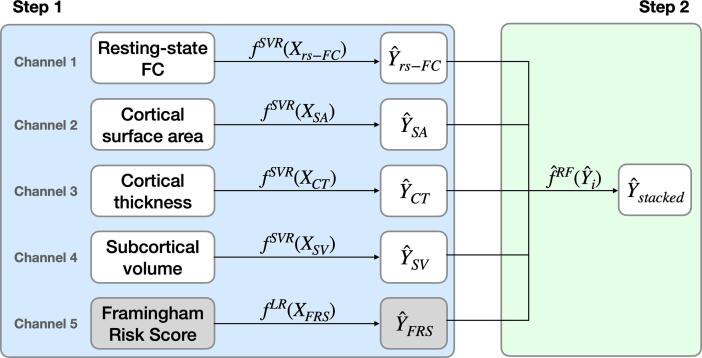
Methods: Neuroimaging, cardiovascular, and demographic data were assessed in 324 midlife and otherwise healthy adults who were free of (a) clinical CVD and (b) use of medications for chronic illnesses (aged 30-51 years, 49% female). We implemented a prediction stacking algorithm that combined multimodal brain imaging measures and Framingham Risk Scores (FRS) to predict CA-IMT. We included imaging measures that could be easily obtained in clinical settings: resting state functional connectivity and structural morphology measures from T1-weighted images.
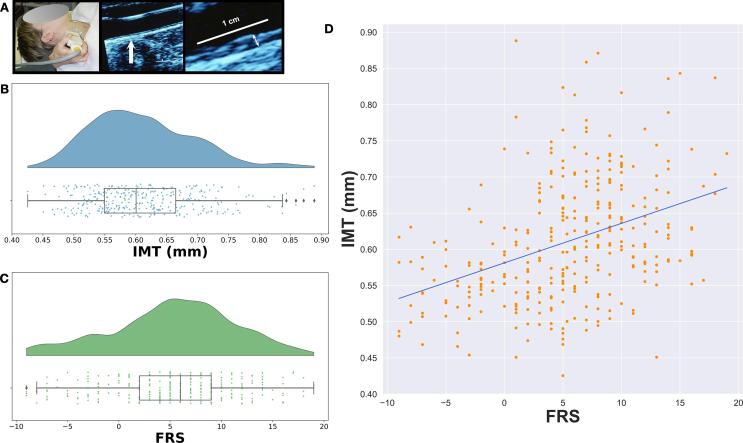
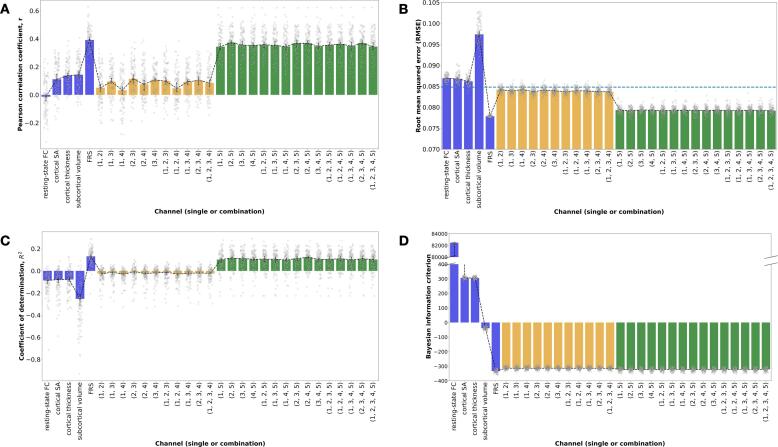
Results: Our models reliably predicted CA-IMT using FRS, as well as for several individual MRI measures; however, none of the individual MRI measures outperformed FRS. Moreover, stacking functional and structural brain measures with FRS did not boost prediction accuracy above that of FRS alone.
Conclusions: Combining multimodal functional and structural brain measures through a stacking algorithm does not appear to yield a reliable brain biomarker of subclinical CVD, as reflected by CA-IMT.
Keywords: Brain imaging; Cardiovascular disease; Intima-media thickness; Prediction stacking.
Copyright © 2022 The Author(s). Published by Elsevier Inc. All rights reserved.
Conflict of interest statement
The authors declare that they have no known competing financial interests or personal relationships that could have appeared to influence the work reported in this paper.
Figures
References
-
- Alhusaini S., Karama S., Nguyen T.-V., Thiel A., Bernhardt B.C., Cox S.R., Corley J., Taylor A., Evans A.C., Star J.M., Bastin M.E., Wardlaw J.M., Deary I.J., Ducharme S. Association between carotid atheroma and cerebral cortex structure at age 73 years. Ann. Neurol. 2018;84:576–587. doi: 10.1002/ana.25324. - DOI - PMC - PubMed
-
- Baber U., Mehran R., Sartori S., Schoos M.M., Sillesen H., Muntendam P., Garcia M.J., Gregson J., Pocock S., Falk E., Fuster V. Prevalence, impact, and predictive value of detecting subclinical coronary and carotid atherosclerosis in asymptomatic adults: the BioImage study. J. Am. Coll. Cardiol. 2015;65:1065–1074. doi: 10.1016/j.jacc.2015.01.017. - DOI - PubMed
-
- Cardenas V.A., Reed B., Chao L.L., Chui H., Sanossian N., DeCarli C.C., Mack W., Kramer J., Hodis H.N., Yan M., Buonocore M.H., Carmichael O., Jagust W.J., Weiner M.W. Associations among vascular risk factors, carotid atherosclerosis, and cortical volume and thickness in older adults. Stroke. 2012;43:2865–2870. doi: 10.1161/STROKEAHA.112.659722. - DOI - PMC - PubMed
-
- Cermakova P., Ding J., Meirelles O., Reis J., Religa D., Schreiner P.J., Jacobs D.R., Bryan R.N., Launer L.J., Newman A. Carotid Intima-Media Thickness and Markers of Brain Health in a Biracial Middle-Aged Cohort: CARDIA Brain MRI Sub-study. J. Gerontol. A Biol. Sci. Med. Sci. 2020;75(2):380–386. - PMC - PubMed
Publication types
MeSH terms
Substances
Grants and funding
LinkOut - more resources
Full Text Sources
Medical
