


Towards a Device Agnostic AI for Diabetic Retinopathy Screening: An External Validation Study
- PMID: 36003071
- PMCID: PMC9393096
- DOI: 10.2147/OPTH.S369675
Towards a Device Agnostic AI for Diabetic Retinopathy Screening: An External Validation Study
Abstract
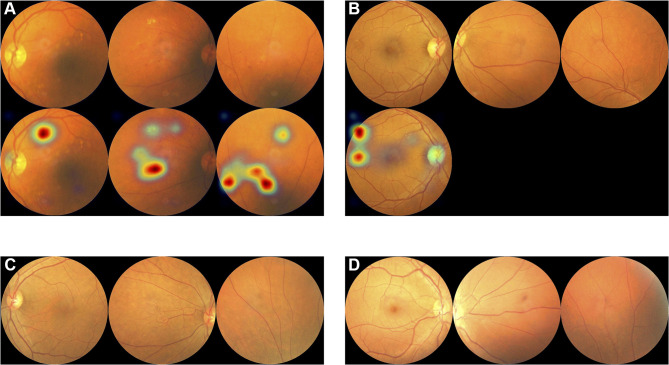
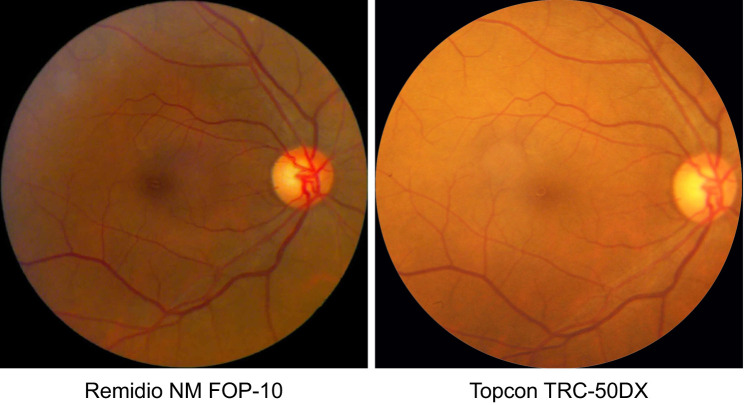
Purpose: To evaluate the performance of a validated Artificial Intelligence (AI) algorithm developed for a smartphone-based camera on images captured using a standard desktop fundus camera to screen for diabetic retinopathy (DR).
Participants: Subjects with established diabetes mellitus.
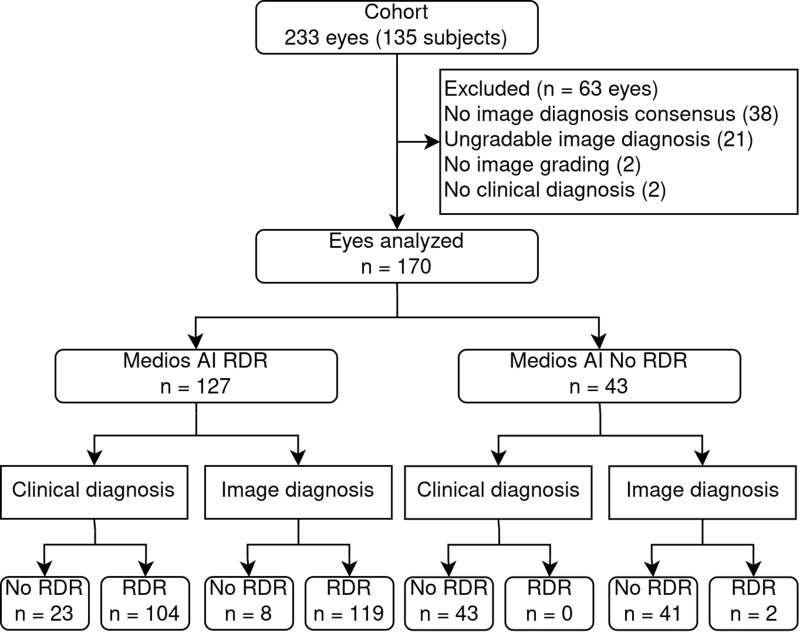
Methods: Images captured on a desktop fundus camera (Topcon TRC-50DX, Japan) for a previous study with 135 consecutive patients (233 eyes) with established diabetes mellitus, with or without DR were analysed by the AI algorithm. The performance of the AI algorithm to detect any DR, referable DR (RDR Ie, worse than mild non proliferative diabetic retinopathy (NPDR) and/or diabetic macular edema (DME)) and sight-threatening DR (STDR Ie, severe NPDR or worse and/or DME) were assessed based on comparisons against both image-based consensus grades by two fellowship trained vitreo-retina specialists and clinical examination.
Results: The sensitivity was 98.3% (95% CI 96%, 100%) and the specificity 83.7% (95% CI 73%, 94%) for RDR against image grading. The specificity for RDR decreased to 65.2% (95% CI 53.7%, 76.6%) and the sensitivity marginally increased to 100% (95% CI 100%, 100%) when compared against clinical examination. The sensitivity for detection of any DR when compared against image-based consensus grading and clinical exam were both 97.6% (95% CI 95%, 100%). The specificity for any DR detection was 90.9% (95% CI 82.3%, 99.4%) as compared against image grading and 88.9% (95% CI 79.7%, 98.1%) on clinical exam. The sensitivity for STDR was 99.0% (95% CI 96%, 100%) against image grading and 100% (95% CI 100%, 100%) as compared against clinical exam.
Conclusion: The AI algorithm could screen for RDR and any DR with robust performance on images captured on a desktop fundus camera when compared to image grading, despite being previously optimized for a smartphone-based camera.
Keywords: Deep Learning; imaging; retina; screening; smartphone.
© 2022 Rao et al.
Conflict of interest statement
Divya Parthasarathy Rao, Anand Sivaraman and Florian M Savoy are Employees of Remidio Innovative Solutions. Medios Technologies, Singapore, where the AI has been developed, and Remidio Innovative Solutions Inc. USA, are wholly owned subsidiaries of Remidio Innovative Solutions Pvt Ltd, India. Dr Sabyasachi Sengupta reports personal fees from Novartis, India, Bayer, Intas, Allergan, outside the submitted work. The authors report no other conflicts of interest in this work.
Figures
References
-
- International Council of Ophthalmology. Guidelines for diabetic eye care. Available from: https://www.urmc.rochester.edu/MediaLibraries/URMCMedia/eye-institute/im.... Accessed March 28, 2022.
LinkOut - more resources
Full Text Sources
