Review
. 2022 Aug 8:13:953716.
doi: 10.3389/fimmu.2022.953716. eCollection 2022.

Current therapeutic strategies and perspectives in refractory ITP: What have we learned recently?

Affiliations
Review

Current therapeutic strategies and perspectives in refractory ITP: What have we learned recently?

Yue Lv et al. Front Immunol. .

Abstract

Immune thrombocytopenia (ITP) is an acquired autoimmune bleeding disorder featured by increased platelet destruction and deficient megakaryocyte maturation. First-line treatments include corticosteroids, intravenous immunoglobulin and intravenous anti-D immunoglobulin. Second-line treatments consist of rituximab, thrombopoietin receptor agonists and splenectomy. Although most patients benefit from these treatments, an individualized treatment approach is warranted due to the large heterogeneity among ITP patients. In addition, ITP patients may relapse and there remains a subset of patients who become refractory to treatments. The management of these refractory patients is still a challenge. This review aims to summarize emerging therapeutic approaches for refractory ITP in several categories according to their different targets, including macrophages, platelets/megakaryocytes, T cells, B cells, and endothelial cells. Moreover, current management strategies and combination regimens of refractory ITP are also discussed.

Keywords: autoimmunity; desialylation; fostamatinib; platelet; refractory immune thrombocytopenia.


Conflict of interest statement

The authors declare that the research was conducted in the absence of any commercial or financial relationships that could be construed as a potential conflict of interest.

Figures
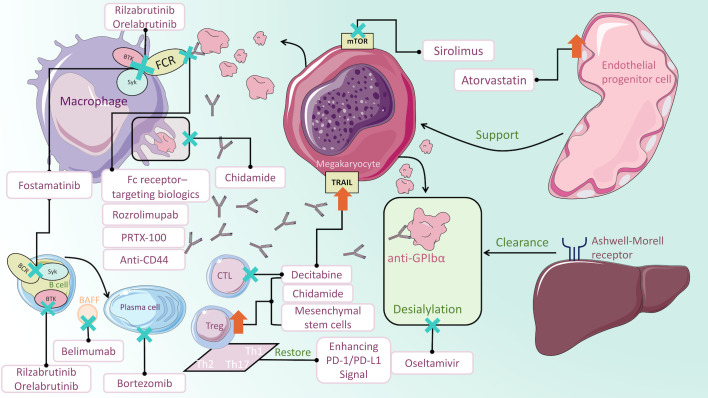
Figure 1
Figure 1
Mechanisms of ITP medications. Fostamatinib impairs Syk-mediated phagocytosis of platelets. Rilzabrutinib and orelabrutinib block FcγR signaling pathway transduction by inhibiting BTK. PRTX-100, Fc receptor-targeting biologics, rozrolimupab and anti-CD44 inhibit macrophage phagocytosis by blocking IgG binding to Fc receptors. Oseltamivir inhibits glycoprotein-induced desialylation, protecting platelets from clearance by hepatocyte Ashwell-Morell receptors. Sirolimus acts on mTOR on megakaryocytes to regulate autophagy. Decitabine not only promotes megakaryocyte maturation but also regulates Treg cells and CTLs. Enhancement of the PD-1/PD-L1 signaling pathway could restore the balance of Th cells. Chidamide increases the immunosuppressive functions of Treg cells and inhibits macrophage phagocytosis. Mesenchymal stem cells could upregulate Treg cells. Bortezomib stimulates apoptosis in LLPCs and short-lived plasma cells, thus decreasing antiplatelet antibodies. In the context of depleting B cells, adding Belimumab to block BAFF can reduce the number of splenic plasma cells. Atorvastatin improves endothelial progenitor cells function to promote megakaryopoietic production.

References

    1. Rodeghiero F, Stasi R, Gernsheimer T, Michel M, Provan D, Arnold DM, et al. Standardization of terminology, definitions and outcome criteria in immune thrombocytopenic purpura of adults and children: Report from an international working group. Blood (2009) 113(11):2386–93. doi: 10.1182/blood-2008-07-162503 - DOI - PubMed
    1. Moulis G, Lapeyre-Mestre M, Adoue D, Sailler L. [Epidemiology and pharmacoepidemiology of immune thrombocytopenia]. Rev Med Interne (2017) 38(7):444–9. doi: 10.1016/j.revmed.2016.12.016 - DOI - PubMed
    1. Provan D, Arnold DM, Bussel JB, Chong BH, Cooper N, Gernsheimer T, et al. Updated international consensus report on the investigation and management of primary immune thrombocytopenia. Blood Adv (2019) 3(22):3780–817. doi: 10.1182/bloodadvances.2019000812 - DOI - PMC - PubMed
    1. Cuker A, Neunert CE. How I treat refractory immune thrombocytopenia. Blood (2016) 128(12):1547–54. doi: 10.1182/blood-2016-03-603365 - DOI - PubMed
    1. Mahévas M, Gerfaud-Valentin M, Moulis G, Terriou L, Audia S, Guenin S, et al. Characteristics, outcome, and response to therapy of multirefractory chronic immune thrombocytopenia. Blood (2016) 128(12):1625–30. doi: 10.1182/blood-2016-03-704734 - DOI - PubMed

LinkOut - more resources
