. 2022 Aug 8:9:969421.
doi: 10.3389/fcvm.2022.969421. eCollection 2022.

PlaqView 2.0: A comprehensive web portal for cardiovascular single-cell genomics

Affiliations

PlaqView 2.0: A comprehensive web portal for cardiovascular single-cell genomics

Wei Feng Ma et al. Front Cardiovasc Med. .

Abstract

Single-cell RNA-seq (scRNA-seq) is a powerful genomics technology to interrogate the cellular composition and behaviors of complex systems. While the number of scRNA-seq datasets and available computational analysis tools have grown exponentially, there are limited systematic data sharing strategies to allow rapid exploration and re-analysis of single-cell datasets, particularly in the cardiovascular field. We previously introduced PlaqView, an open-source web portal for the exploration and analysis of published atherosclerosis single-cell datasets. Now, we introduce PlaqView 2.0 (www.plaqview.com), which provides expanded features and functionalities as well as additional cardiovascular single-cell datasets. We showcase improved PlaqView functionality, backend data processing, user-interface, and capacity. PlaqView brings new or improved tools to explore scRNA-seq data, including gene query, metadata browser, cell identity prediction, ad hoc RNA-trajectory analysis, and drug-gene interaction prediction. PlaqView serves as one of the largest central repositories for cardiovascular single-cell datasets, which now includes data from human aortic aneurysm, gene-specific mouse knockouts, and healthy references. PlaqView 2.0 brings advanced tools and high-performance computing directly to users without the need for any programming knowledge. Lastly, we outline steps to generalize and repurpose PlaqView's framework for single-cell datasets from other fields.

Keywords: cardiovascular; database; genomics; scRNA-seq; single-cell; web portal.


Conflict of interest statement

Author SL has received Roche funding for unrelated work. The remining authors declare that the research was conducted in the absence of any commercial or financial relationships that could be construed as a potential conflict of interest.

Figures
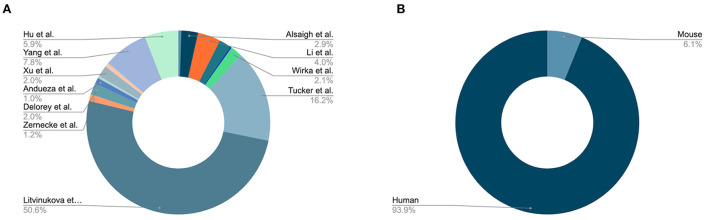
Figure 1
Figure 1
PlaqView 2.0 incorporates 32 cardiovascular-related datasets. (A) Major datasets available on PlaqView. PlaqView brings high-performance computing directly to the browser in order to handle large datasets such as ones from Litvinukova et al., which are atlas-type survey data that contain tissues from the entire human heart. (B) Species composition of PlaqView's database.
Figure 2
Figure 2
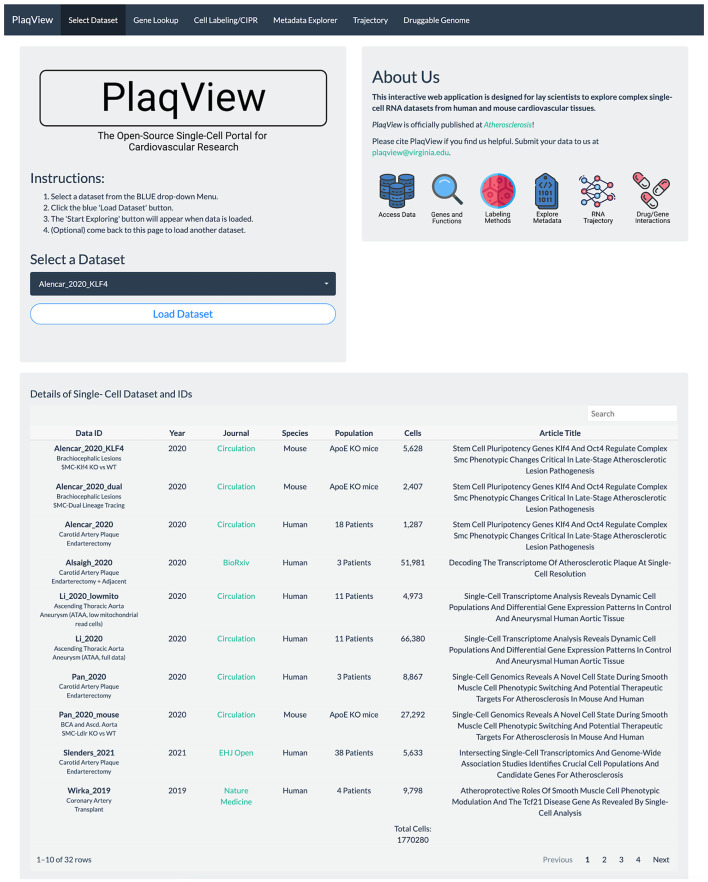
PlaqView 2.0 homepage facilitates selection and loading of relevant datasets. The homepage allows users to browse dataset details and load selected datasets into their dedicated session for further exploration.
Figure 3
Figure 3
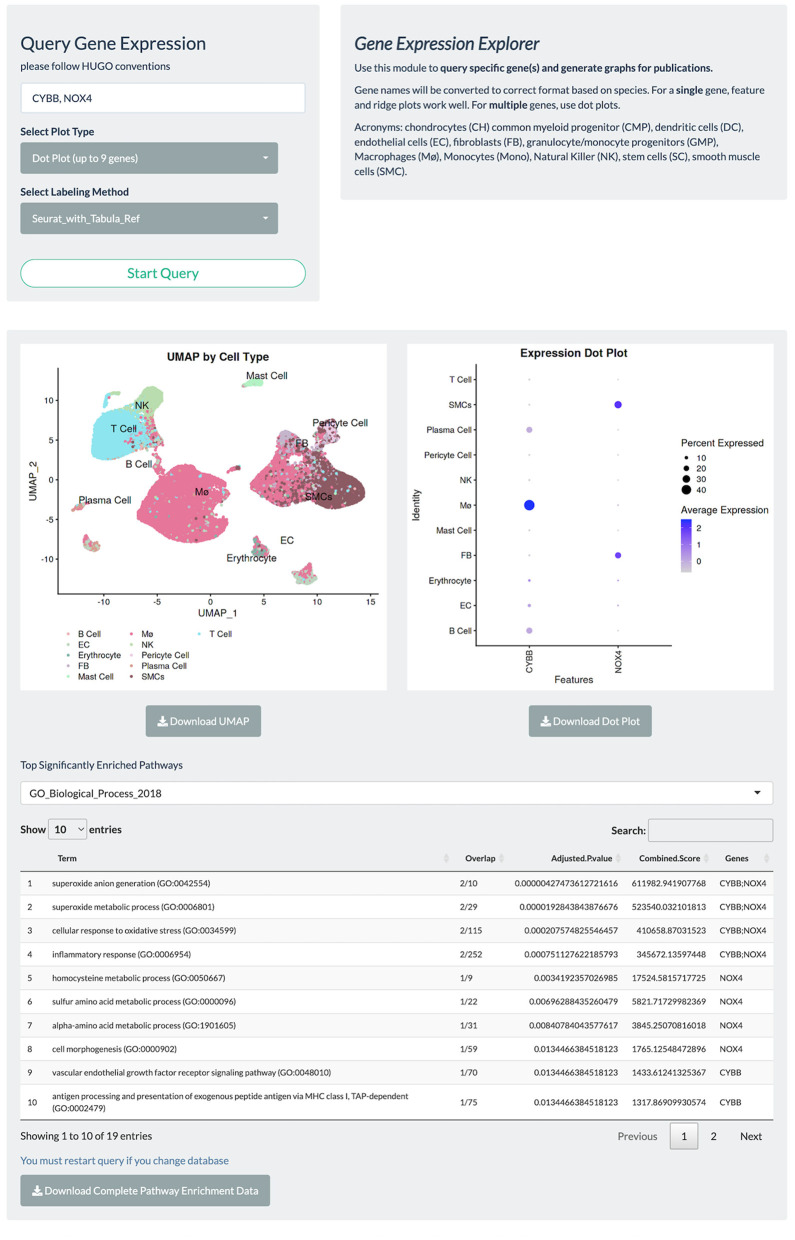
Gene query page allows rapid visualization of gene expression, UMAP embeddings, and facilitates automated GSEA. PlaqView 2.0 supports visualization of a single gene or multiple genes via feature, dot, and ridge plots, as powered by Seurat. Users can also choose their preferred annotation methods and download high-quality pdfs for publication. This instance is a demonstration using the Li et al. dataset.
Figure 4
Figure 4
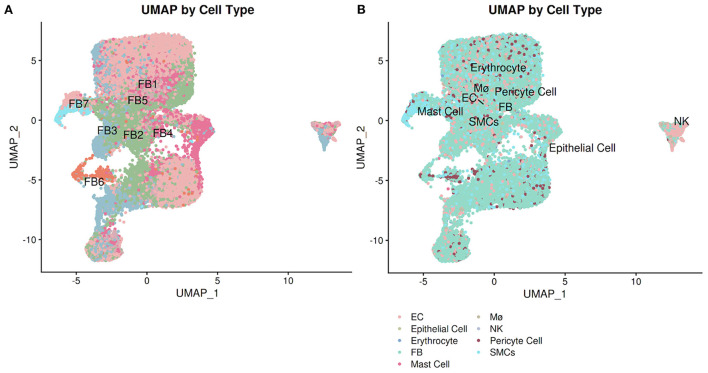
Annotation explorer page facilitates cell-level annotation comparison. Users can compare pre-computed cell identity annotations as well as author-provided labels (when available). Using the Litvinukova et al. dataset, we demonstrate the difference between the annotation from the (A) original authors and (B) Seurat label transfer using the Tabula Sapiens reference.
Figure 5
Figure 5
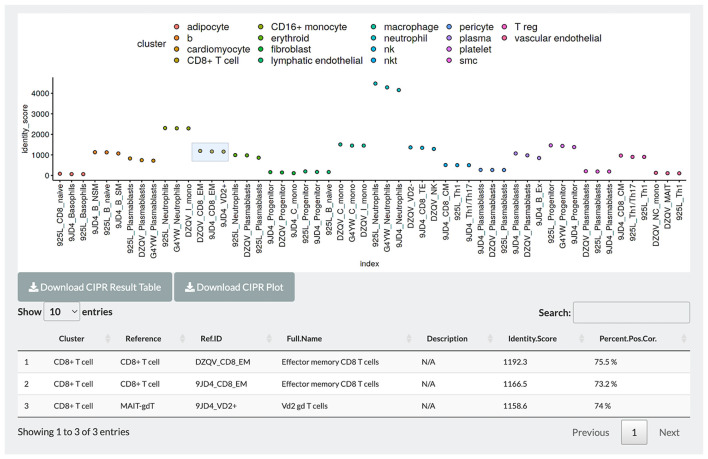
CIPR integration allows further exploration and interaction with cell-level annotation. Users can benchmark pre-computed annotations with existing single-cell references, and interactively compare and visualize identity scores and percent correlations with the top candidate reference identities. Light blue box indicates selected groups for detailed tables.
Figure 6
Figure 6
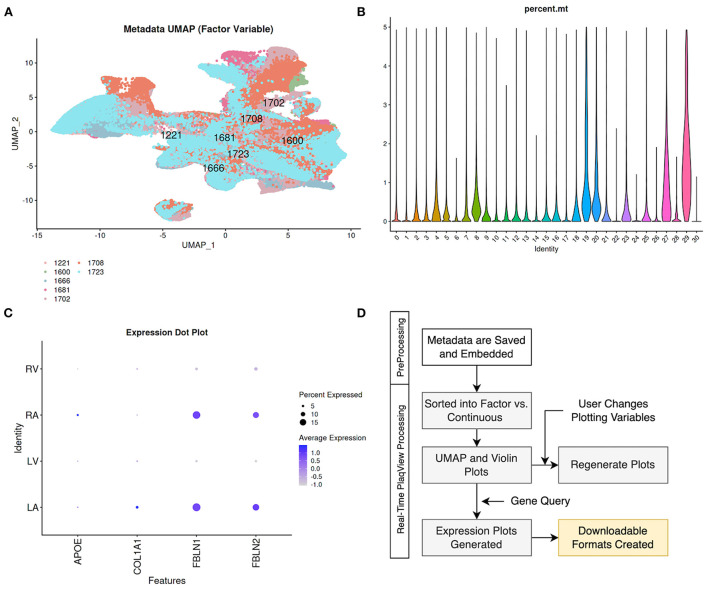
Metadata Explorer enables visualization and query of unabridged cell-level metadata. When available, cell-level metadata are divided into (A) factor-type such as cells separated by “biological_individuals,” and (B) continuous-type such as percent mitochondria by seurat cluster for visualization. (C) Users can also query gene expression based on factor-type metadata such as the heart “chamber” in the case of Tucker et al. (31). (D) We embed the metadata during the preprocessing stage and PlaqView sorts the metadata and runs calculations in response to the user selection to generate corresponding UMAPs and Violin plots.
Figure 7
Figure 7
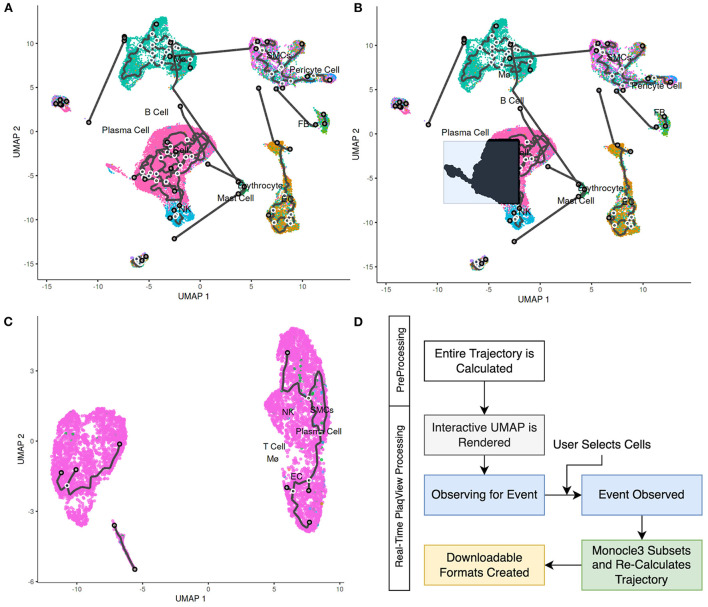
PlaqView 2.0 enables interactive RNA trajectory inference. (A) Full cell trajectory inferences are presented to the user, as demonstrated using the Alsaigh et al. dataset. (B) Selected cells are highlighted in black. These cells can be subsetted and their (C) trajectories can be re-calculated in PlaqView as powered by Monocle 3. (D) We pre-compute the overall trajectory during the pre-processing stage, and recalculations of subset trajectories are done ad hoc as needed by PlaqView as an on-demand function.
Figure 8
Figure 8
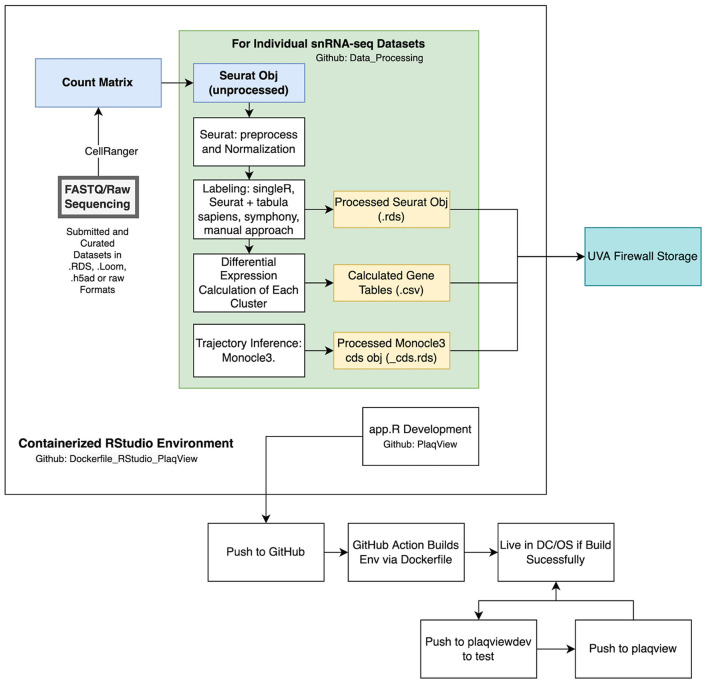
Overview of data processing and programmatic strategy for PlaqView. Data submitted to PlaqView are processed systematically and stored as Seurat.rds objects. These objects, along with calculated differential gene expression tables and trajectories, are stored in secured storage provided by the University of Virginia. Additionally, app development and data processes are all conducted in a cataloged, stable Docker RStudio environment that is registered both on GitHub and DockerHub.

References

    1. Method of the Year 2013 . Nat Methods. (2014) 11:1–1. 10.1038/nmeth.2801 - DOI - PubMed
    1. Method of the Year 2019: single-cell multimodal omics . Nat Methods. (2020) 17:1–1. 10.1038/s41592-019-0703-5 - DOI - PubMed
    1. Zappia L, Theis FJ. Over 1000 tools reveal trends in the single-cell RNA-seq analysis landscape. Genome Biol. (2021) 22:301. 10.1186/s13059-021-02519-4 - DOI - PMC - PubMed
    1. Puntambekar S, Hesselberth JR, Riemondy KA, Fu R. Cell-level metadata are indispensable for documenting single-cell sequencing datasets. PLoS Biol. (2021) 19:e3001077. 10.1371/journal.pbio.3001077 - DOI - PMC - PubMed
    1. Li F, Yan K, Wu L, Zheng Z, Du Y, Liu Z, et al. Single-cell RNA-seq reveals cellular heterogeneity of mouse carotid artery under disturbed flow. Cell Death Discov. (2021) 7:180. 10.1038/s41420-021-00567-0 - DOI - PMC - PubMed

LinkOut - more resources