The association between sleep-disordered breathing and maternal endothelial and metabolic markers in pregnancies complicated by obesity
- PMID: 36004747
- PMCID: PMC9806794
- DOI: 10.5664/jcsm.10254
The association between sleep-disordered breathing and maternal endothelial and metabolic markers in pregnancies complicated by obesity
Abstract
Study objectives: To evaluate the impact of sleep-disordered breathing (SDB) on vascular, angiogenic and metabolic analytes in pregnancy.
Methods: Participants with a body mass index ≥30 kg/m2 underwent polysomnography at 14-20 weeks gestation (visit 1). Participants with SDB (defined as an apnea-hypopnea index ≥5 events/h) were then enrolled in a separate trial. SDB-negative participants returned for a polysomnogram at 28-31 weeks (visit 2) and were recategorized as persistent-negative SDB or new-onset SDB. Mean arterial blood pressure, mean uterine artery Doppler pulsatility index, endoglin, soluble Feline McDonough Sarcoma-like tyrosine kinase 1, placental growth factor, and the homeostatic model assessment for insulin resistance were measured after each visit. Our primary outcome was a composite of uterine artery Doppler pulsatility index, soluble FMS-like tyrosine kinase 1/placental growth factor ratio, and homeostatic model assessment for insulin resistance. For secondary analyses, each outcome variable was analyzed independently.
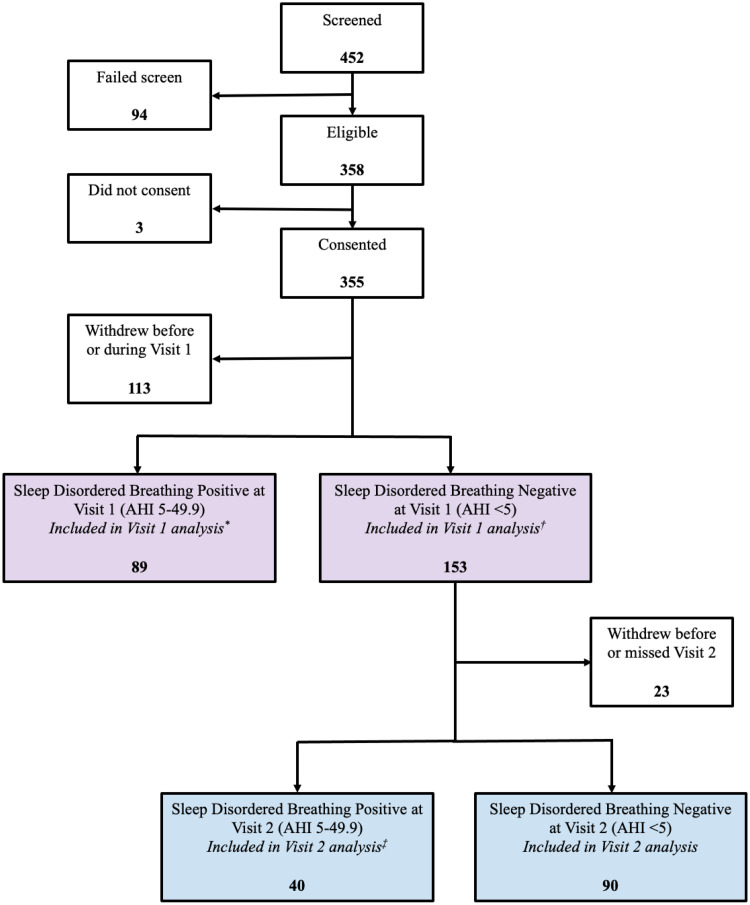
Results: A total of 242 and 130 participants completed visit 1 and visit 2, respectively. Newly diagnosed SDB was present in 37% of individuals at visit 1 and 31% of individuals at visit 2. No significant differences in our composite outcome vector were observed in individuals with and without SDB at either visit. In our secondary analysis, mean arterial blood pressure (88.7 ± 7.3 mm Hg vs 85.4 ± 7.1 mm Hg, P = .04) and fasting glucose (92.4 ± 15.2 mg/dL vs 86.6 ± 11.5 mg/dL, P = .05) were higher in participants with early pregnancy SDB. These associations were not observed for new-onset SDB. No associations were observed between uterine artery Doppler pulsatility index and angiogenic markers and SDB in pregnancy.
Conclusions: SDB in early pregnancy was not associated with our composite primary outcome but was associated with higher mean arterial blood pressure and fasting glucose. The pathophysiologic changes that occur in pregnant individuals with SDB and how they lead to an increased risk of preeclampsia and gestational diabetes remain poorly understood.
Clinical trial registration: Registry: ClinicalTrials.gov; Name: Sleep Disordered Breathing, Obesity and Pregnancy Study (SOAP); URL: https://clinicaltrials.gov/ct2/show/NCT02086448; Identifier: NCT02086448.
Citation: Onslow ML, Wolsk J, Wisniewski S, et al. The association between sleep-disordered breathing and maternal endothelial and metabolic markers in pregnancies complicated by obesity. J Clin Sleep Med. 2023;19(1):97-109.
Keywords: endothelial; metabolic; pregnancy; sleep-disordered breathing.
© 2023 American Academy of Sleep Medicine.
Conflict of interest statement
All authors have seen and approved this manuscript. Work for this study was performed at the University of Pittsburgh Medical Center. This study was funded by the National Heart, Lung, and Blood Institute Grant RO1-HL120354. The authors report no conflicts of interest.
Figures
References
-
- Young T , Finn L , Austin D , Peterson A . Menopausal status and sleep-disordered breathing in the Wisconsin Sleep Cohort Study . Am J Respir Crit Care Med. 2003. ; 167 ( 9 ): 1181 – 1185 . - PubMed
-
- Kent BD , Grote L , Ryan S , et al . Diabetes mellitus prevalence and control in sleep-disordered breathing: the European Sleep Apnea Cohort (ESADA) study . Chest. 2014. ; 146 ( 4 ): 982 – 990 . - PubMed
Publication types
MeSH terms
Substances
Associated data
Grants and funding
LinkOut - more resources
Full Text Sources
Medical
Miscellaneous