


Inflammatory pathways in heart failure with preserved left ventricular ejection fraction: implications for future interventions
- PMID: 36004819
- PMCID: PMC9897694
- DOI: 10.1093/cvr/cvac133
Inflammatory pathways in heart failure with preserved left ventricular ejection fraction: implications for future interventions
Abstract
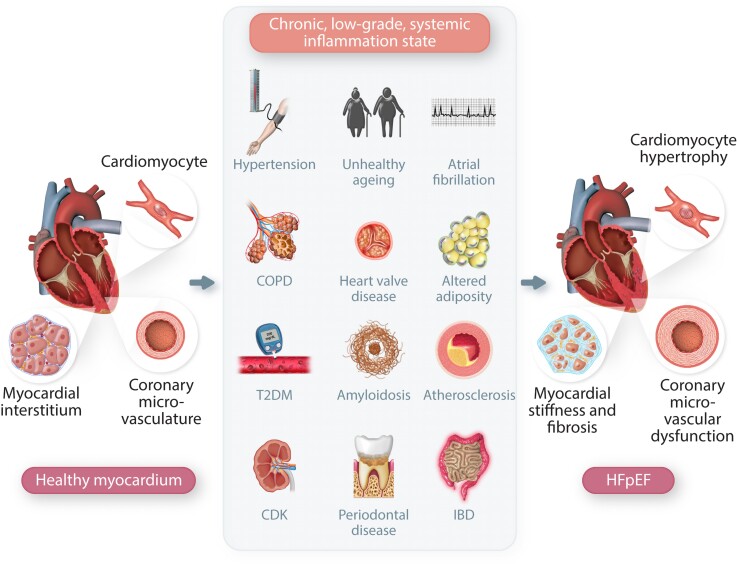
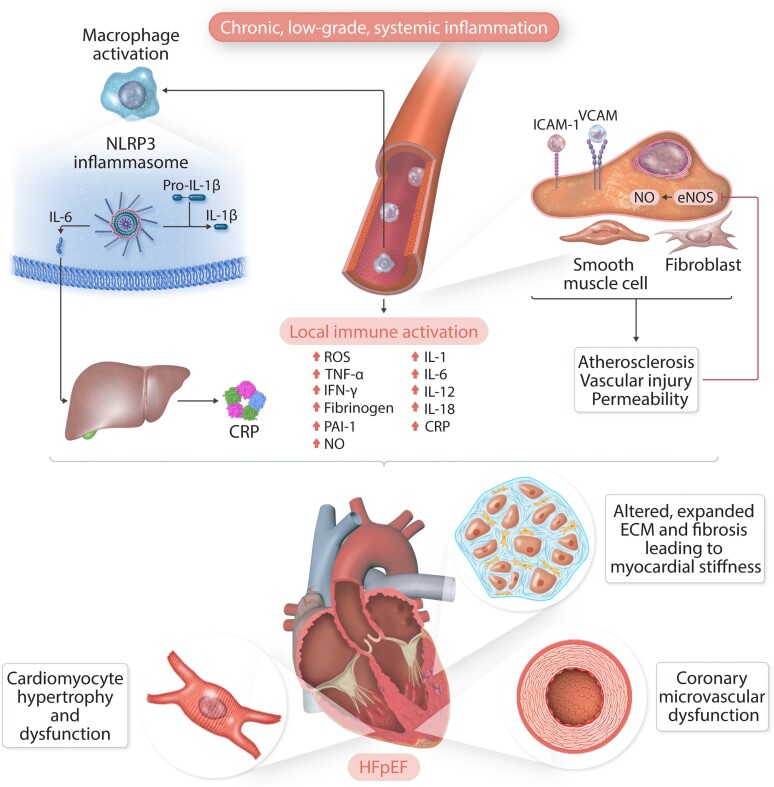
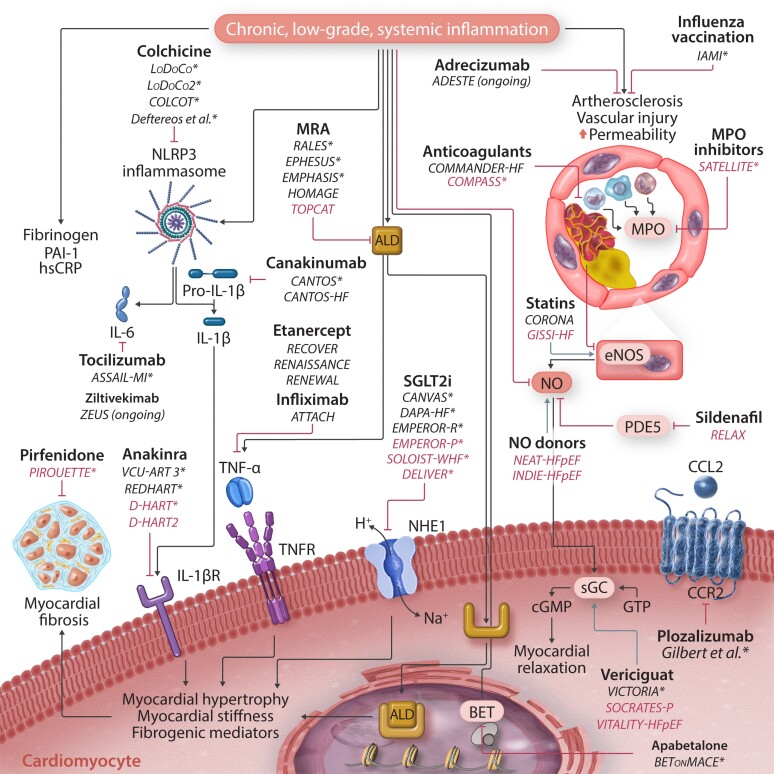
Many patients with symptoms and signs of heart failure have a left ventricular ejection fraction ≥50%, termed heart failure with preserved ejection fraction (HFpEF). HFpEF is a heterogeneous syndrome mainly affecting older people who have many other cardiac and non-cardiac conditions that often cast doubt on the origin of symptoms, such as breathlessness, or signs, such as peripheral oedema, rendering them neither sensitive nor specific to the diagnosis of HFpEF. Currently, management of HFpEF is mainly directed at controlling symptoms and treating comorbid conditions such as hypertension, atrial fibrillation, anaemia, and coronary artery disease. HFpEF is also characterized by a persistent increase in inflammatory biomarkers. Inflammation may be a key driver of the development and progression of HFpEF and many of its associated comorbidities. Detailed characterization of specific inflammatory pathways may provide insights into the pathophysiology of HFpEF and guide its future management. There is growing interest in novel therapies specifically designed to target deregulated inflammation in many therapeutic areas, including cardiovascular disease. However, large-scale clinical trials investigating the effectiveness of anti-inflammatory treatments in HFpEF are still lacking. In this manuscript, we review the role of inflammation in HFpEF and the possible implications for future trials.
Keywords: Cardiovascular; Epidemiology; Global; Hypertension; International.
© The Author(s) 2022. Published by Oxford University Press on behalf of the European Society of Cardiology.
Conflict of interest statement
Conflict of interest: This manuscript was handled by Guest Editor Carolyn S.P. Lam.
Figures
References
-
- McDonagh TA, Metra M, Adamo M, Gardner RS, Baumbach A, Böhm M, Burri H, Butler J, Celutkiene J, Chioncel O, Cleland JGF, Coats AJS, Crespo-Leiro MG, Farmakis D, Gilard M, Heymans S. 2021 ESC guidelines for the diagnosis and treatment of acute and chronic heart failure. Eur Heart J 2021;42:3599–3726. - PubMed
-
- Anker MS, Hülsmann M, Cleland JG. What do patients with heart failure die from? A single assassin or a conspiracy? Eur J Heart Fail 2020;22:26–28. - PubMed
-
- Cleland JGF, McDonagh T, Rigby AS, Yassin A, Whittaker T, Dargie HJ. The national heart failure audit for England and Wales 2008–2009. Heart 2011;97:876–886. - PubMed
-
- Pellicori P, Kallvikbacka-Bennett A, Khaleva O, Carubelli V, Costanzo P, Castiello T, Wong K, Zhang J, Cleland JGF, Clark AL. Global longitudinal strain in patients with suspected heart failure and a normal ejection fraction: does it improve diagnosis and risk stratification? Int J Cardiovasc Imaging 2014;30:69–79. - PubMed
-
- Cleland JGF, Pellicori P, Clark AL, Petrie MC. Time to take the failure out of heart failure: the importance of optimism. JACC: Heart Fail 2017;5:538–540. - PubMed
Publication types
MeSH terms
Grants and funding
LinkOut - more resources
Full Text Sources
Medical
Miscellaneous
