. 2022 Aug 3;12(8):717.
doi: 10.3390/metabo12080717.

GC-TOF/MS-Based Metabolomics for Comparison of Volar and Non-Volar Skin Types

Affiliations

GC-TOF/MS-Based Metabolomics for Comparison of Volar and Non-Volar Skin Types

Ting Bu et al. Metabolites. .

Abstract

Skin has heterogenous identities on different body sites despite similar cellular compositions. There are two types of skin, volar (palmoplantar) and non-volar (dorsal), which are characterized by epidermal thickness, pigmentation, and presence of hair follicles. However, the mechanisms underlying the development of these different skin types remain unclear. To investigate these, we profiled the cellular metabolites of volar and non-volar skin in mice using gas chromatography-time-of-flight/mass spectrometry (GC-TOF/MS), and further assessed the metabolic differences between them. In total, 96 metabolites from both volar and non-volar skin of mice were identified using the BinBase database system. Metabolomics analysis revealed important differences associated with amino acid metabolism (phenylalanine, tyrosine, and tryptophan biosynthesis; aspartate and glutamate metabolism), sugar metabolism (pentose phosphate pathway), and nucleotide metabolism (pyrimidine metabolism) in volar skin. Fifty metabolites were identified as potential biomarkers differentiating the physiological characteristics of these skin types. Of these, nine were highly increased whereas 41 were significantly decreased in volar skin compared with those in non-volar skin. Overall, these results provide valuable information for understanding the metabolic differences between volar and non-volar skin.

Keywords: GC-TOF/MS; metabolomic analysis; non-volar skin; volar skin.


Conflict of interest statement

The author has no conflict of interest.

Figures
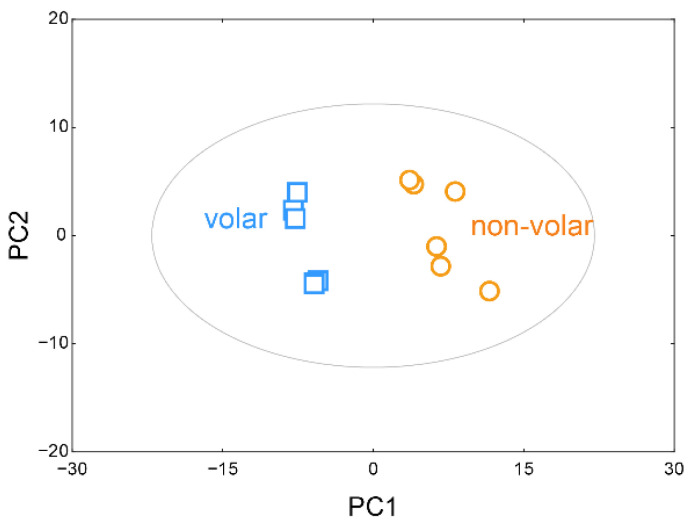
Figure 1
Figure 1
Principal component analysis (PCA) scores plot. PCA score plots based on GC/TOF-MS data show the relationship between volar and non-volar skin.
Figure 2
Figure 2
Hierarchical clustering analysis (HCA) of 96 metabolites from volar and non-volar skin tissue. Clustering similarity was evaluated based on the Pearson correlation coefficient and average linkage method. Each vertical column represents one of the six samples of volar skin and non-volar skin whereas each horizontal row represents a different metabolite.
Figure 3
Figure 3
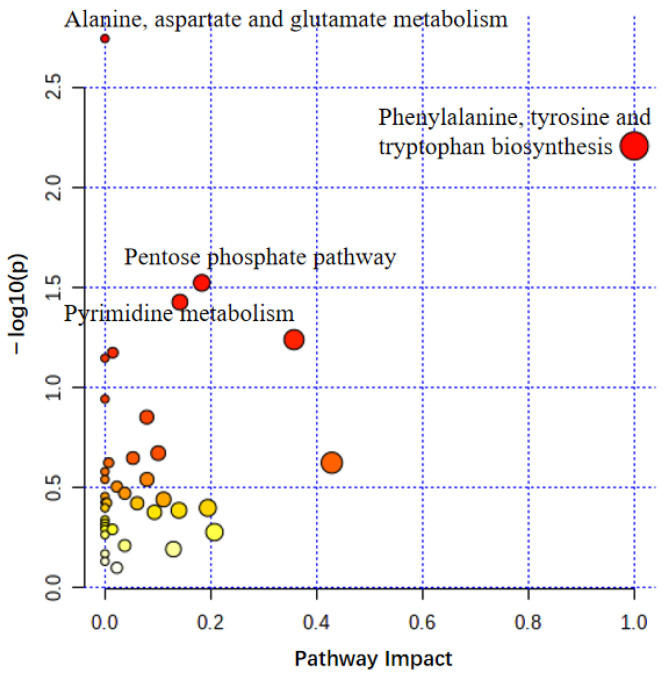
Use of MetaboAnalyst for summarizing pathway analysis. The color and size of the circles indicated their p-value and pathway impact value, respectively. The following showed significant differences between volar skin and non-volar skin at a significance level of p < 0.05: alanine, aspartate, and glutamate metabolism; phenylalanine, tyrosine, and tryptophan biosynthesis; pentose phosphate pathway; and pyrimidine metabolism.

References

    1. Janson D.G., Saintigny G., van Adrichem A., Mahe C., El Ghalbzouri A. Different gene expression patterns in human papillary and reticular fibroblasts. J. Investig. Dermatol. 2012;132:2565–2572. doi: 10.1038/jid.2012.192. - DOI - PubMed
    1. Harper R.A., Grove G. Human skin fibroblasts derived from papillary and reticular dermis: Differences in growth potential in vitro. Science. 1979;204:526–527. doi: 10.1126/science.432659. - DOI - PubMed
    1. Matsuzaki T., Yoshizato K. Role of hair papilla cells on induction and regeneration processes of hair follicles. Wound Repair Regen. 1998;6:524–530. doi: 10.1046/j.1524-475X.1998.60605.x. - DOI - PubMed
    1. Frech S., Forsthuber A., Korosec A., Lipp K., Kozumov V., Lichtenberger B.M. Hedgehog-signalling in papillary fibroblasts is essential for hair follicle regeneration during wound healing. J. Investig. Dermatol. 2021;142:1737–1748. doi: 10.1016/j.jid.2021.11.026. - DOI - PubMed
    1. Chang H.Y., Chi J.-T., Dudoit S., Bondre C., van de Rijn M., Botstein D., Brown P.O. Diversity, topographic differentiation, and positional memory in human fibroblasts. Proc. Natl. Acad. Sci. USA. 2002;99:12877–12882. doi: 10.1073/pnas.162488599. - DOI - PMC - PubMed

LinkOut - more resources