


Non-Proteinogenic Amino Acid β-N-Methylamino-L-Alanine (BMAA): Bioactivity and Ecological Significance
- PMID: 36006201
- PMCID: PMC9414260
- DOI: 10.3390/toxins14080539
Non-Proteinogenic Amino Acid β-N-Methylamino-L-Alanine (BMAA): Bioactivity and Ecological Significance
Abstract
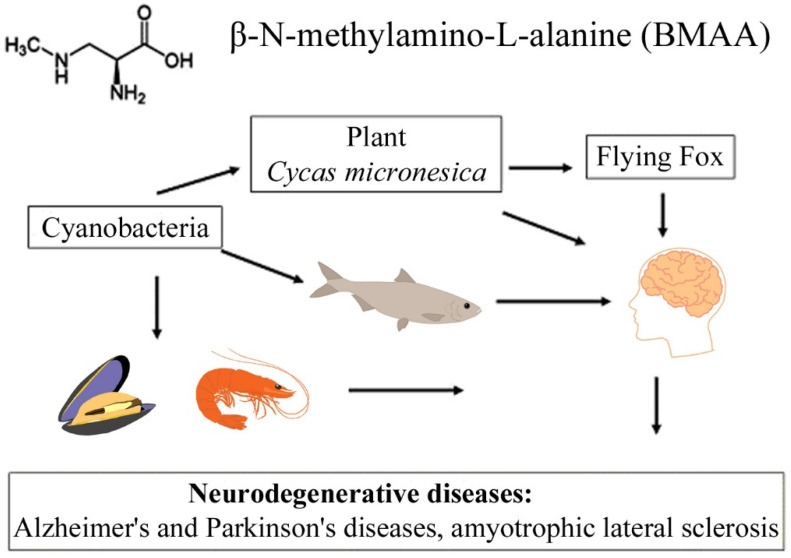
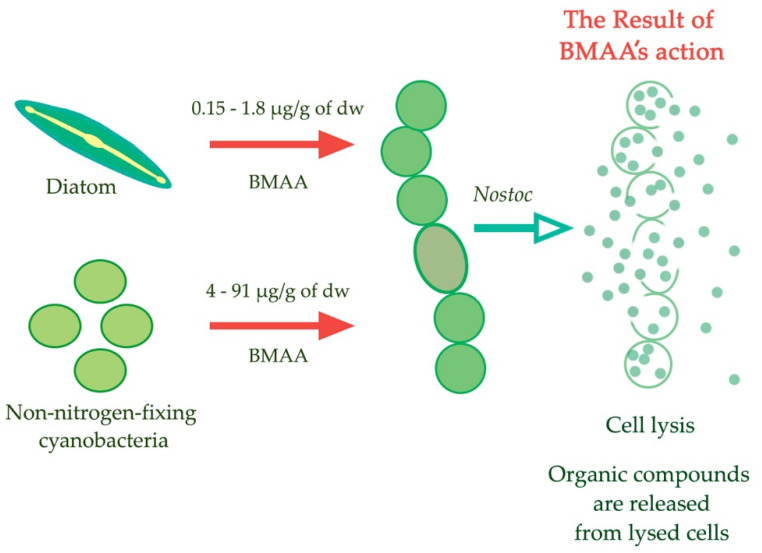
Research interest in a non-protein amino acid β-N-methylamino-L-alanine (BMAA) arose due to the discovery of a connection between exposure to BMAA and the occurrence of neurodegenerative diseases. Previous reviews on this topic either considered BMAA as a risk factor for neurodegenerative diseases or focused on the problems of detecting BMAA in various environmental samples. Our review is devoted to a wide range of fundamental biological problems related to BMAA, including the molecular mechanisms of biological activity of BMAA and the complex relationships between producers of BMAA and the environment in various natural ecosystems. At the beginning, we briefly recall the most important facts about the producers of BMAA (cyanobacteria, microalgae, and bacteria), the pathways of BMAA biosynthesis, and reliable methods of identification of BMAA. The main distinctive feature of our review is a detailed examination of the molecular mechanisms underlying the toxicity of BMAA to living cells. A brand new aspect, not previously discussed in any reviews, is the effect of BMAA on cyanobacterial cells. These recent studies, conducted using transcriptomics and proteomics, revealed potent regulatory effects of BMAA on the basic metabolism and cell development of these ancient photoautotrophic prokaryotes. Exogenous BMAA strongly influences cell differentiation and primary metabolic processes in cyanobacteria, such as nitrogen fixation, photosynthesis, carbon fixation, and various biosynthetic processes involving 2-oxoglutarate and glutamate. Cyanobacteria were found to be more sensitive to exogenous BMAA under nitrogen-limited growth conditions. We suggest a hypothesis that this toxic diaminoacid can be used by phytoplankton organisms as a possible allelopathic tool for controlling the population of cyanobacterial cells during a period of intense competition for nitrogen and other resources in various ecosystems.
Keywords: LC-MS/MS; algae; cyanobacteria; diatoms; glutamate receptors; nitrogen metabolism; oxidative stress; photosynthesis; proteomics; toxic molecules.
Conflict of interest statement
The authors declare no conflict of interest.
Figures


References
-
- Vega A., Bell E.A. α-Amino-β-methylaminopropionic acid, a new amino acid from seeds of Cycas circinalis. Phytochemistry. 1967;6:759–762. doi: 10.1016/S0031-9422(00)86018-5. - DOI
-
- Vranova V., Rejsek K., Skene K.R., Formanek P. Non-protein amino acids: Plant, soil and ecosystem interactions. Plant Soil. 2011;342:31–48. doi: 10.1007/s11104-010-0673-y. - DOI
-
- Casagrande D.J., Given P.H. Geochemistry of amino acids in some Florida peat accumulation-II. Amino acid distributions. Geochim. Cosmochim. Acta. 1980;44:1493–1507. doi: 10.1016/0016-7037(80)90114-3. - DOI
Publication types
MeSH terms
Substances
LinkOut - more resources
Full Text Sources
