


Mycotoxins in Cattle Feed and Feed Ingredients in Brazil: A Five-Year Survey
- PMID: 36006214
- PMCID: PMC9416694
- DOI: 10.3390/toxins14080552
Mycotoxins in Cattle Feed and Feed Ingredients in Brazil: A Five-Year Survey
Abstract
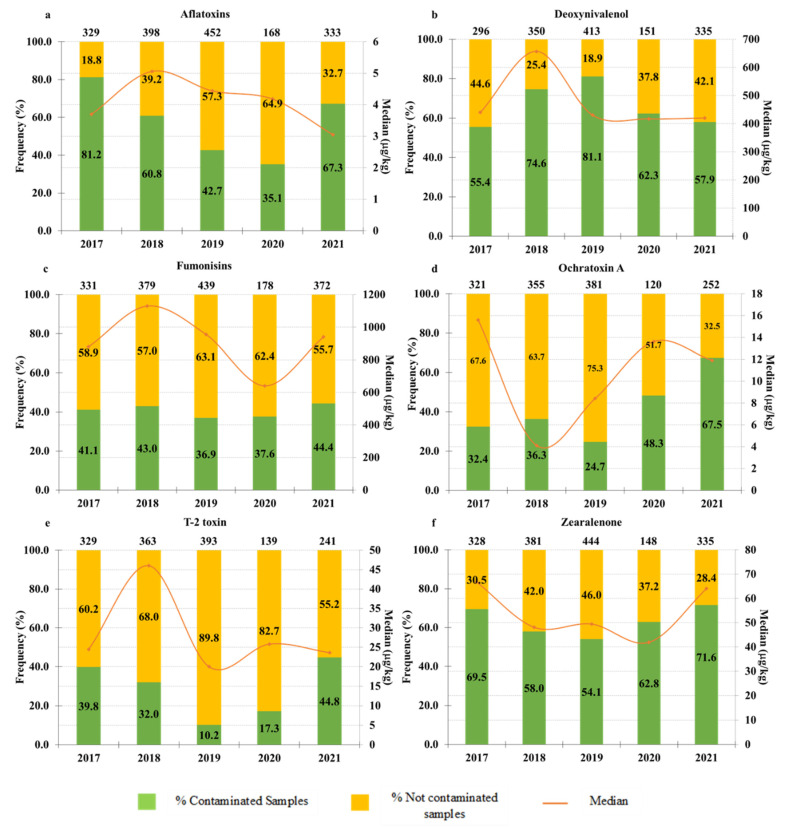
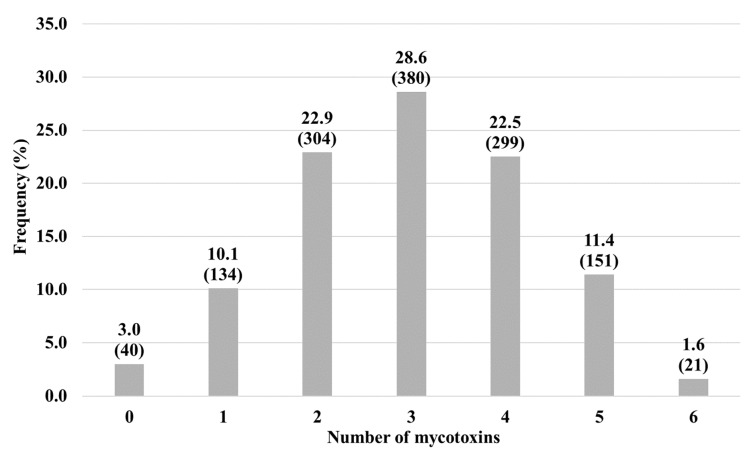
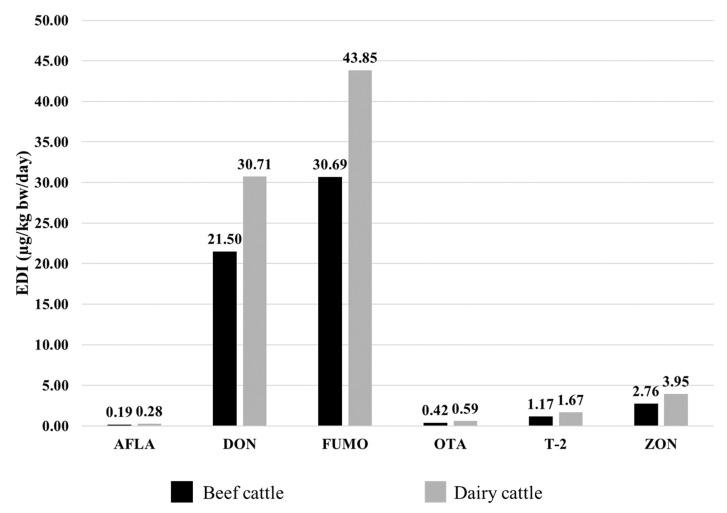
Mycotoxins are toxic secondary metabolites produced by a variety of fungi, which when ingested can cause several deleterious effects to the health of humans and animals. In this work, the detection and quantification of six major mycotoxins (aflatoxins-AFLA, deoxynivalenol-DON, fumonisins-FUMO, ochratoxin A-OTA, T-2 toxin-T-2 and zearalenone-ZON) in 1749 samples of feed and feed ingredients for cattle, collected in Brazil between 2017 and 2021, was carried out using enzyme-linked immunosorbent assay (ELISA). In total, 97% of samples were contaminated with at least one mycotoxin, yet, very few samples exceeded the lowest European Union guidance values for cattle, and the estimated daily intake also showed a low risk for the animals. However, co-occurrences were widely observed, as 87% of samples contained two or more mycotoxins at the same time, and the presence of more than one mycotoxin at the same time in feed can lead to interactions. In conclusion, the contamination of feed and feed ingredients for cattle with mycotoxins in Brazil is very common. Hence, the monitoring of these mycotoxins is of significant importance for food safety.
Keywords: ELISA; TMR; aflatoxins; co-occurrences; deoxynivalenol; feed; maize; silages; zearalenone.
Conflict of interest statement
The authors declare no conflict of interest.
Figures
References
-
- Mycotoxins: Risks in Plant, Animal, and Human Systems. Volume 139. Council for Agricultural Science and Technology; Ames, IA, USA: 2003. CAST Report; p. 199.
-
- Freire F.d.C.O., Vieira I.G.P., Guedes M.I.F., Mendes F.N.P. Micotoxinas: Importância na alimentação e na saúde humana e animal. Embrapa Agroind.Trop. 2007;110:48.
-
- Bhat R., Miller J. Food, Nutrition and Agriculture-Food for the Future. FAO; Rome, Italy: 1991. Mycotoxins and food supply; p. 16.
Publication types
MeSH terms
Substances
LinkOut - more resources
Full Text Sources
