


Web-Based Educational Intervention to Improve Knowledge of Systematic Reviews Among Health Science Professionals: Randomized Controlled Trial
- PMID: 36006686
- PMCID: PMC9459937
- DOI: 10.2196/37000
Web-Based Educational Intervention to Improve Knowledge of Systematic Reviews Among Health Science Professionals: Randomized Controlled Trial
Abstract
Background: Lack of knowledge of systematic reviews (SRs) could prevent individual health care professionals from using SRs as a source of information in their clinical practice or discourage them from participating in such research.
Objective: In this randomized controlled trial, we evaluated the effect of a short web-based educational intervention on short-term knowledge of SRs.
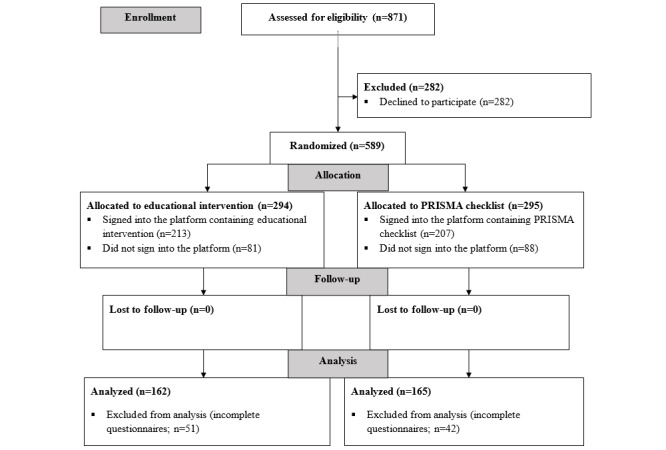
Methods: Eligible participants were 871 Master's students of university health sciences studies in Croatia; 589 (67.6%) students who agreed to participate in the trial were randomized using a computer program into 2 groups. Intervention group A (294/589, 49.9%) received a short web-based educational intervention about SR methodology, and intervention group B (295/589, 50.1%) was presented with the PRISMA (Preferred Reporting Items for Systematic Reviews and Meta-Analyses) checklist. The participants' knowledge of SRs was assessed before and after the intervention. The participants could not be blinded because of the nature of the intervention. The primary outcome was the difference in the percentage of correct answers about SR methodology per participant between the groups after the intervention, expressed as relative risk and 95% CI.
Results: Results from 162 and 165 participants in the educational intervention and PRISMA checklist groups, respectively, were available for analysis. Most of them (educational intervention group: 130/162, 80.2%; PRISMA checklist group: 131/165, 79.4%) were employed as health care professionals in addition to being health sciences students. After the intervention, the educational intervention group had 23% (relative risk percentage) more correct answers in the postintervention questionnaire than the PRISMA checklist group (relative risk=1.23, 95% CI 1.17-1.29).
Conclusions: A short web-based educational intervention about SRs is an effective tool for short-term improvement of knowledge of SRs among health care studies students, most of whom were also employed as health care professionals. Further studies are needed to explore the long-term effects of the tested education.
Trial registration: OSF Registries 10.17605/OSF.IO/RYMVC; https://osf.io/rymvc.
Keywords: educational intervention; health science professionals; knowledge; randomized controlled trial; systematic review.
©Marina Krnic Martinic, Marta Čivljak, Ana Marušić, Damir Sapunar, Tina Poklepović Peričić, Ivan Buljan, Ružica Tokalić, Snježana Mališa, Marijana Neuberg, Kata Ivanišević, Diana Aranza, Nataša Skitarelić, Sanja Zoranić, Štefica Mikšić, Dalibor Čavić, Livia Puljak. Originally published in the Journal of Medical Internet Research (https://www.jmir.org), 25.08.2022.
Conflict of interest statement
Conflicts of Interest: Multiple authors of this study are members of Cochrane Croatia (AM, TPP, IB, RT, and LP), but this was not an official research project of the global Cochrane organization.
Figures
References
-
- Novak K, Mirić D, Jurin A, Vukojević K, Aljinović J, Carić A, Marinović Guić M, Poljicanin A, Kosta V, Rako D, Marusic A, Marusić M, Puljak L. Awareness and use of evidence-based medicine databases and Cochrane Library among physicians in Croatia. Croat Med J. 2010 Apr;51(2):157–64. doi: 10.3325/cmj.2010.51.157. http://www.cmj.hr/2010/51/2/20401959.htm - DOI - PMC - PubMed
-
- Ulvenes LV, Aasland O, Nylenna M, Kristiansen IS. Norwegian physicians' knowledge of and opinions about evidence-based medicine: cross-sectional study. PLoS One. 2009 Nov 13;4(11):e7828. doi: 10.1371/journal.pone.0007828. https://dx.plos.org/10.1371/journal.pone.0007828 - DOI - PMC - PubMed
Publication types
MeSH terms
LinkOut - more resources
Full Text Sources
Research Materials
