


Semantic segmentation method of underwater images based on encoder-decoder architecture
- PMID: 36006956
- PMCID: PMC9409518
- DOI: 10.1371/journal.pone.0272666
Semantic segmentation method of underwater images based on encoder-decoder architecture
Abstract
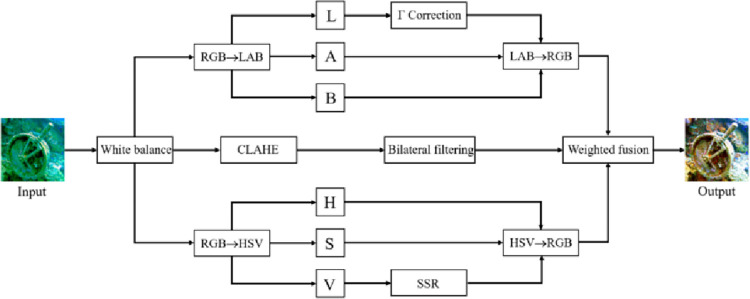
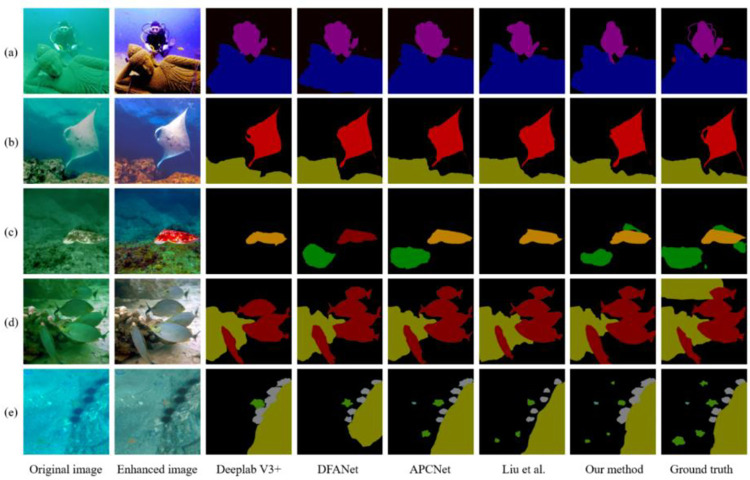
With the exploration and development of marine resources, deep learning is more and more widely used in underwater image processing. However, the quality of the original underwater images is so low that traditional semantic segmentation methods obtain poor segmentation results, such as blurred target edges, insufficient segmentation accuracy, and poor regional boundary segmentation effects. To solve these problems, this paper proposes a semantic segmentation method for underwater images. Firstly, the image enhancement based on multi-spatial transformation is performed to improve the quality of the original images, which is not common in other advanced semantic segmentation methods. Then, the densely connected hybrid atrous convolution effectively expands the receptive field and slows down the speed of resolution reduction. Next, the cascaded atrous convolutional spatial pyramid pooling module integrates boundary features of different scales to enrich target details. Finally, the context information aggregation decoder fuses the features of the shallow network and the deep network to extract rich contextual information, which greatly reduces information loss. The proposed method was evaluated on RUIE, HabCam UID, and UIEBD. Compared with the state-of-the-art semantic segmentation algorithms, the proposed method has advantages in segmentation integrity, location accuracy, boundary clarity, and detail in subjective perception. On the objective data, the proposed method achieves the highest MIOU of 68.3 and OA of 79.4, and it has a low resource consumption. Besides, the ablation experiment also verifies the effectiveness of our method.
Conflict of interest statement
The authors have declared that no competing interests exist.
Figures






References
-
- Li C., Saeed A., Fatih P. Underwater scene prior inspired deep underwater image and video enhancement. Pattern Recog. 2020, 98, 107038.
-
- Li Y., Chen R. UDA‐Net: Densely attention network for underwater image enhancement. IET Image Process. 2021, 15, 774–785.
-
- Wei X., Yu L., Tian S., Feng P., Ning X. Underwater target detection with an attention mechanism and improved scale. Multimedia Tools App. 2021, 80, 33747–33761.
-
- Chen L.; Liu Z.; Tong L. Underwater object detection using Invert Multi-Class Adaboost with deep learning. 2020 International Joint Conference on Neural Networks (IJCNN). IEEE, 2020.
Publication types
MeSH terms
LinkOut - more resources
Full Text Sources
