


Association between work stress and health behaviours in Korean and Japanese ageing studies: a cross-sectional study
- PMID: 36008063
- PMCID: PMC9422816
- DOI: 10.1136/bmjopen-2022-063538
Association between work stress and health behaviours in Korean and Japanese ageing studies: a cross-sectional study
Abstract
Objectives: Limited research has focused on the association between work stress and health behaviours in Asian countries. We aimed to explore the effect of work stress on two health behaviours among employees aged 45 years or above in two countries with ageing populations, Korea and Japan.
Design: A cross-sectional study.
Setting: This secondary data analysis was conducted on baseline data from the Korean Longitudinal Study of Aging (KLoSA, 2006) and the Japanese Study of Aging and Retirement (JSTAR, 2007 and 2009).
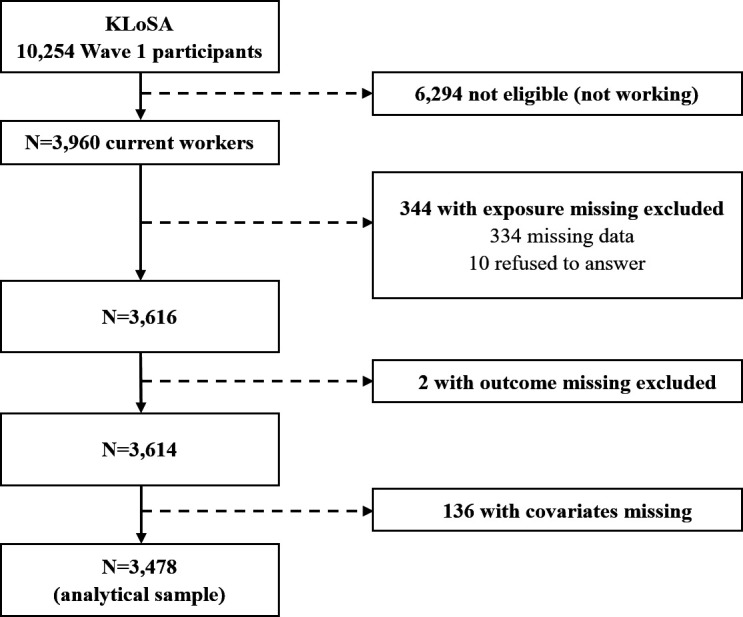
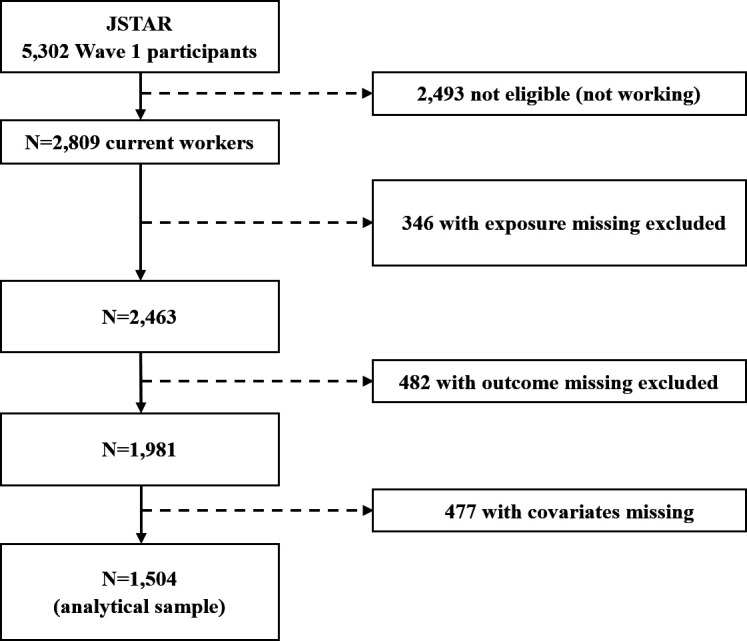
Participants: Included in the analytical sample were 4982 responders without missing data aged 45 years or older who reported work positions and hours (KLoSA n=3478, JSTAR n=1504).
Main outcome measures: Work stress was represented by the short version of the effort-reward imbalance (ERI) model. We used logistic regression and multinomial logistic regression to investigate the association between work stress and smoking (binary current smoking) and between work stress and drinking (categorical volume of alcohol). Socioeconomic and work-related characteristics were taken into consideration, and we examined the potential interaction between ERI and gender.
Results: Work stress as measured by ERI ratio was significantly associated with both smoking and drinking in the KLoSA analysis; after the model was fully adjusted, ORs were 1.45 (95% CI 1.17 to 1.80) and 1.44 (95% CI 1.09 to 1.90), respectively. In analysis of the data from JSTAR, the ERI ratio was associated with smoking (OR 1.37, 95% CI 1.01 to 1.89) but not with drinking. No statistically significant interaction was found between ERI and gender in any model (p=0.82 in KLoSA data and p=0.19 in JSTAR data).
Conclusions: Statistically significant associations were found between work stress and both smoking and drinking behaviours in Korea and between work stress and smoking in Japan. Government integration of effort-reward balance programmes and health promotion programmes could effectively promote population health in these two Asian countries.
Keywords: epidemiology; mental health; public health.
© Author(s) (or their employer(s)) 2022. Re-use permitted under CC BY-NC. No commercial re-use. See rights and permissions. Published by BMJ.
Conflict of interest statement
Competing interests: None declared.
Figures
References
-
- Ganster DC, Rosen CC. Work stress and employee health: a multidisciplinary review. J Manag 2013;39:1085–122.
-
- Kang KH, Lee KS, Kim SI, et al. The relationship between alcohol use and job stress among firemen. Korean J Occup Environ Med 2001;13:401–12. 10.35371/kjoem.2001.13.4.401 - DOI
MeSH terms
LinkOut - more resources
Full Text Sources
Medical
