. 2022 Aug 26;10(1):136.
doi: 10.1186/s40168-022-01327-7.

Capturing the antibiotic resistome of preterm infants reveals new benefits of probiotic supplementation

Affiliations

Capturing the antibiotic resistome of preterm infants reveals new benefits of probiotic supplementation

Allison K Guitor et al. Microbiome. .

Abstract

Background: Probiotic use in preterm infants can mitigate the impact of antibiotic exposure and reduce rates of certain illnesses; however, the benefit on the gut resistome, the collection of antibiotic resistance genes, requires further investigation. We hypothesized that probiotic supplementation of early preterm infants (born < 32-week gestation) while in hospital reduces the prevalence of antibiotic resistance genes associated with pathogenic bacteria in the gut. We used a targeted capture approach to compare the resistome from stool samples collected at the term corrected age of 40 weeks for two groups of preterm infants (those that routinely received a multi-strain probiotic during hospitalization and those that did not) with samples from full-term infants at 10 days of age to identify if preterm birth or probiotic supplementation impacted the resistome. We also compared the two groups of preterm infants up to 5 months of age to identify persistent antibiotic resistance genes.

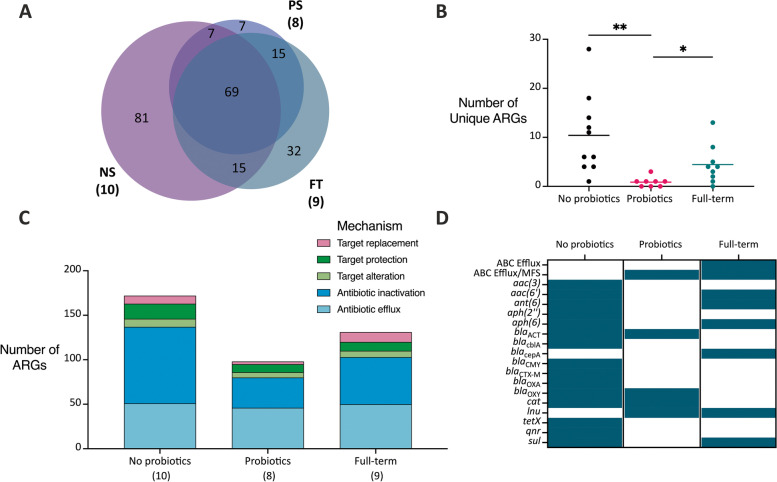
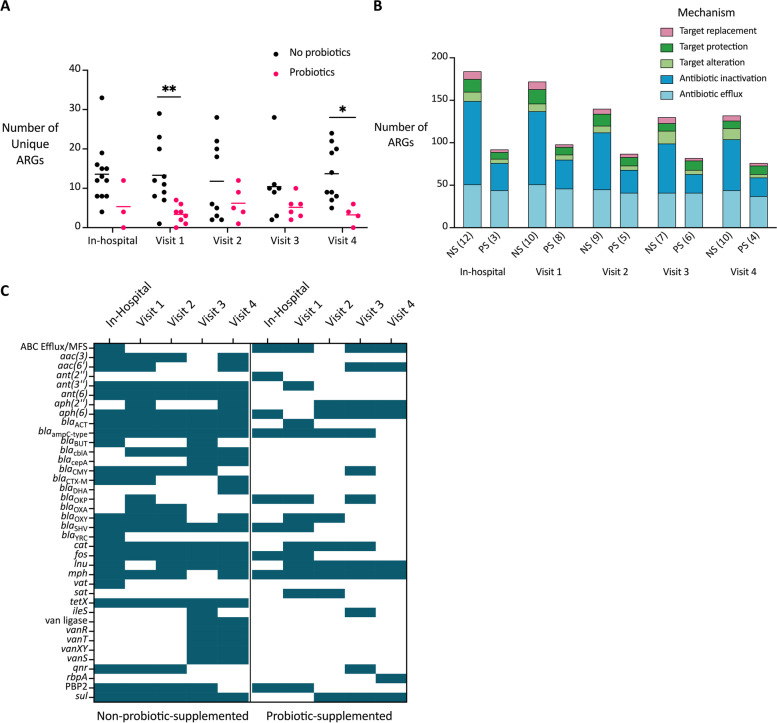
Results: At the term corrected age, or 10 days of age for the full-term infants, we found over 80 antibiotic resistance genes in the preterm infants that did not receive probiotics that were not identified in either the full-term or probiotic-supplemented preterm infants. More genes associated with antibiotic inactivation mechanisms were identified in preterm infants unexposed to probiotics at this collection time-point compared to the other infants. We further linked these genes to mobile genetic elements and Enterobacteriaceae, which were also abundant in their gut microbiomes. Various genes associated with aminoglycoside and beta-lactam resistance, commonly found in pathogenic bacteria, were retained for up to 5 months in the preterm infants that did not receive probiotics.

Conclusions: This pilot survey of preterm infants shows that probiotics administered after preterm birth during hospitalization reduced the diversity and prevented persistence of antibiotic resistance genes in the gut microbiome. The benefits of probiotic use on the microbiome and the resistome should be further explored in larger groups of infants. Due to its high sensitivity and lower sequencing cost, our targeted capture approach can facilitate these surveys to further address the implications of resistance genes persisting into infancy without the need for large-scale metagenomic sequencing. Video Abstract.

Keywords: Antibiotics; Gut microbiota; Preterm infants; Probiotics; Resistome; Targeted capture.


Conflict of interest statement

The authors declare that they have no competing interests.

Figures
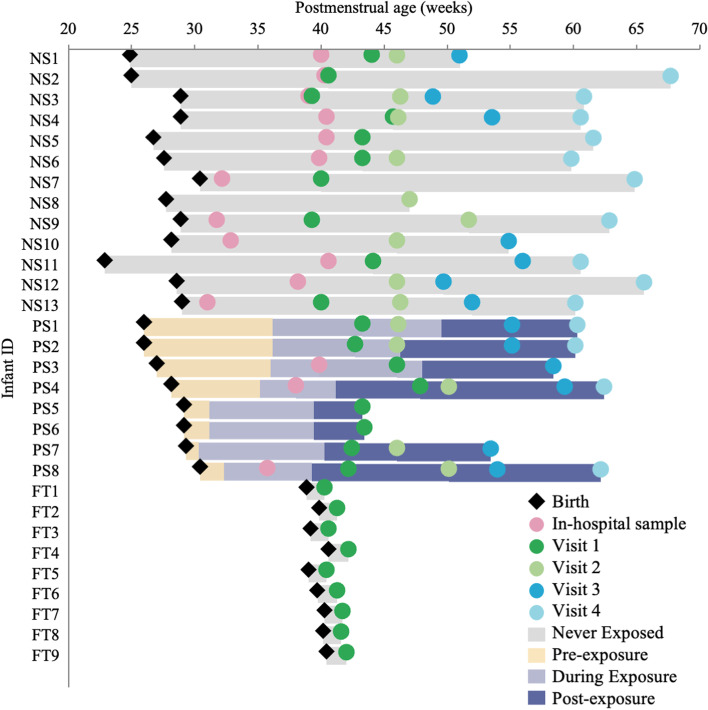
Fig. 1
Fig. 1
Sample collection and probiotic exposure of preterm infants. Timelines from birth to final sample collection for all infants are included in this study. The duration of exposure to probiotics (lavender bar) and timing of sample collection in relation to postmenstrual age in weeks are shown for non-probiotic-supplemented (NS), probiotic-supplemented (PS) preterm infants, and full-term (FT) infants
Fig. 2
Fig. 2
Differences in the resistome identified through RGI bwt in infants at visit 1. Reads were mapped to CARD using bowtie2, and antibiotic resistance genes with at least 100 reads were reported. The data presented is from the full set of preterm and full-term infants and at visit 1. A) Unique and overlapping ARGs identified in each infant group. The number of infant samples included in each is shown next to the sample type. B) The number of unique ARGs identified in each infant. Significant differences are denoted by a line and asterisk(s) above the groups that were compared (P = 0.0047 for NS vs PS, P = 0.0262 for PS vs FT). C) A breakdown of the mechanisms of antibiotic resistance identified in each infant group. The number of infant samples included in each is shown next to the sample type. D) The presence or absence of selected AMR gene families in each infant group. A teal box indicates that at least one gene from that AMR gene family was identified in any of the infant samples (NS = not supplemented preterm, PS = probiotic-supplemented preterm, and FT = full-term infants)
Fig. 3
Fig. 3
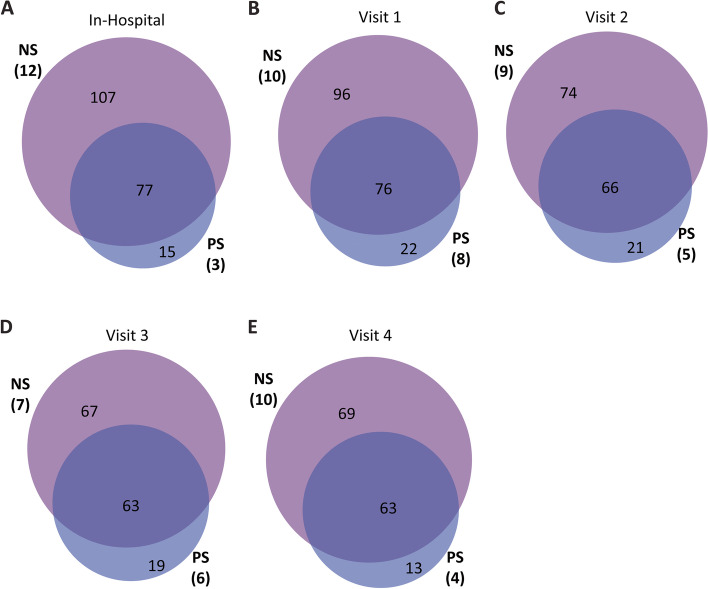
Number of unique genes in preterm infants at various time-points. These gene counts are from mapping reads to CARD using bowtie2 and counting the number of genes with at least 100 reads. Data are from NS and PS infants at the inhospital collection (A), visit 1 (B), visit 2 (C), visit 3 (D), and visit 4 (E) time-points. The number of infants included in each time-point is indicated (NS = non-probiotic-supplemented preterm, PS = probiotic-supplemented preterm)
Fig. 4
Fig. 4
Unique ARGs, mechanisms, and families in preterm infants up to 5 months of age. Reads were mapped to CARD using bowtie2, and ARGs with at least 100 reads were reported. The data presented is for all preterm infants at all visits. A) The number of unique ARGs identified in each infant. Significant differences are denoted by a line and asterisk(s) above the groups that were compared (P = 0.0052 for visit 1, P = 0.0144 for visit 4). B) The number of ARGs identified in each infant group classified by resistance gene mechanism. The number of infant samples included in each is shown next to the sample type (NS = non-probiotic-supplemented preterm, PS = probiotic-supplemented preterm). C) A selected subset of detected AMR gene families in preterm infants. A teal box indicates that at least one gene from that AMR gene family was identified in any of the infants at that time-point
Fig. 5
Fig. 5
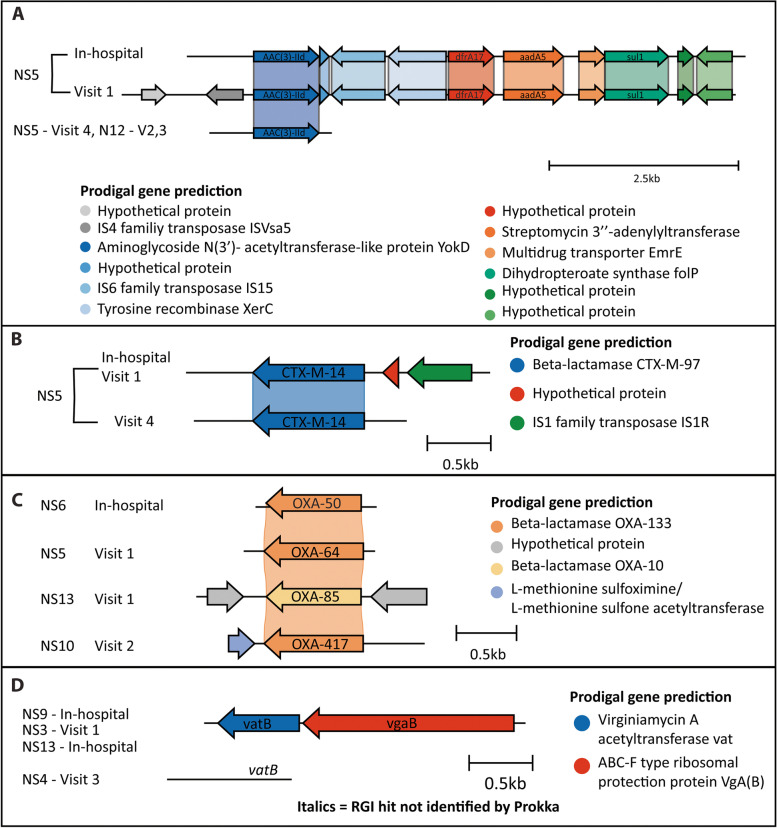
Genetic context of AMR gene families unique to NS infants. From the de novo assembly, open reading frames were annotated using Prokka, and resistance genes were predicted using RGI main. The Prokka annotations are the colored arrows, and the RGI main predictions are labeled on each ORF. The genes are shown grouped into their respective AMR gene families: (A) AAC(3) gene family, (B) CTX-M beta-lactamase family, (C) OXA beta-lactamase family, (D) streptogramin vat acetyltransferase family (NS = not supplemented preterm)
Fig. 6
Fig. 6
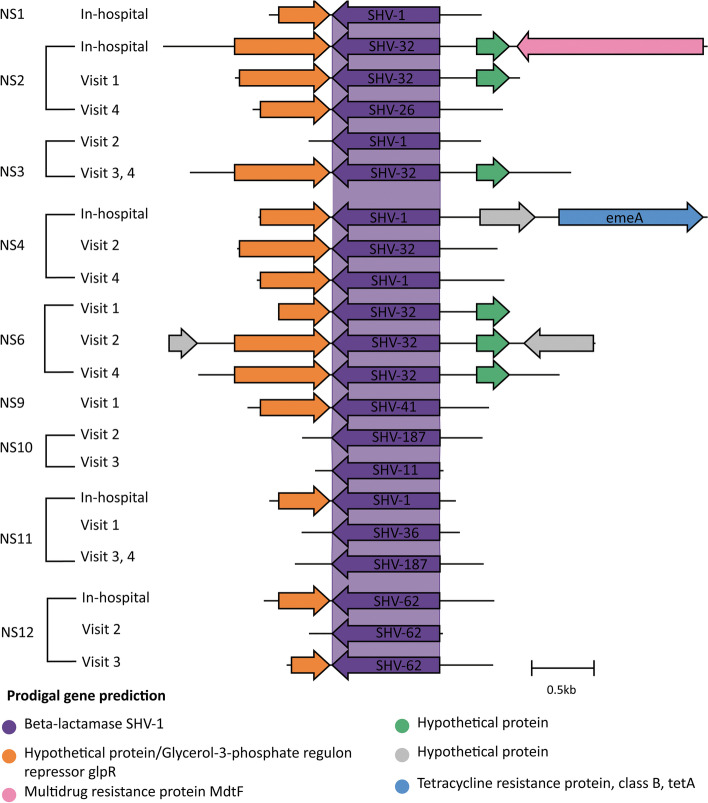
Genetic context of the SHV beta-lactamases. From the de novo assembly, open reading frames were annotated using Prokka, and resistance genes were predicted using RGI main. The Prokka annotations are the colored arrows, and the RGI main predictions are labeled on each ORF (NS = not supplemented preterm)

References

    1. Pärnänen K, Karkman A, Hultman J, Lyra C, Bengtsson-Palme J, Larsson DGJ, et al. Maternal gut and breast milk microbiota affect infant gut antibiotic resistome and mobile genetic elements. Nat Commun. 2018;9:1–11. doi: 10.1038/s41467-018-06393-w. - DOI - PMC - PubMed
    1. van den Akker CHP, van Goudoever JB, Shamir R, Domellöf M, Embleton ND, Hojsak I, et al. Probiotics and preterm infants: a position paper by the European Society for Paediatric Gastroenterology Hepatology and Nutrition Committee on Nutrition and the European Society for Paediatric Gastroenterology Hepatology and Nutrition Working Group for Pr. J Pediatr Gastroenterol Nutr. 2020;70:664–680. doi: 10.1097/MPG.0000000000002655. - DOI - PubMed
    1. Matamoros S, Gras-Leguen C, Le Vacon F, Potel G, de La Cochetiere M-F. Development of intestinal microbiota in infants and its impact on health. Trends Microbiol. 2013;21:167–173. doi: 10.1016/j.tim.2012.12.001. - DOI - PubMed
    1. Simioni J, Hutton EK, Gunn E, Holloway AC, Stearns JC, McDonald H, et al. A comparison of intestinal microbiota in a population of low-risk infants exposed and not exposed to intrapartum antibiotics: the Baby & Microbiota of the Intestine Cohort Study protocol. BMC Pediatr. 2016;16:1–7. doi: 10.1186/s12887-016-0724-5. - DOI - PMC - PubMed
    1. Stearns JC, Simioni J, Gunn E, McDonald H, Holloway AC, Thabane L, et al. Intrapartum antibiotics for GBS prophylaxis alter colonization patterns in the early infant gut microbiome of low risk infants. Sci Rep. 2017;7:1–9. doi: 10.1038/s41598-017-16606-9. - DOI - PMC - PubMed

Publication types

Substances

LinkOut - more resources