Review
. 2022 Aug 20;11(8):1619.
doi: 10.3390/antiox11081619.

The Potential Implications of Hydrogen Sulfide in Aging and Age-Related Diseases through the Lens of Mitohormesis

Affiliations
Review

The Potential Implications of Hydrogen Sulfide in Aging and Age-Related Diseases through the Lens of Mitohormesis

Thi Thuy Tien Vo et al. Antioxidants (Basel). .

Abstract

The growing increases in the global life expectancy and the incidence of chronic diseases as a direct consequence have highlighted a demand to develop effective strategies for promoting the health of the aging population. Understanding conserved mechanisms of aging across species is believed helpful for the development of approaches to delay the progression of aging and the onset of age-related diseases. Mitochondrial hormesis (or mitohormesis), which can be defined as an evolutionary-based adaptive response to low-level stress, is emerging as a promising paradigm in the field of anti-aging. Depending on the severity of the perceived stress, there are varying levels of hormetic response existing in the mitochondria called mitochondrial stress response. Hydrogen sulfide (H2S) is a volatile, flammable, and toxic gas, with a characteristic odor of rotten eggs. However, H2S is now recognized an important gaseous signaling molecule to both physiology and pathophysiology in biological systems. Recent studies that elucidate the importance of H2S as a therapeutic molecule has suggested its protective effects beyond the traditional understanding of its antioxidant properties. H2S can also be crucial for the activation of mitochondrial stress response, postulating a potential mechanism for combating aging and age-related diseases. Therefore, this review focuses on highlighting the involvement of H2S and its sulfur-containing derivatives in the induction of mitochondrial stress response, suggesting a novel possibility of mitohormesis through which this gaseous signaling molecule may promote the healthspan and lifespan of an organism.

Keywords: hydrogen sulfide; mitochondrial dynamics; mitochondrial unfolded protein response; mitohormesis; mitophagy.


Conflict of interest statement

The authors declare that there is no conflict of interest regarding the publication of this article.

Figures
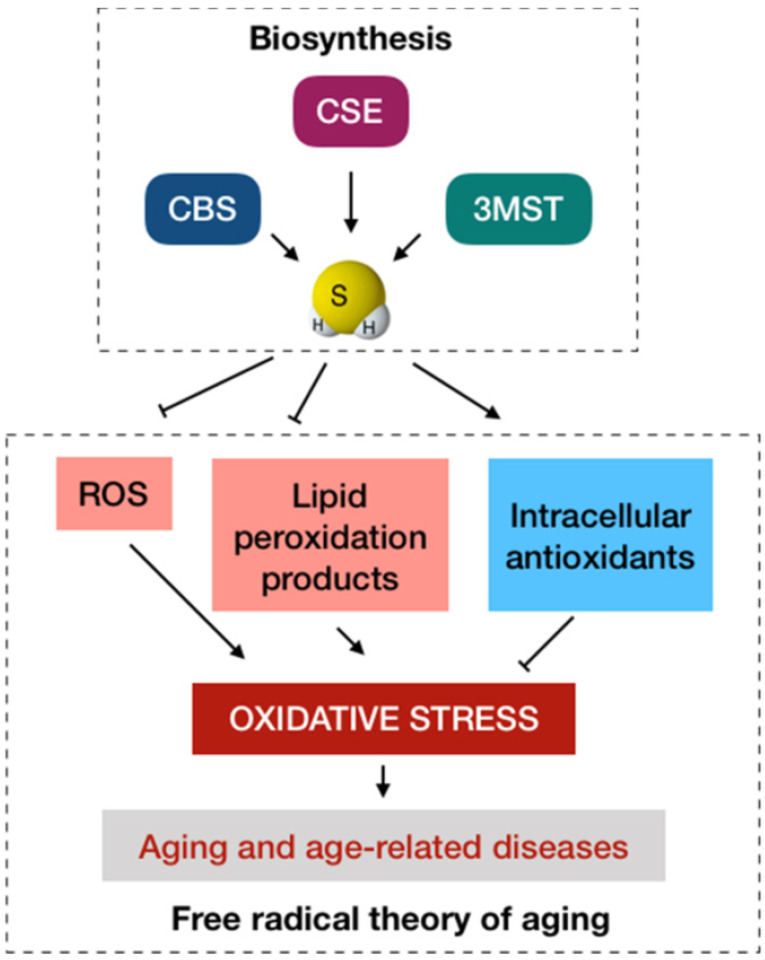
Figure 1
Figure 1
The conventional antioxidant paradigm of H2S in anti-aging. The biosynthesis of H2S in mammalian cells primarily involve cystathionine β-synthase (CBS), cystathionine γ-lyase (CSE), and 3-mercaptopyruvate sulfurtransferase (3MST). From the viewpoint of the free radical theory of aging, oxidative stress caused by the excessive production and accumulation of ROS is a major cause of aging that in turn has a progressive role in age-related diseases. H2S at physiological levels may function as an antioxidant to protect the cells and tissues from oxidative stress by scavenging ROS, reducing the aggregation of lipid peroxidation products, and increasing the generation of intracellular antioxidants.
Figure 2
Figure 2
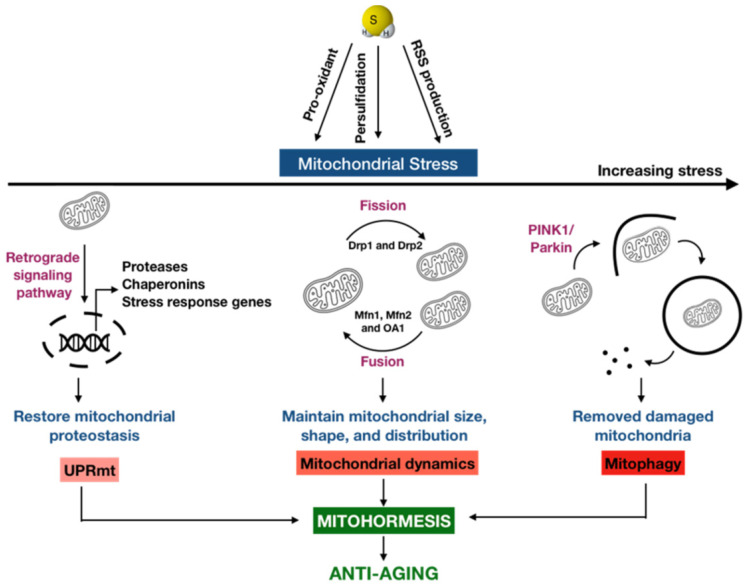
A new possibility of H2S in anti-aging via mitohormesis. Mitohormesis refers to as an adaptive response through which the induction of mild or moderate mitochondrial stress can promote the viability and health of a cell, tissue, or organism. Depending on the severity of the perceived stress, there are varying hormetic responses existing in the mitochondria called mitochondrial stress response to adapt to different stress levels. The mitochondrial unfolded protein response (UPRmt) is activated as the first line of defense for mitigating the stress, which induces a retrograde signaling pathway from the mitochondria to the nucleus, leading to the expression of proteases, chaperonins, and many stress response genes to degrade the unfolded or misfolded proteins and re-establish the mitochondrial protein homeostasis. In addition, mitochondria are highly dynamic organelles that undergo coordinated cycles of fission and fusion, referred to as mitochondrial dynamics, to maintain their size, shape, and distribution. When the stress level is increased, mitochondrial dynamics comes into action. When the mitochondrial stress level is overwhelmed, a selective type of autophagy targeting the damaged mitochondria for degradation, termed mitophagy, takes place. H2S can be an important regulator for these mitochondrial stress responses, both directly and indirectly, as this gas itself may be a pro-oxidant by stimulating the Fenton reaction or it may undergo the sulfide oxidation pathway in the mitochondria to generate highly reactive sulfur species (RSS), which can be further oxidized or can modify cysteine residues via persulfidation.

References

    1. Franceschi C., Garagnani P., Morsiani C., Conte M., Santoro A., Grignolio A., Monti D., Capri M., Salvioli S. The continuum of aging and age-related diseases: Common mechanisms but different rates. Front. Med. 2018;5:61. doi: 10.3389/fmed.2018.00061. - DOI - PMC - PubMed
    1. Li Z., Zhang Z., Ren Y., Wang Y., Fang J., Yue H., Ma S., Guan F. Aging and age-related diseases: From mechanisms to therapeutic strategies. Biogerontology. 2021;22:165–187. doi: 10.1007/s10522-021-09910-5. - DOI - PMC - PubMed
    1. Chang A.Y., Skirbekk V.F., Tyrovolas S., Kassebaum N.J., Dieleman J.L. Measuring population ageing: An analysis of the Global Burden of Disease Study 2017. Lancet Public Health. 2019;4:e159–e167. doi: 10.1016/S2468-2667(19)30019-2. - DOI - PMC - PubMed
    1. Dröge W. Aging-related changes in the thiol/disulfide redox state: Implications for the use of thiol antioxidants. Exp. Gerontol. 2002;37:1333–1345. doi: 10.1016/S0531-5565(02)00175-4. - DOI - PubMed
    1. Perridon B.W., Leuvenink H.G., Hillebrands J.L., van Goor H., Bos E.M. The role of hydrogen sulfide in aging and age-related pathologies. Aging. 2016;8:2264–2289. doi: 10.18632/aging.101026. - DOI - PMC - PubMed

LinkOut - more resources