Review
. 2022 Jul 30;10(8):1841.
doi: 10.3390/biomedicines10081841.

Properties of Leukemic Stem Cells in Regulating Drug Resistance in Acute and Chronic Myeloid Leukemias

Affiliations
Review

Properties of Leukemic Stem Cells in Regulating Drug Resistance in Acute and Chronic Myeloid Leukemias

Xingjian Zhai et al. Biomedicines. .

Abstract

Notoriously known for their capacity to reconstitute hematological malignancies in vivo, leukemic stem cells (LSCs) represent key drivers of therapeutic resistance and disease relapse, posing as a major medical dilemma. Despite having low abundance in the bulk leukemic population, LSCs have developed unique molecular dependencies and intricate signaling networks to enable self-renewal, quiescence, and drug resistance. To illustrate the multi-dimensional landscape of LSC-mediated leukemogenesis, in this review, we present phenotypical characteristics of LSCs, address the LSC-associated leukemic stromal microenvironment, highlight molecular aberrations that occur in the transcriptome, epigenome, proteome, and metabolome of LSCs, and showcase promising novel therapeutic strategies that potentially target the molecular vulnerabilities of LSCs.

Keywords: acute myeloid leukemia; chronic myeloid leukemia; combination therapy; drug resistance; leukemic stem cells; metabolism; multi-omics; signal transduction; tumor microenvironment.


Conflict of interest statement

The authors declare no conflict of interest.

Figures
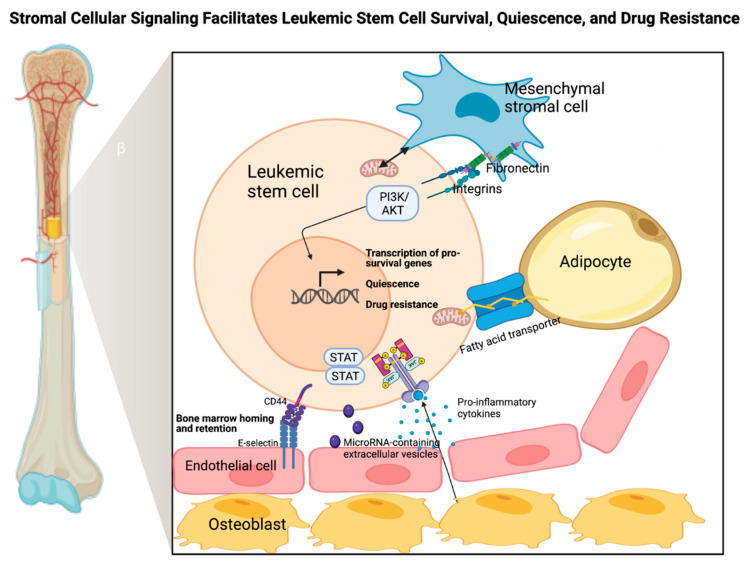
Figure 1
Figure 1
Stromal cellular signaling facilitates leukemic stem cell (LSC) survival, quiescence, and drug resistance. LSCs engage in bidirectional crosstalk with multiple BM cellular constituents. E-selectin expressed on the surface of endothelial cells interacts with CD44 on LSCs to drive LSC homing and retention in the protective BM microenvironment, sheltering LSCs from therapeutic insults. Furthermore, endothelial cells also release microRNA (miRNA)-containing extracellular vesicles to further enrich the quiescence phenotype of LSCs. Osteoblasts primarily release proinflammatory cytokines that lead to the transcription of genes implicated in LSC survival, self-renewal, and quiescence. Mesenchymal stromal cells are known to physically transfer mitochondria to LSCs via nanotubes to repair and replace damaged mitochondria with new ones inside LSCs, potentially helping LSCs evade apoptosis. Mesenchymal stromal cells can also activate pro-survival integrin-mediated signaling in LSCs, involving the PI3K/AKT pathway. Moreover, adipocytes assist in the rewiring of LSC metabolism, supplying free fatty acids to fuel oxidative phosphorylation, a known metabolic dependency of LSCs.
Figure 2
Figure 2
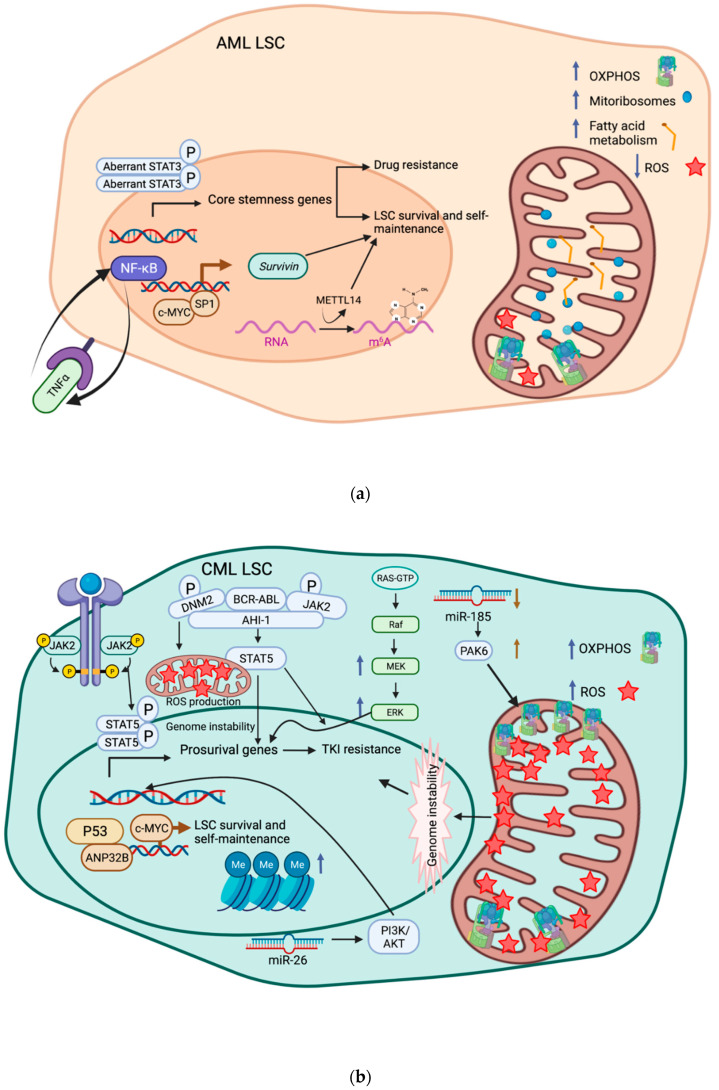
Multi-omics circuitry of AML and CML LSC-mediated drug resistance. (a) Notable transcriptomic features of AML LSCs include dysregulated transcription factors, such as STAT3, the aberrant activation of which is associated with the transcription of core stemness genes; constitutive NFκB activation, which can be mediated by a self-sustaining, autocrine positive feedback loop with tumor necrosis factor-α (TNF-α); and aberrant c-Myc activity, which, along with sp1, enhances transcription of survivin, concertedly driving LSC survival, self-maintenance, and drug resistance. Epigenetically, m6A RNA modification by METTL14 is essential for LSC self-renewal and frequency in vivo. In regard to the proteomic and metabolomic landscapes of AML LSCs, AML LSCs tend to harbor high abundance of mitochondrial ribosomes, also known as mito-ribosomes, to facilitate translation of mitochondrial and oxidative phosphorylation (OXPHOS) machineries, to which fatty acid oxidation contributes a great deal. Interestingly, AML LSCs generally maintain modest to low levels of reactive oxygen species (ROS), in alignment with their generally quiescent state. (b) CML LSCs have also shown oncogenic aberrations to transcription factor activities, including JAK2/STAT5 signaling, which activates transcription of pro-survival genes and confers TKI resistance. Dysregulation of P53 signaling by c-Myc or Acidic Nuclear Phosphoprotein 32 Family Member B (ANP32B) fosters LSC survival and self-maintenance. Furthermore, the AHI-1-BCR-ABL-JAK2-DNM2 signaling network facilitates multiple features of CML LSC survival and drug resistance, such as activating STAT5 signaling, increasing ROS production, and promoting genome instability, all of which drive overall LSC proliferation and resistance to therapy. The abilities of CML LSCs to self-renew and to resist against TKI therapy can further be enhanced by epigenetic mechanisms such as increased global DNA methylation and dysregulated miRNA milieu (e.g., downregulation of miR-185 or increased level of miR-26). Particularly, downregulation of miR-185 increases its target PAK6 level, which leads to increased OXPHOS capacity and ROS production of CML LSCs. Aberrant kinase activation, such as ERK/MEK, may partially account for proteomic anomalies underlying LSC survival. Like AML LSCs, CML LSCs tend to rely on OXPHOS to maintain cellular bioenergetics. However, unlike AML LSCs, CML LSCs thrive under elevated ROS, as it triggers further genome instability and potentially gives rise to TKI-resistant BCR-ABL mutations such as T315I.

References

    1. Steensma D.P., Kyle R.A. James Till and Ernest McCulloch: Hematopoietic Stem Cell Discoverers. Mayo Clin. Proc. 2021;96:830–831. doi: 10.1016/j.mayocp.2021.01.016. - DOI - PubMed
    1. Sharkis S.J. Canadian Stem Cell Scientists Take the Prize. Cell. 2005;122:817–819. doi: 10.1016/j.cell.2005.09.008. - DOI - PubMed
    1. Eaves C.J. Hematopoietic stem cells: Concepts, definitions, and the new reality. Blood. 2015;125:2605–2613. doi: 10.1182/blood-2014-12-570200. - DOI - PMC - PubMed
    1. Bonner W.A., Hulett H.R., Sweet R.G., Herzenberg L.A. Fluorescence Activated Cell Sorting. Rev. Sci. Instrum. 1972;43:404–409. doi: 10.1063/1.1685647. - DOI - PubMed
    1. Eaves C.J., Cashman J.D., Zoumbos N.C., Barnett M.J., Eaves A.C. Biological strategies for the selective manipulation of normal and leukemic stem cells. Stem Cells. 1993;11:109–121. doi: 10.1002/stem.5530110924. - DOI - PubMed

Grants and funding

LinkOut - more resources