


Tumor Temperature: Friend or Foe of Virus-Based Cancer Immunotherapy
- PMID: 36009571
- PMCID: PMC9405776
- DOI: 10.3390/biomedicines10082024
Tumor Temperature: Friend or Foe of Virus-Based Cancer Immunotherapy
Abstract
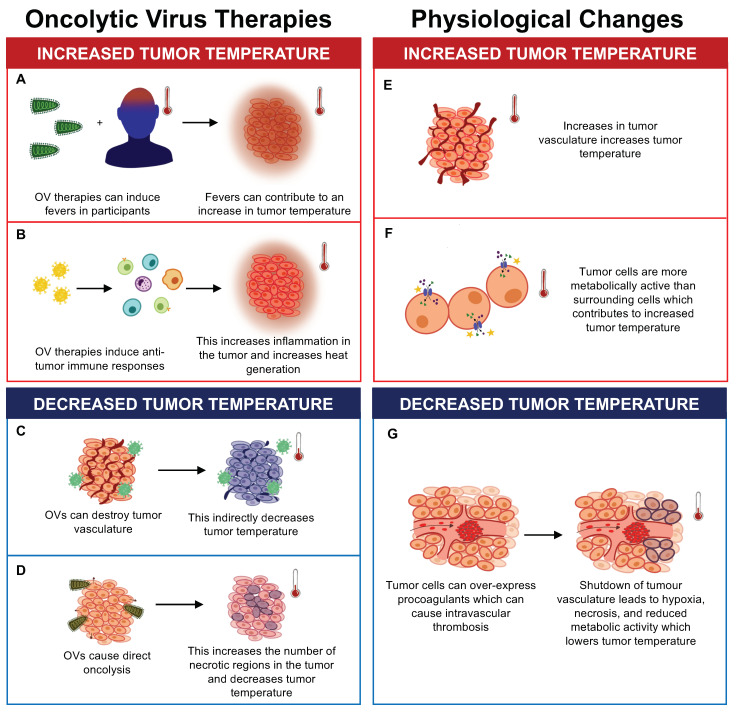
The temperature of a solid tumor is often dissimilar to baseline body temperature and, compared to healthy tissues, may be elevated, reduced, or a mix of both. The temperature of a tumor is dependent on metabolic activity and vascularization and can change due to tumor progression, treatment, or cancer type. Despite the need to function optimally within temperature-variable tumors, oncolytic viruses (OVs) are primarily tested at 37 °C in vitro. Furthermore, animal species utilized to test oncolytic viruses, such as mice, dogs, cats, and non-human primates, poorly recapitulate the temperature profile of humans. In this review, we discuss the importance of temperature as a variable for OV immunotherapy of solid tumors. Accumulating evidence supports that the temperature sensitivity of OVs lies on a spectrum, with some OVs likely hindered but others enhanced by elevated temperatures. We suggest that in vitro temperature sensitivity screening be performed for all OVs destined for the clinic to identify potential hinderances or benefits with regard to elevated temperature. Furthermore, we provide recommendations for the clinical use of temperature and OVs.
Keywords: cancer; oncolytic virus; solid tumor; temperature.
Conflict of interest statement
The funders had no role in the design of the study; in the collection, analyses, or interpretation of data; in the writing of the manuscript, or in the decision to publish the results. B.W.B is the Chief Operating Officer of ImmunoCeutica Inc., a company dedicated to the research and development of immunoceuticals. ImmunoCeutica Inc. did not provide funding, nor did they influence this manuscript in any way. The research objectives of ImmunoCeutica Inc are independent of the subject matter of this manuscript. D.J.S. is the Director of Scientific Operations of Novometrix Research Inc., which specializes in integration of stakeholder networks and information synthesis; this mandate is unrelated to the content of this manuscript. Novometrix Research Inc. did not provide funding, nor did they influence this manuscript in any way. The other two authors declare no potential conflicts of interest.
Figures
References
-
- Owens A., Godbole M., Dabydeen D., Medeiros L., Phatak P., Kandlikar S. A comparative analysis of the tumor pathology and the metabolic heat generation of growing malignant tumors; Proceedings of the ASME 2020 18th International Conference on Nanochannels, Microchannels, and Minichannels collocated with the ASME 2020 Heat Transfer Summer Conference and the ASME 2020 Fluids Engineering Division Summer Meeting; Online. 13–15 July 2020; - DOI
-
- Sella T., Sklair-Levy M., Cohen M., Rozin M., Shapiro-Feinberg M., Allweis T.M., Libson E., Izhaky D. A Novel Functional Infrared Imaging System Coupled with Multiparametric Computerised Analysis for Risk Assessment of Breast Cancer. Eur. Radiol. 2013;23:1191–1198. doi: 10.1007/s00330-012-2724-7. - DOI - PubMed
Publication types
Grants and funding
LinkOut - more resources
Full Text Sources
Miscellaneous
