


The Role of Lung Ultrasound in SARS-CoV-19 Pneumonia Management
- PMID: 36010207
- PMCID: PMC9406504
- DOI: 10.3390/diagnostics12081856
The Role of Lung Ultrasound in SARS-CoV-19 Pneumonia Management
Abstract
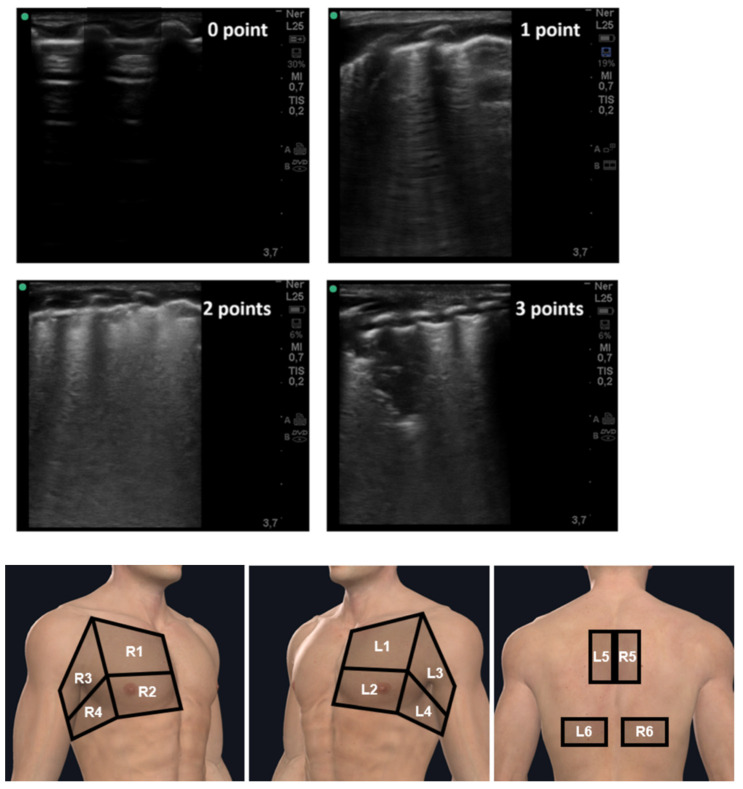
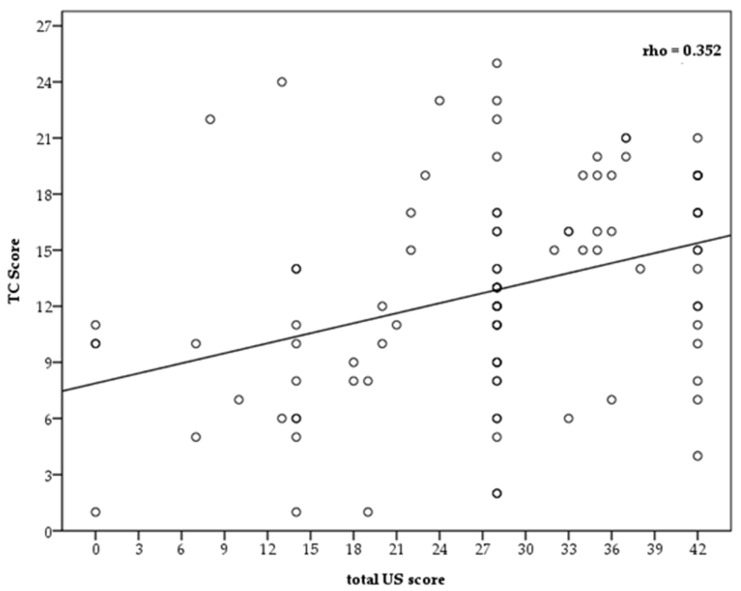
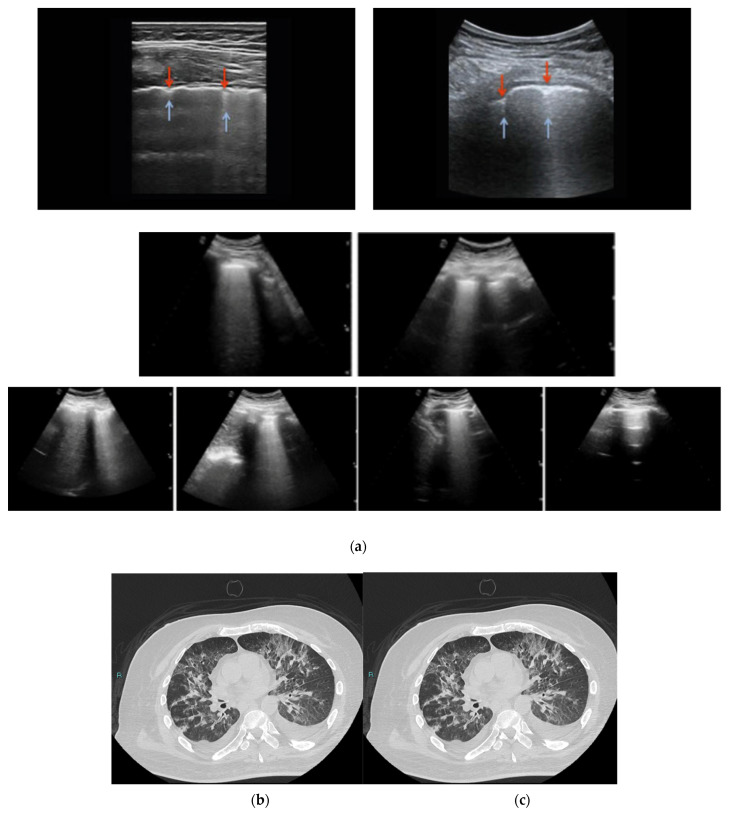
Purpose: We aimed to assess the role of lung ultrasound (LUS) in the diagnosis and prognosis of SARS-CoV-2 pneumonia, by comparing it with High Resolution Computed Tomography (HRCT). Patients and methods: All consecutive patients with laboratory-confirmed SARS-CoV-2 infection and hospitalized in COVID Centers were enrolled. LUS and HRCT were carried out on all patients by expert operators within 48−72 h of admission. A four-level scoring system computed in 12 regions of the chest was used to categorize the ultrasound imaging, from 0 (absence of visible alterations with ultrasound) to 3 (large consolidation and cobbled pleural line). Likewise, a semi-quantitative scoring system was used for HRCT to estimate pulmonary involvement, from 0 (no involvement) to 5 (>75% involvement for each lobe). The total CT score was the sum of the individual lobar scores and ranged from 0 to 25. LUS scans were evaluated according to a dedicated scoring system. CT scans were assessed for typical findings of COVID-19 pneumonia (bilateral, multi-lobar lung infiltration, posterior peripheral ground glass opacities). Oxygen requirement and mortality were also recorded. Results: Ninety-nine patients were included in the study (male 68.7%, median age 71). 40.4% of patients required a Venturi mask and 25.3% required non-invasive ventilation (C-PAP/Bi-level). The overall mortality rate was 21.2% (median hospitalization 30 days). The median ultrasound thoracic score was 28 (IQR 20−36). For the CT evaluation, the mean score was 12.63 (SD 5.72), with most of the patients having LUS scores of 2 (59.6%). The bivariate correlation analysis displayed statistically significant and high positive correlations between both the CT and composite LUS scores and ventilation, lactates, COVID-19 phenotype, tachycardia, dyspnea, and mortality. Moreover, the most relevant and clinically important inverse proportionality in terms of P/F, i.e., a decrease in P/F levels, was indicative of higher LUS/CT scores. Inverse proportionality P/F levels and LUS and TC scores were evaluated by univariate analysis, with a P/F−TC score correlation coefficient of −0.762, p < 0.001, and a P/F−LUS score correlation coefficient of −0.689, p < 0.001. Conclusions: LUS and HRCT show a synergistic role in the diagnosis and disease severity evaluation of COVID-19.
Keywords: ARDS; SARS-CoV-19; high resolution computed tomography; interstitial pneumonia; lung ultrasound.
Conflict of interest statement
The authors declare that the research was conducted in the absence of any commercial or financial relationships that could be construed as a potential conflict of interest.
Figures
References
-
- WHO Coronavirus (COVID-19) Dashboard. [(accessed on 16 February 2022)]; Available online: https://covid19.who.int/
-
- Valdenassi L., Franzini M., Ricevuti G., Rinaldi L., Galoforo A.C., Tirelli U. Letter to the Editor: Potential mechanisms by which the oxygen-ozone (O2–O3) therapy could contribute to the treatment against the coronavirus COVID-19. Eur. Rev. Med. Pharmacol. Sci. 2020;24:4059–4061. doi: 10.26355/eurrev_202004_20976. - DOI - PubMed
-
- Zhou F., Yu T., Du R., Fan G., Liu Y., Liu Z., Xiang J., Wang Y., Song B., Gu X., et al. Clinical Course and Risk Factors for Mortality of Adult Inpatients with COVID-19 in Wuhan, China: A Retrospective Cohort Study. Lancet. 2020;395:1054–1062. doi: 10.1016/S0140-6736(20)30566-3. - DOI - PMC - PubMed
-
- Kudlinski B., Zgoła D., Stolińska M., Murkos M., Kania J., Nowak P., Noga A., Wojciech M., Zaborniak G., Zembron-Lacny A. Systemic Inflammatory Predictors of In-Hospital Mortality in COVID-19 Patients: A Retrospective Study. Diagnostics. 2022;12:859. doi: 10.3390/diagnostics12040859. - DOI - PMC - PubMed
LinkOut - more resources
Full Text Sources
Research Materials
Miscellaneous
