Case Reports
. 2022 Aug 2;12(8):1869.
doi: 10.3390/diagnostics12081869.

Non-Syndromic Familial Mesiodens: Presentation of Three Cases

Affiliations
Case Reports

Non-Syndromic Familial Mesiodens: Presentation of Three Cases

Josefa Alarcón et al. Diagnostics (Basel). .

Abstract

Mesiodens are the most common supernumerary teeth and are detected incidentally during routine radiographic examination, so late diagnosis complications are very common. The dentist must make a timely diagnosis and thus avoid clinical complications. Despite advances in knowledge of dental morphogenesis and differentiation, the etiology of mesiodens remains unclear. Therefore, several theories have been postulated to explain how and why they develop. It was described in the literature that heredity could play an important role in the appearance of supernumerary teeth, with a higher rate of appearance in relatives of those affected. This article reports three cases, a mother and two children, who present mesiodens, which shows that supernumerary teeth may involve a genetic factor. In addition, a literature review was carried out to assess the importance of the genetic factor as a possible cause of mesiodens. The relevance and implications of timely diagnosis in clinical practice to avoid manifestations of clinical complications are discussed. Therefore, the identification of the genetic risk factors responsible for the formation of supernumerary teeth is essential for developing a screening tool to determine an individual's genetic risk.

Keywords: complications; diagnosis; genetics; supernumerary teeth.


Conflict of interest statement

The authors declare no conflict of interest.

Figures
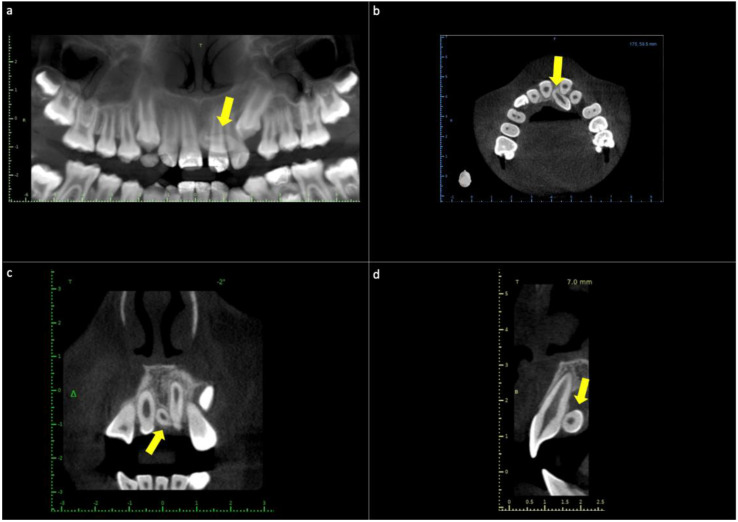
Figure 1
Figure 1
Cone−beam computed tomography (CBCT) of the maxilla. (a) The panoramic reconstruction shows the presence of a mesiodens supernumerary tooth between the midlines of maxillary central teeth. (b) Axial slice image showing the palatal location of the mesiodens in intimate relation to teeth 2.1 and 2.2. (c) Frontal slice image showing mesiodens between central incisors. (d) Sagittal slice image showing the palatal location of the supernumerary tooth in the crown-apical middle third of the central incisor. Yellow arrows—location of mesiodens.
Figure 2
Figure 2
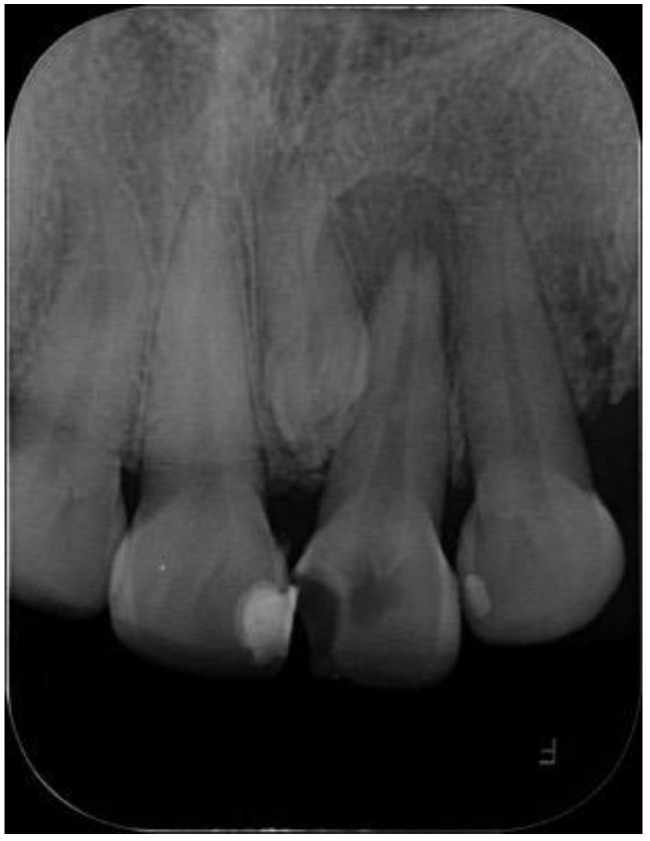
Periapical X-ray showing supernumerary tooth located between tooth 1.1 and 2.1. Mesiodens crown overprojected in mesial root profile of tooth 2.1. Periapical osteolytic radiolucent area with clear non-corticalized limits.
Figure 3
Figure 3
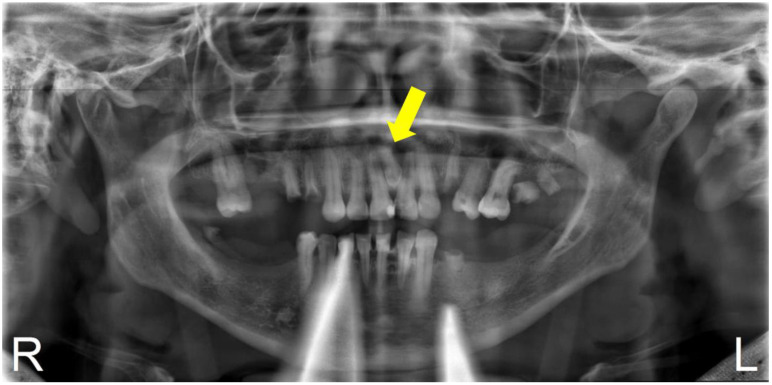
Panoramic X-ray. Bimaxillary partial edentulousness. Presence of multiple root remnants. The presence of supernumerary tooth located between teeth 1.1 and 2.1 is observed. Yellow arrows—location of mesiodens.
Figure 4
Figure 4
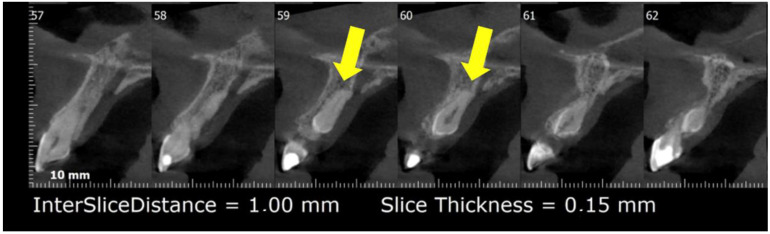
Maxillary cone-beam computed tomography (CBCT). Sagittal slice image. Located in the inter-radicular area of teeth 1.1–2.1. Mesiodens with the dilacerated apex towards the palate, impacted the cortical bone of the nasopalatine canal, with slight compromise of the cortical bone. Yellow arrows—location of mesiodens.
Figure 5
Figure 5
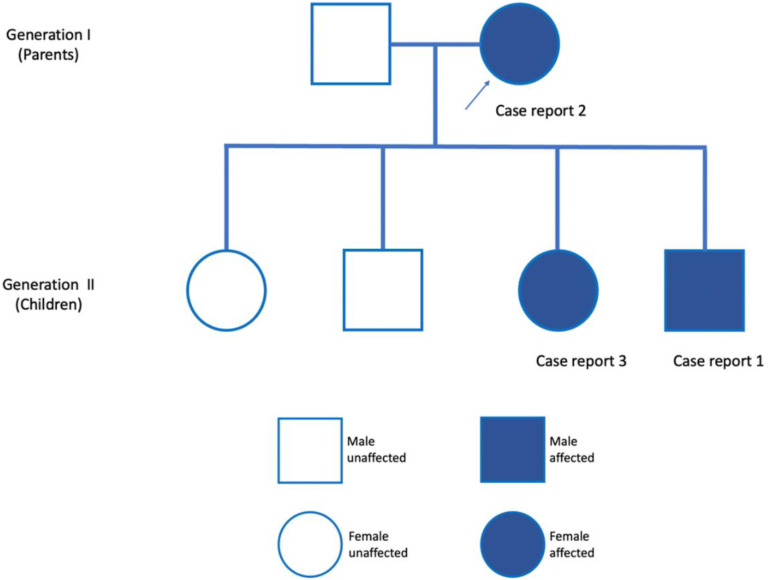
The pedigree shows autosomal dominant transmission of mesiodens in the proband (arrow) and two of her four children.

References

    1. Villavicencio J., Hernández J., Medina S. Clinical variations of double mesiodens: A review and case report. Rev. Fac. Odontol. Univ. Antioq. 2015;27:216–227. doi: 10.17533/udea.rfo.v27n1a11. - DOI
    1. Mallineni S.K. Supernumerary Teeth: Review of the Literature with Recent Updates. Conf. Pap. Sci. 2014;2014:764050. doi: 10.1155/2014/764050. - DOI
    1. Ata-Ali F., Ata-Ali J., Peñarrocha-Oltra D., Peñarrocha-Diago M. Prevalence, etiology, diagnosis, treatment and complications of supernumerary teeth. J. Clin. Exp. Dent. 2014;6:e414–e418. doi: 10.4317/jced.51499. - DOI - PMC - PubMed
    1. Wang X.X., Zhang J., Wei F.C. Autosomal dominant inherence of multiple supernumerary teeth. Int. J. Oral. Maxillofac. Surg. 2007;36:756–758. doi: 10.1016/j.ijom.2007.01.017. - DOI - PubMed
    1. Rajab L.D., Hamdan M.A.M. Supernumerary teeth: Review of the literature and a survey of 152 cases. Int. J. Paediatr. Dent. 2002;12:244–254. doi: 10.1046/j.1365-263X.2002.00366.x. - DOI - PubMed

Publication types

LinkOut - more resources