


The Role of Amaranth, Quinoa, and Millets for the Development of Healthy, Sustainable Food Products-A Concise Review
- PMID: 36010444
- PMCID: PMC9407507
- DOI: 10.3390/foods11162442
The Role of Amaranth, Quinoa, and Millets for the Development of Healthy, Sustainable Food Products-A Concise Review
Abstract
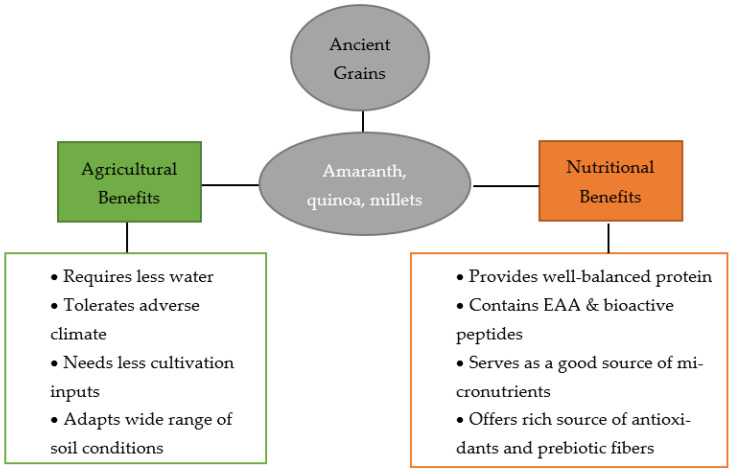
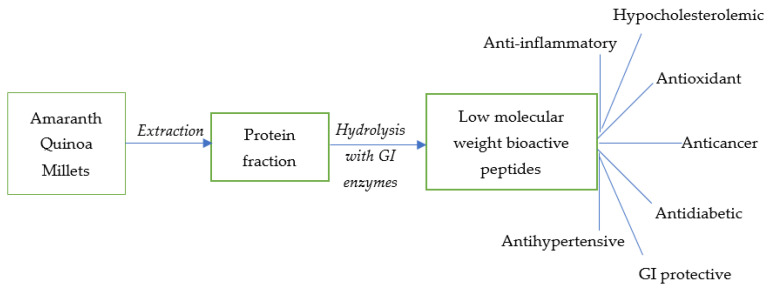
The selection of sustainable crops adaptable to the rapidly changing environment, which also cater to the dietary needs of the growing population, is a primary challenge in meeting food security. Grains from ancient crops such as amaranth, quinoa, and millets are positioned to address this challenge and hence have gained dietary predominance among cereals and pseudocereals due to their nutritional value and energy efficiency. From a nutritional perspective, they are recognized for their complete protein, phenolic compounds and flavonoids, prebiotic fibers, and essential micronutrients, including minerals and vitamins. Bioactive peptides from their proteins have shown antihypertensive, antidiabetic, antioxidant, and anticancer properties. The nutritional diversity of these grains makes them a preferred choice over traditional cereals for developing healthy, sustainable food products such as plant-based dairy, vegan meats, and gluten-free products. With growing consumer awareness about sustainability and health, the categories mentioned above are transitioning from 'emerging' to 'mainstream'; however, there is still a significant need to include such healthy grains to fulfill the nutritional gap. This review article emphasizes the health benefits of amaranth, quinoa, and millet grains and discusses the recent research progress in understanding their application in new sustainable food categories. The challenges associated with their incorporation into novel foods and future research directions are also provided.
Keywords: ancient grains; bioactive peptides; cereals; dairy-free; food security; gluten-free; health; plant-based food; protein; sustainable.
Conflict of interest statement
The authors declare no conflict of interest.
Figures
References
-
- FAO FAO in the 21st Century: Ensuring Food Security in a Changing World. 2011. [(accessed on 7 August 2022)]. Available online: http://www.fao.org/3/i2307e/i2307e.pdf.
-
- Zamaratskaia G., Gerhardt K., Wendin K. Biochemical characteristics and potential applications of ancient cereals-An underexploited opportunity for sustainable production and consumption. Trends Food Sci. Technol. 2021;107:114–123. doi: 10.1016/j.tifs.2020.12.006. - DOI
-
- Senthilkumar K., Bindraban P., Thiyagarajan T., De Ridder N., Giller K. Modified rice cultivation in Tamil Nadu, India: Yield gains and farmers’ (lack of) acceptance. Agric. Syst. 2008;98:82–94. doi: 10.1016/j.agsy.2008.04.002. - DOI
-
- Wakeel A., Farooq M., Bashir K., Ozturk L. Plant Micronutrient Use Efficiency. Academic Press; Cambridge, MA, USA: 2018. Micronutrient malnutrition and biofortification: Recent advances and future perspectives; pp. 225–243.
Publication types
LinkOut - more resources
Full Text Sources
Miscellaneous
