Review
. 2022 Aug 16;11(16):2549.
doi: 10.3390/cells11162549.

Corneal Regeneration Using Adipose-Derived Mesenchymal Stem Cells

Affiliations
Review

Corneal Regeneration Using Adipose-Derived Mesenchymal Stem Cells

Jorge L Alió Del Barrio et al. Cells. .

Abstract

Adipose-derived stem cells are a subtype of mesenchymal stem cell that offers the important advantage of being easily obtained (in an autologous manner) from low invasive procedures, rendering a high number of multipotent stem cells with the potential to differentiate into several cellular lineages, to show immunomodulatory properties, and to promote tissue regeneration by a paracrine action through the secretion of extracellular vesicles containing trophic factors. This secretome is currently being investigated as a potential source for a cell-free based regenerative therapy for human tissues, which would significantly reduce the involved costs, risks and law regulations, allowing for a broader application in real clinical practice. In the current article, we will review the existing preclinical and human clinical evidence regarding the use of such adipose-derived mesenchymal stem cells for the regeneration of the three main layers of the human cornea: the epithelium (derived from the surface ectoderm), the stroma (derived from the neural crest mesenchyme), and the endothelium (derived from the neural crest cells).

Keywords: adipose-derived stem cells; cellular therapy; cornea; corneal epithelium; corneal regeneration; corneal stroma; corneal transplant; decellularized cornea; extracellular vesicles; mesenchymal stem cells; regenerative medicine; stem cells.


Conflict of interest statement

The authors, their families, their employers and their business associates have no financial or proprietary interest in any product or company associated with any device, instrument or drug mentioned in this article. The authors have not received any payment as consultants, reviewers or evaluators for any of the devices, instruments or drugs mentioned in this article.

Figures
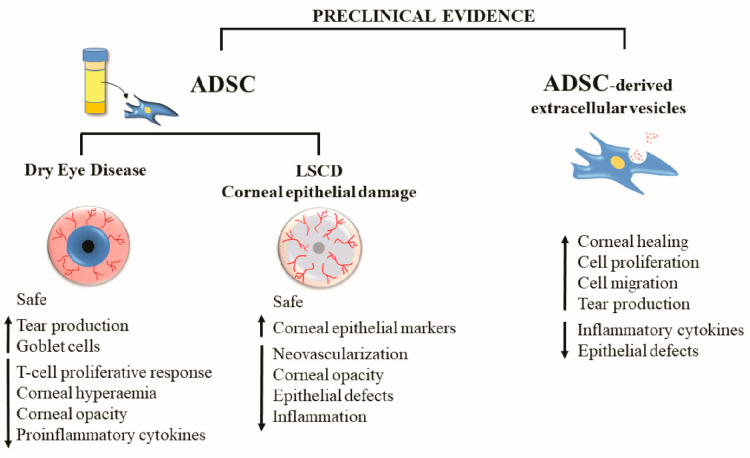
Figure 1
Figure 1
Preclinical evidence of the effects of ADSC-based therapy for the treatment of corneal epithelial damage (ADSC: adipose tissue-derived mesenchymal stem cells; LSCD: limbal stem cell deficiency).
Figure 2
Figure 2
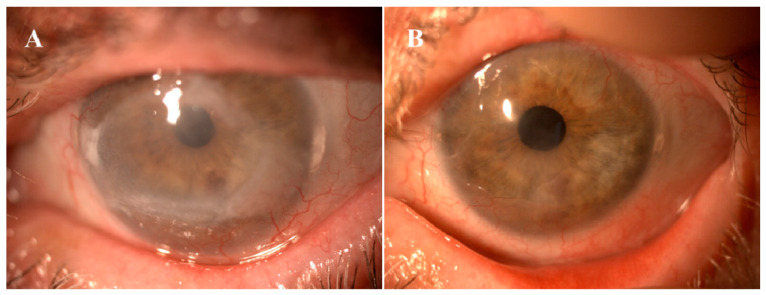
64-year-old female with chronic epithelial defect due to local chemotherapy for ocular surface neoplasia. Before (A) and 12 months after mesenchymal stem cell transplantation (B).
Figure 3
Figure 3
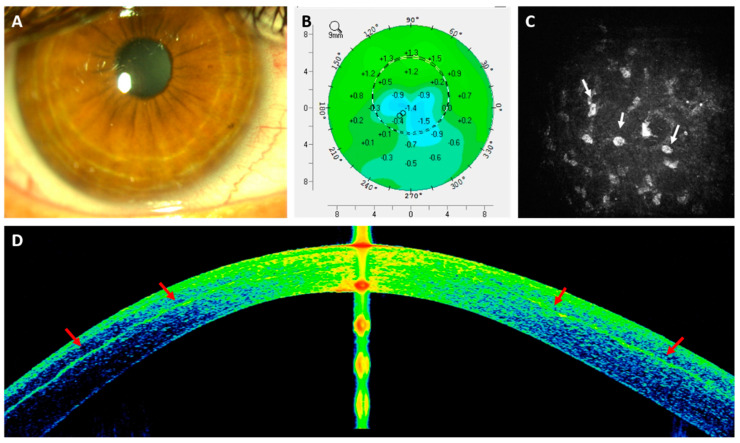
Autologous h-ADSCs corneal stroma implantation for advanced keratoconus. (A) Slit lamp picture 24 h after the procedure; (B) Topographic changes (Pentacam) between preop and 6 months after surgery. Observe the overall stability of the keratometric parameters; (C) Corneal confocal biomicroscopy pictures at the surgical plane in the first postoperative month. Stem cell survival is confirmed by the presence of cells showing a more rounded morphology (white arrows) (image corresponds to an area of 0.1 mm2); (D) AS-OCT picture 6 months postoperatively. Note the patched hyper-reflective areas (red arrows) at the level of the stromal pocket compatible with areas of new collagen production.
Figure 4
Figure 4
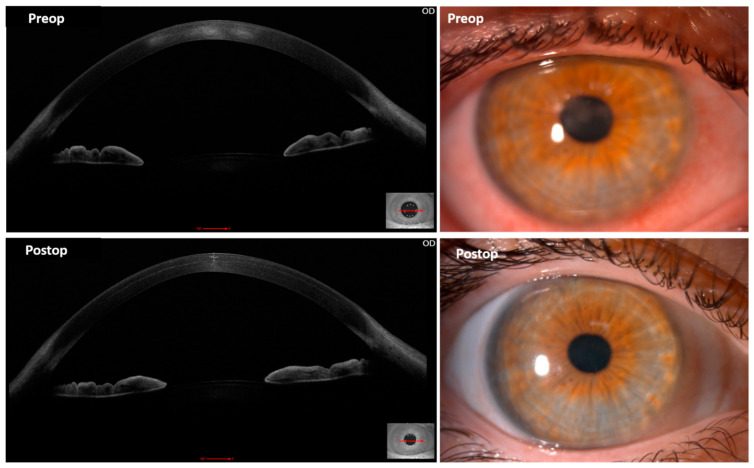
Anterior segment OCT and slit-lamp images from a keratoconus patient before (up) and 1 month after (down) autologous mid-stromal ADSC implantation. Observe the postoperative improvement in the density and severity of the central preoperative scars both clinically and in OCT. The ADSC intrastromal deposit of new collagen can be already observed 1 month after surgery in this case (down-left image).

References

    1. López-Iglesias P., Blázquez-Martínez A., Fernández-Delgado J., Regadera J., Nistal M., De Miguel M.P. Fate of human AMSCs over the short and long term after subcutaneous injection in immunodeficient mice. World J. Stem Cells. 2011;3:53–62. doi: 10.4252/wjsc.v3.i6.53. - DOI - PMC - PubMed
    1. Blázquez-Martínez A., Chiesa M., Arnalich F., Fernandez F.A., Nistal M., De Miguel M. c-Kit identifies a subpopulation of mesenchymal stem cells in adipose tissue with higher telomerase expression and differentiation potential. Differentiation. 2014;87:147–160. doi: 10.1016/j.diff.2014.02.007. - DOI - PubMed
    1. Arnalich-Montiel F., Pastor S., Blazquez-Martinez A., Fernandez-Delgado J., Nistal M., Alio J.L., De Miguel M.P. Adipose-Derived Stem Cells Are a Source for Cell Therapy of the Corneal Stroma. Stem Cells. 2007;26:570–579. doi: 10.1634/stemcells.2007-0653. - DOI - PubMed
    1. De Miguel M.P., Fuentes-Julian S., Blazquez-Martinez A., Pascual C.Y., Aller M.A., Arias J., Arnalich-Montiel F. Immunosuppressive Properties of Mesenchymal Stem Cells: Advances and Applications. Curr. Mol. Med. 2012;12:574–591. doi: 10.2174/156652412800619950. - DOI - PubMed
    1. Tögel F., Hu Z., Weiss K., Isaac J., Lange C., Westenfelder C. Administered mesenchymal stem cells protect against ischemic acute renal failure through differentiation-independent mechanisms. Am. J. Physiol. Physiol. 2005;289:F31–F42. doi: 10.1152/ajprenal.00007.2005. - DOI - PubMed

LinkOut - more resources