Review
. 2022 Aug 17;11(16):2562.
doi: 10.3390/cells11162562.

Modulating Chaperone-Mediated Autophagy and Its Clinical Applications in Cancer

Affiliations
Review

Modulating Chaperone-Mediated Autophagy and Its Clinical Applications in Cancer

Virginie Hubert et al. Cells. .

Abstract

Autophagy is a central mechanism for maintaining cellular homeostasis in health and disease as it provides the critical energy through the breakdown and recycling of cellular components and molecules within lysosomes. One of the three types of autophagy is chaperone-mediated autophagy (CMA), a degradation pathway selective for soluble cytosolic proteins that contain a targeting motif related to KFERQ in their amino acid sequence. This motif marks them as CMA substrate and is, in the initial step of CMA, recognised by the heat shock protein 70 (Hsc70). The protein complex is then targeted to the lysosomal membrane where the interaction with the splice variant A of the lysosomal-associated membrane protein-2 (LAMP-2A) results in its unfolding and translocation into the lysosome for degradation. Altered levels of CMA have been reported in a wide range of pathologies including many cancer types that upregulate CMA as part of the pro-tumorigenic phenotype, while in aging a decline is observed and associated with a decrease of LAMP-2 expression. The potential of altering CMA to modify a physiological or pathological process has been firmly established through genetic manipulation in animals and chemical interference with this pathway. However, its use for therapeutic purposes has remained limited. Compounds used to target and modify CMA have been applied successfully to gain a better understanding of its cellular mechanisms, but they are mostly not specific, also influence other autophagic pathways and are associated with high levels of toxicity. Here, we will focus on the molecular mechanisms involved in CMA regulation as well as on potential ways to intersect them, describe modulators successfully used, their mechanism of action and therapeutic potential. Furthermore, we will discuss the potential benefits and drawbacks of CMA modulation in diseases such as cancer.

Keywords: KFERQ; LAMP-2A; autophagy; cancer; chaperone; chaperone-mediated autophagy; lysosome; protein degradation.


Conflict of interest statement

The authors declare no conflict of interest.

Figures
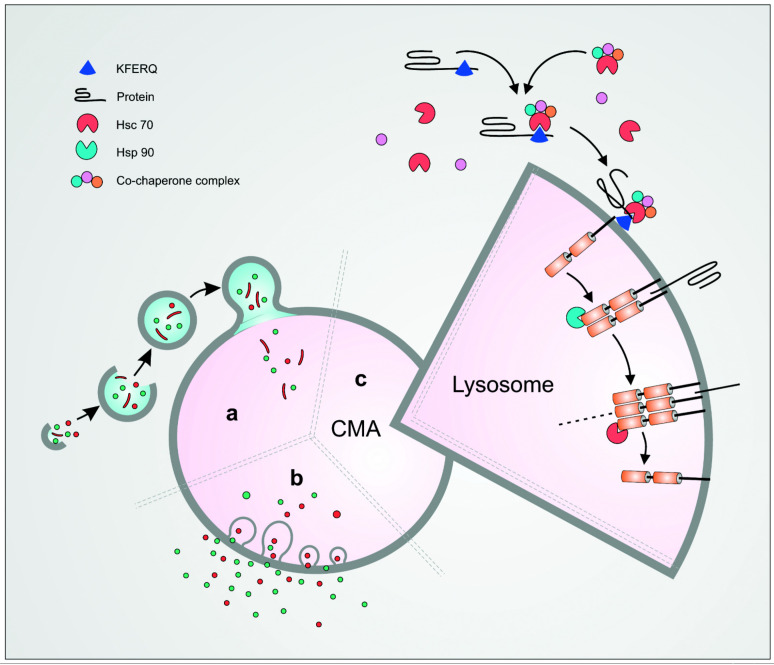
Figure 1
Figure 1
Schematic representation of the three main types of autophagy. Macroautophagy involves the sequestration of the cargo inside a double membrane vesicle—the autophagosome—followed by its fusion with the lysosomes (a). In microautophagy, an invagination of the lysosomal membrane occurs into which the substrate is engulfed (b). Chaperone-mediated autophagy (CMA) is a selective type of autophagy in which a protein bearing the KFERQ motif is recognised by the cytosolic chaperone Hsc70 and its co-chaperone complex. The complex is then targeted to LAMP-2A on the lysosomal membrane where it will unfold and translocate into the lysosome (c).
Figure 2
Figure 2
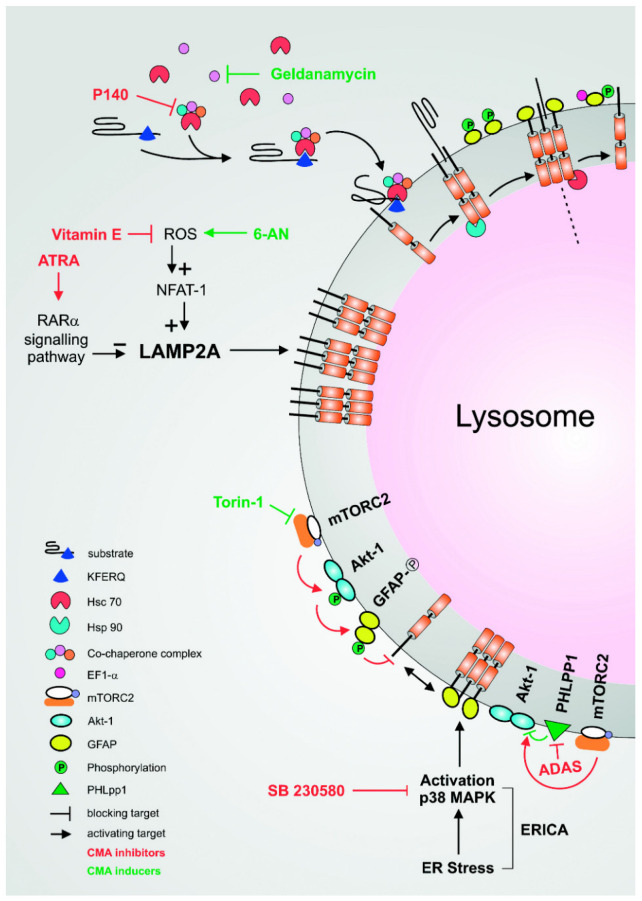
Inducers and inhibitors of CMA. Targeting the chaperone: One potential approach to modulate CMA involves the direct targeting of the chaperone such as Hsp90. Through the inhibition of the ATPase activity of Hsp90, Geldanamycin acts as an inducer of CMA. Conversely, the synthetic peptide p140 targets and hampers the chaperone function of Hsc70, acting as an inhibitor. Modulation of LAMP-2A levels: The expression of LAMP-2A is directly connected to the level of CMA. Reactive oxygen species (ROS) target the activation of transcription factor, NFAT-1 leading to its recruitment on the LAMP-2 promoter followed by an upregulation of its expression. Modulation of oxidative stress constitutes another potential approach to modulating CMA. Inducer of ROS, such as 6-AN, upregulates the level of CMA while vitamin E is a powerful antioxidant reducing or restoring its basal level. The mTORC2/PHLPP1/AKT pathway: The mTORC2/AKT1/PHLPP1 axis coordinates the dynamic assembly and disassembly of LAMP-2A into multimers. Torin-1 inhibits the function of mTORC2, therefore blocking the activation of AKT, promoting the formation of LAMP-2A multimers and, finally, inducing CMA. ADAS is a small molecule that inhibits the catalytic site of PHLPP1, thus blocking its phosphatase activity on AKT1. The phosphorylation of AKT1, which in turn phosphorylates the glial fibrillary acidic protein (GFAP), negatively regulates the dynamics of LAMP-2A assembly and inhibits CMA. The ERICA pathway: The ER-stress-induced CMA (ERICA) is a pathway connecting endoplasmic reticulum (ER) stress with CMA induction through the activation of p38 MAPK. The level of CMA is decreased in the presence of SB230580, an inhibitor of the activation of the p38 MAPK.

References

    1. Klionsky D.J. Autophagy Revisited: A Conversation with Christian de Duve. Autophagy. 2008;4:740–743. doi: 10.4161/auto.6398. - DOI - PubMed
    1. Clark S.L. Cellular Differentiation in the Kidneys of Newborn Mice Studies with the Electron Microscope. J. Biophys. Biochem. Cytol. 1957;3:349–362. doi: 10.1083/jcb.3.3.349. - DOI - PMC - PubMed
    1. Takeshige K., Baba M., Tsuboi S., Noda T., Ohsumi Y. Autophagy in Yeast Demonstrated with Proteinase-Deficient Mutants and Conditions for Its Induction. J. Cell Biol. 1992;119:301–311. doi: 10.1083/jcb.119.2.301. - DOI - PMC - PubMed
    1. Shintani T., Klionsky D.J. Autophagy in Health and Disease: A Double-Edged Sword. Science. 2004;306:990–995. doi: 10.1126/science.1099993. - DOI - PMC - PubMed
    1. Mijaljica D., Prescott M., Devenish R.J. Microautophagy in Mammalian Cells: Revisiting a 40-Year-Old Conundrum. Autophagy. 2011;7:673–682. doi: 10.4161/auto.7.7.14733. - DOI - PubMed

Publication types

MeSH terms

Substances