Review
. 2022 Aug 20;14(16):4034.
doi: 10.3390/cancers14164034.

STEAP1-4 (Six-Transmembrane Epithelial Antigen of the Prostate 1-4) and Their Clinical Implications for Prostate Cancer

Affiliations
Review

STEAP1-4 (Six-Transmembrane Epithelial Antigen of the Prostate 1-4) and Their Clinical Implications for Prostate Cancer

Michael Xu et al. Cancers (Basel). .

Abstract

Six-Transmembrane Epithelial Antigen of the Prostate 1-4 (STEAP1-4) compose a family of metalloproteinases involved in iron and copper homeostasis and other cellular processes. Thus far, five homologs are known: STEAP1, STEAP1B, STEAP2, STEAP3, and STEAP4. In prostate cancer, STEAP1, STEAP2, and STEAP4 are overexpressed, while STEAP3 expression is downregulated. Although the metalloreductase activities of STEAP1-4 are well documented, their other biological functions are not. Furthermore, the properties and expression levels of STEAP heterotrimers, homotrimers, heterodimers, and homodimers are not well understood. Nevertheless, studies over the last few decades have provided sufficient impetus to investigate STEAP1-4 as potential biomarkers and therapeutic targets for prostate cancer. In particular, STEAP1 is the target of many emerging immunotherapies. Herein, we give an overview of the structure, physiology, and pathophysiology of STEAP1-4 to provide context for past and current efforts to translate STEAP1-4 into the clinic.

Keywords: T-cell-engaging antibody; biomarker; cancer vaccine; immunotherapy; prostate cancer; six-transmembrane epithelial antigen of the prostate.


Conflict of interest statement

J.S. is an employee at Amgen Research (Munich) GmbH and owns stock in Amgen Inc. The other authors declare no conflict of interest.

Figures
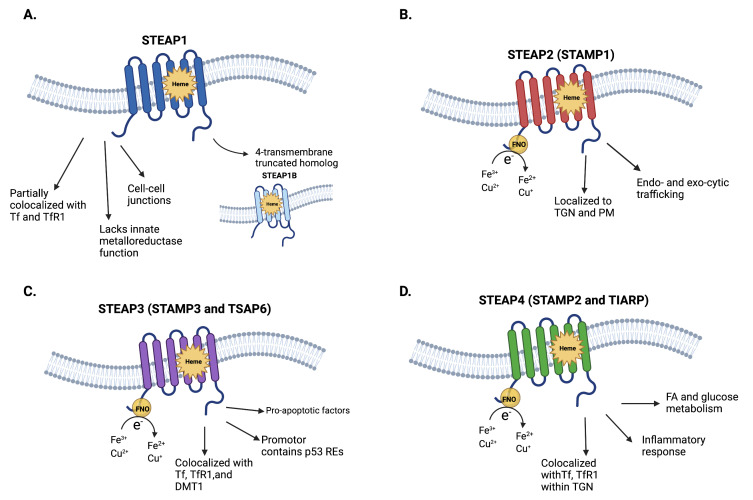
Figure 1
Figure 1
Structural and physiologic properties of STEAP1–4. (A) STEAP1 and its truncated homolog, STEAP1B (only STEAP1B1 is displayed). The C-terminal domain of STEAP1 and STEAP1B is homologous with Saccharomyces cerevisiae ferric reductase (FRE) and contains a b-type heme cofactor. (B) STEAP2, (C) STEAP3, and (D) STEAP4. Like STEAP1 and STEAP1B, STEAP2-4 have C-terminal domains that are homologous with FRE. Unlike STEAP1 and STEAP1B, STEAP2-4 also have N-terminal domains that are homologous with prokaryotic F420:NADP+ oxidoreductase (represented by a yellow circle, FNO). TGN, trans-Golgi network. PM, plasma membrane. Tf, transferrin. TfR1, transferrin receptor 1. DMT1, divalent metal transporter 1. REs, response elements. FA, fatty acid. Fe, iron. Cu, copper.
Figure 2
Figure 2
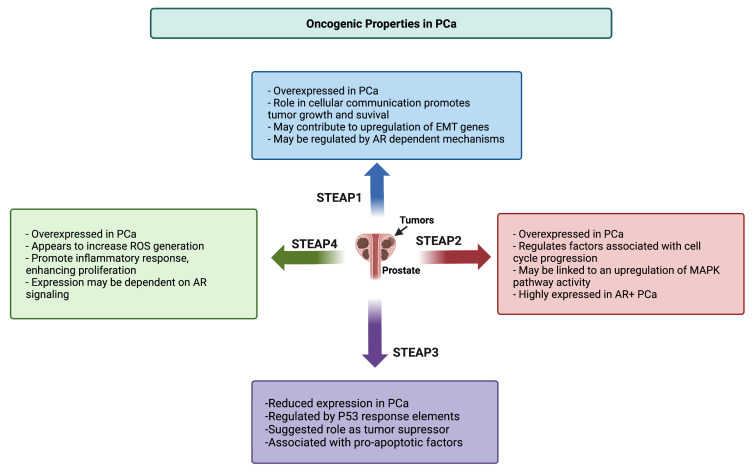
Oncogenic roles of STEAP1–4 in prostate cancer. STEAP1, STEAP2, and STEAP4 are overexpressed in PCa, while STEAP3 expression is downregulated in PCa. Each STEAP protein has its own associated oncogenic mechanisms, many of which remain ill-understood in the literature. PCa, prostate cancer. MAPK, mitogen-activated protein kinase. EMT, epithelial-to-mesenchymal transition. AR, androgen receptor.
Figure 3
Figure 3
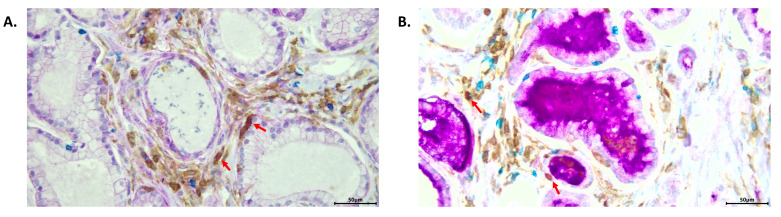
Prostate cancer tumor immune microenvironment. Multiplex immunohistochemical staining of a section of a moderate-grade PCa tumor, magnified 40×. (A,B) Stains for CD4+ T-cells (brown), CD8+ T-cells (blue), and CD4+/FoxP3+ T-regulatory cells (brown and red, nuclear) are present. Immune cells are seen infiltrating the tumor stroma, with red arrows identifying CD4+/FoxP3+ T-regulatory cells. (A) Staining for STEAP1 (purple, membranous) is present. (B) Staining for prostate-specific membrane antigen (purple, membranous and cytoplasmic) is present.

References

    1. Siegel R.L., Miller K.D., Fuchs H.E., Jemal A. Cancer statistics, 2022. CA Cancer J. Clin. 2022;72:7–33. doi: 10.3322/caac.21708. - DOI - PubMed
    1. Litwin M.S., Tan H.J. The Diagnosis and Treatment of Prostate Cancer: A Review. JAMA. 2017;317:2532–2542. doi: 10.1001/jama.2017.7248. - DOI - PubMed
    1. Quigley D.A., Dang H.X., Zhao S.G., Lloyd P., Aggarwal R., Alumkal J.J., Foye A., Kothari V., Perry M.D., Bailey A.M., et al. Genomic Hallmarks and Structural Variation in Metastatic Prostate Cancer. Cell. 2018;174:758–769.e9. doi: 10.1016/j.cell.2018.06.039. - DOI - PMC - PubMed
    1. Ohgami R.S., Campagna D.R., McDonald A., Fleming M.D. The Steap proteins are metalloreductases. Blood. 2006;108:1388–1394. doi: 10.1182/blood-2006-02-003681. - DOI - PMC - PubMed
    1. Korkmaz K.S., Elbi C., Korkmaz C.G., Loda M., Hager G.L., Saatcioglu F. Molecular cloning and characterization of STAMP1, a highly prostate-specific six transmembrane protein that is overexpressed in prostate cancer. J. Biol. Chem. 2002;277:36689–36696. doi: 10.1074/jbc.M202414200. - DOI - PubMed

LinkOut - more resources