


Estimation of Tinnitus-Related Socioeconomic Costs in Germany
- PMID: 36012089
- PMCID: PMC9407899
- DOI: 10.3390/ijerph191610455
Estimation of Tinnitus-Related Socioeconomic Costs in Germany
Abstract
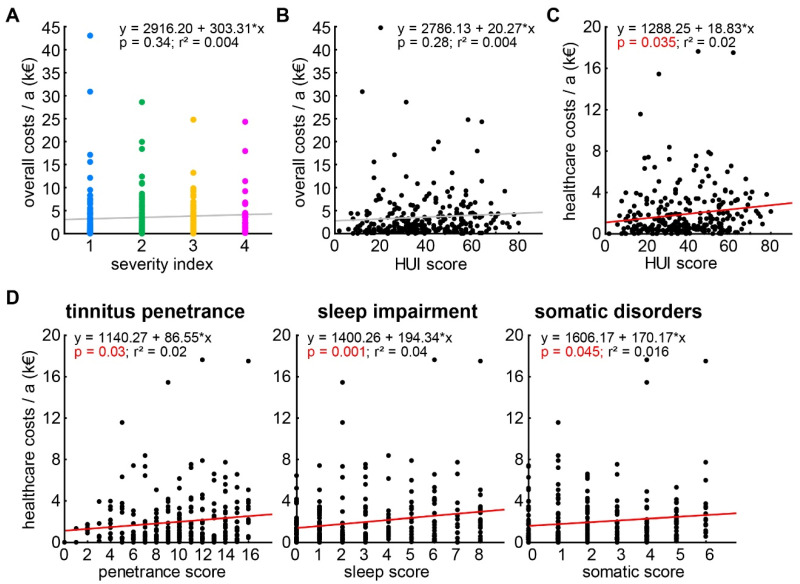
Despite the high prevalence of tinnitus in Germany of nearly 12% of the general population, there have been no systematic studies on the socioeconomic costs for German society caused by tinnitus so far. Here we analyzed data from 258 chronic tinnitus patients-namely tinnitus severity and health utility index (HUI)-and correlated them with their tinnitus-related public health care costs, private expenses, and economic loss due to their tinnitus percept as assessed by questionnaires. We found correlations of the HUI with health care costs and calculated the mean socioeconomic costs per tinnitus patient in Germany. According to our most conservative estimate, these sum up to EUR 4798.91 per year. Of that EUR 2206.95 account for the public health care, EUR 290.45 are carried by the patient privately and the remaining EUR 2301.51 account for economical loss due to sick leave. With a prevalence of 5.5% with at least bothersome tinnitus, this sums up to 21.9 billion Euro per year and with 25.82 sick leave days; tinnitus patients miss work more than double the time of the average German employee (10.9 days). The findings fit within the cost ranges of studies from other European countries and the USA and show that the socioeconomic burden of this disease-like symptom is a global problem. In comparison with the costs of other major chronic diseases in Germany-such as chronic obstructive pulmonary diseases (ca. 16 billion Euro) or diabetes mellitus (ca. 42 billion Euro)-the relevance of the 'symptom' tinnitus for the German social economy becomes even more obvious.
Keywords: health utility index; hearing loss; socioeconomic costs; tinnitus; tinnitus questionnaire.
Conflict of interest statement
The authors declare no conflict of interest.
Figures
References
-
- Biesinger E., Goebel G., Hesse G., Kießling J., Laubert A., Mazurek B., Michel O., Schaaf H., Szczepek A.J. Tinnitus. Georg Thieme Verlag; Leipzig, Germany: 2016.
-
- Henry J.A.M., Gilbert A. Audiometric correlates of tinnitus pitch: Insights from the Tinnitus Data Registry. In: Hazell J., editor. Proceedings of the Sixth International Tinnitus Seminar; Cambridge, UK. 5–9 September 1999; London, UK: The Tinnitus and Hyperacusis Centre; 1999. pp. 51–57.
MeSH terms
LinkOut - more resources
Full Text Sources
Medical
