Review
. 2022 Aug 9;23(16):8852.
doi: 10.3390/ijms23168852.

Impairment of Mitochondrial Respiration in Metabolic Diseases: An Overview

Affiliations
Review

Impairment of Mitochondrial Respiration in Metabolic Diseases: An Overview

Vlad Florian Avram et al. Int J Mol Sci. .

Abstract

Mitochondrial dysfunction has emerged as a central pathomechanism in the setting of obesity and diabetes mellitus, linking these intertwined pathologies that share insulin resistance as a common denominator. High-resolution respirometry (HRR) is a state-of-the-art research method currently used to study mitochondrial respiration and its impairment in health and disease. Tissue samples, cells or isolated mitochondria are exposed to various substrate-uncoupler-inhibitor-titration protocols, which allows the measurement and calculation of several parameters of mitochondrial respiration. In this review, we discuss the alterations of mitochondrial bioenergetics in the main dysfunctional organs that contribute to the development of the obese and diabetic phenotypes in both animal models and human subjects. Herein we review data regarding the impairment of oxidative phosphorylation as integrated mitochondrial function assessed by means of HRR. We acknowledge the critical role of this method in determining the alterations in oxidative phosphorylation occurring in the early stages of metabolic pathologies. We conclude that there is a mutual two-way relationship between mitochondrial dysfunction and insulin insensitivity that characterizes these diseases.

Keywords: diabetes mellitus; high-resolution respirometry; insulin resistance; mitochondrial respiration; obesity.


Conflict of interest statement

The authors declare no conflict of interest.

Figures
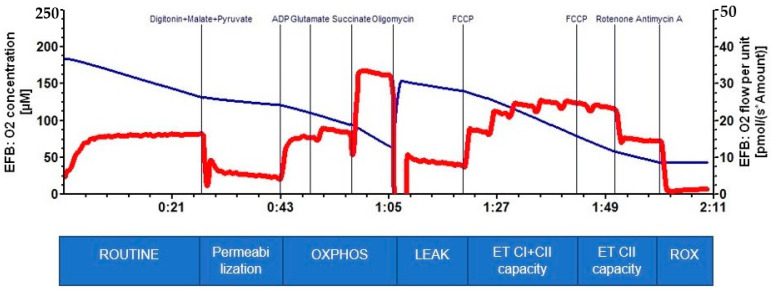
Figure 1
Figure 1
A representative trace of HRR in permeabilized cells (platelets) displaying the oxygen concentration in the chamber over time (blue trace) and the oxygen flux (red trace) according to the SUIT protocol. The additions are provided in the upper part of the chart. The respiratory parameters are provided in the lower part: ROUTINE respiration; OXPHOS capacity (the maximal active respiration in the presence of CI and CII substrates plus ADP); LEAK (the non-phosphorylating respiration in the presence of oligomycin); ET capacity (the maximal uncoupled respiration in the presence of FCCP); and ROX (residual oxygen consumption). See the explanations in the text above.

References

    1. Hroudová J., Fišar Z. Control mechanisms in mitochondrial oxidative phosphorylation. Neural Regen. Res. 2013;8:363–375. doi: 10.3969/j.issn.1673-5374.2013.04.009. - DOI - PMC - PubMed
    1. Brand M.D., Nicholls D.G. Assessing mitochondrial dysfunction in cells. Biochem. J. 2011;435:297–312. doi: 10.1042/BJ20110162. - DOI - PMC - PubMed
    1. Giménez-Palomo A., Dodd S., Anmella G., Carvalho A.F., Scaini G., Quevedo J., Pacchiarotti I., Vieta E., Berk M. The Role of Mitochondria in Mood Disorders: From Physiology to Pathophysiology and to Treatment. Front. Psychiatry. 2021;12:546801. doi: 10.3389/fpsyt.2021.546801. - DOI - PMC - PubMed
    1. Auger C., Alhasawi A., Contavadoo M., Appanna V.D. Dysfunctional mitochondrial bioenergetics and the pathogenesis of hepatic disorders. Front. Cell Dev. Biol. 2015;3:40. doi: 10.3389/fcell.2015.00040. - DOI - PMC - PubMed
    1. Rosca M.G., Vazquez E.J., Kerner J., Parland W., Chandler M.P., Stanley W., Sabbah H.N., Hoppel C.L. Cardiac mitochondria in heart failure: Decrease in respirasomes and oxidative phosphorylation. Cardiovasc. Res. 2008;80:30–39. doi: 10.1093/cvr/cvn184. - DOI - PMC - PubMed

LinkOut - more resources
