Review
. 2022 Aug 12;23(16):8994.
doi: 10.3390/ijms23168994.

DNA Methyltransferases: From Evolution to Clinical Applications

Affiliations
Review

DNA Methyltransferases: From Evolution to Clinical Applications

Victor M Del Castillo Falconi et al. Int J Mol Sci. .

Abstract

DNA methylation is an epigenetic mark that living beings have used in different environments. The MTases family catalyzes DNA methylation. This process is conserved from archaea to eukaryotes, from fertilization to every stage of development, and from the early stages of cancer to metastasis. The family of DNMTs has been classified into DNMT1, DNMT2, and DNMT3. Each DNMT has been duplicated or deleted, having consequences on DNMT structure and cellular function, resulting in a conserved evolutionary reaction of DNA methylation. DNMTs are conserved in the five kingdoms of life: bacteria, protists, fungi, plants, and animals. The importance of DNMTs in whether methylate or not has a historical adaptation that in mammals has been discovered in complex regulatory mechanisms to develop another padlock to genomic insurance stability. The regulatory mechanisms that control DNMTs expression are involved in a diversity of cell phenotypes and are associated with pathologies transcription deregulation. This work focused on DNA methyltransferases, their biology, functions, and new inhibitory mechanisms reported. We also discuss different approaches to inhibit DNMTs, the use of non-coding RNAs and nucleoside chemical compounds in recent studies, and their importance in biological, clinical, and industry research.

Keywords: 5-methylcytosine; DNA methylation; DNA methyltransferases; DNMTs isoforms; cancer biology; epigenetics.


Conflict of interest statement

The authors declare no conflict of interest.

Figures
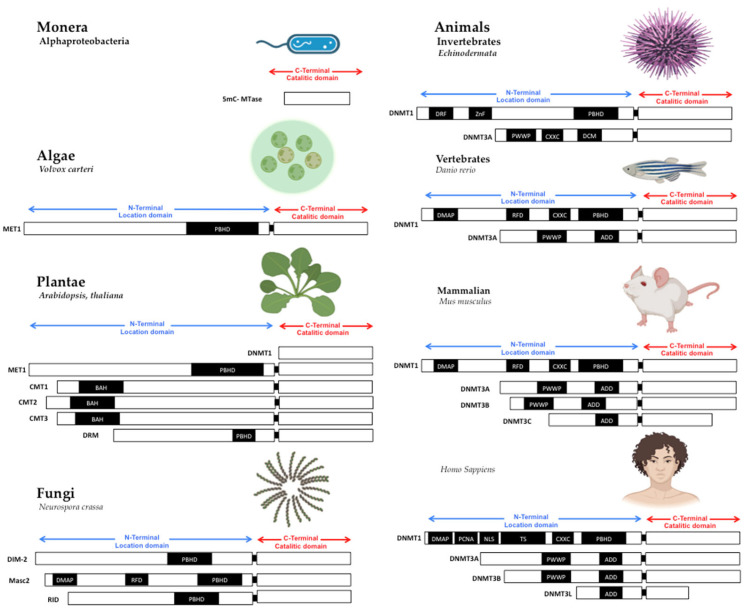
Figure 1
Figure 1
Structure of DNA methyltransferases. The DNMTs family is the DNA methylator in living beings. DNMTs have two domains: catalytic domain in the carboxy-terminal extreme, with the conserved catalytic motives, and location domain in the amino-terminal extreme, with the location and interaction chromatin motives. Monera has the catalytic domain mtase, Alphaproteobacteria. Protists and Algae are composed of MET1, CMT3, and DRM2 protein paralogs; MET1 is an example present in Volvox carteri. Fungi are composed of the protein paralogs: DIM-2, Masc1 and 2, and RID; the example is Neurospora crassa. In animals, Invertebrates, the protein paralogs are DNMT1 and DNMT3, in Echinoderma; Vertebrates, Fishes, DNMT1, and 3, zebrafish has 8 DNMT3 mammalians, the protein paralogs are: DNMT1 and DNMT3A/B/C in Mus musculus, and DNMT1, 3A/B/L in Homo sapiens. Abbreviatures: CD (chromo dominio), DMAP-1, binding domain (DMAP); motif to interact with PCNA (PCDNA); Nuclear localization Signal (NLS); Targeted Site (TS); Motif to Cys-X-X-Cys amino-acids, with zinc fingers (CXXC), Protein Binding Homeo Domain (PBHD); the motif of interaction with pro-trp-trp-pro (PWWP), and ATRX, DNMT3, DNMT3L domain (ADD). Note: Created with Biorender.com, accessed on 21 July 2022.
Figure 2
Figure 2
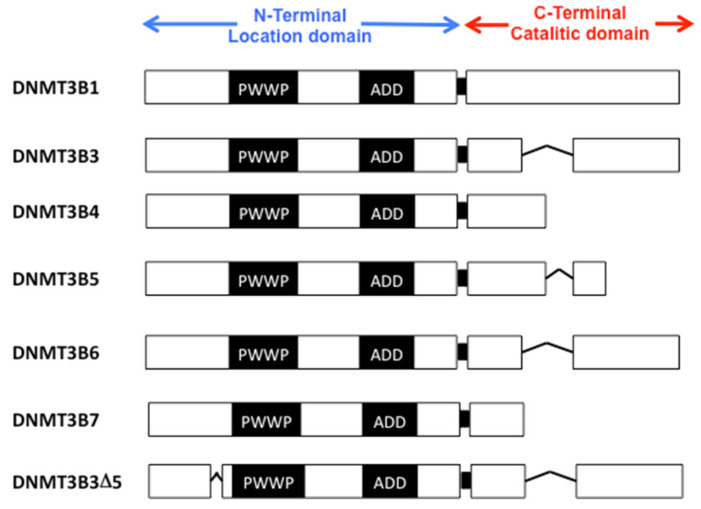
Structure of Human DNMT3B isoforms. Splice variants isoforms of DNMT3B have different characters. DNMT3B isoforms variates mammalians. Amino and carboxyl-terminal domains variates. DNMT3B isoforms’ nuclear location variates during embryonic development and in tissue specificity. Moreover, it has been found that DNMT3B isoform variates in cancer with their own origin tissue. Suggesting that DNMT3B isoforms have an important role in cancer development. Abbreviatures: motif of interaction with pro-trp-trp-pro (PWWP), and ATRX, DNMT3, DNMT3L domain (ADD).
Figure 3
Figure 3
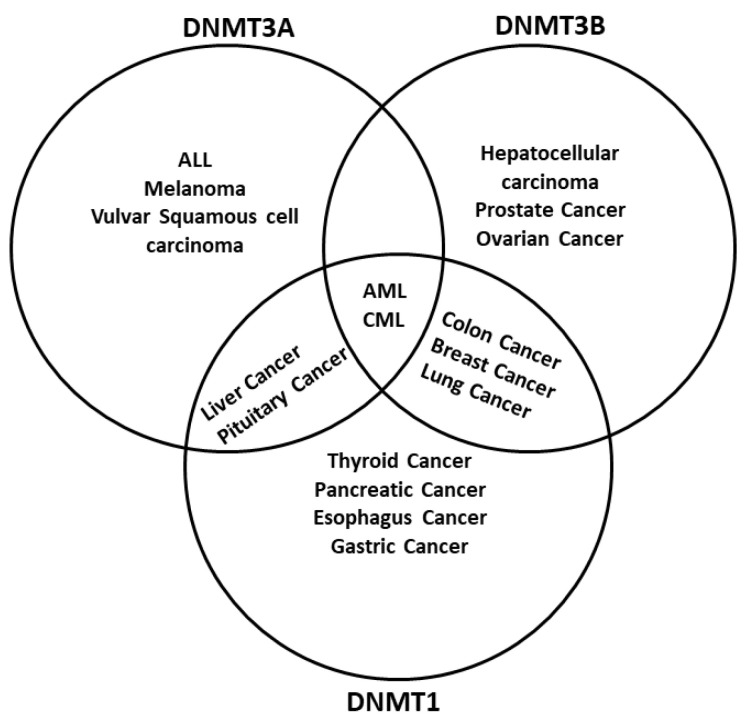
DNA methyltransferases are altered in cancer. DNMTs have a role in genomic regulation. In cancer, DNMTs are affected in expression level. In acute myeloid leukemia (AML) and chronic myeloid leukemia (CML), The three DNMTs are overexpressed. DNMT1 and DNMT3A have been described as affected in liver cancer and pituitary cancer, while DNMT1 and DNMT3B are overexpressed in breast cancer, colon cancer, and lung cancer; DNMT3B is deregulated in colon cancer and prostate cancer, and DNMT1 is deregulated in the pancreas cancer and esophagus cancer. In other cases, only one DNMT is overexpressed; however, only one DNMT could be enough to result in cancer development, progression, and metastasis. Abbreviatures: Myelodysplastic syndrome (MDS), chronic myelomonocytic leukemia (CMML), acute lymphoblastic leukemia (ALL), melanoma.

References

    1. Oliveira P.H., Fang G. Conserved DNA Methyltransferases: A Window into Fundamental Mechanisms of Epigenetic Regulation in Bacteria. Trends Microbiol. 2021;29:28–40. doi: 10.1016/j.tim.2020.04.007. - DOI - PMC - PubMed
    1. Ponger L., Li W.-H. Evolutionary Diversification of DNA Methyltransferases in Eukaryotic Genomes. Mol. Biol. Evol. 2005;22:1119–1128. doi: 10.1093/molbev/msi098. - DOI - PubMed
    1. Campos C., Valente L.M.P., Fernandes J.M.O. Molecular Evolution of Zebrafish Dnmt3 Genes and Thermal Plasticity of Their Expression during Embryonic Development. Gene. 2012;500:93–100. doi: 10.1016/j.gene.2012.03.041. - DOI - PubMed
    1. Mosquera-Rendón J., Cárdenas-Brito S., Pineda J.D., Corredor M., Benítez-Páez A. Evolutionary and Sequence-Based Relationships in Bacterial AdoMet-Dependent Non-Coding RNA Methyltransferases. BMC Res. Notes. 2014;7:440. doi: 10.1186/1756-0500-7-440. - DOI - PMC - PubMed
    1. Zhenilo S.V., Sokolov A.S., Prokhortchouk E.B. Epigenetics of Ancient DNA. Acta Nat. 2016;30:72–76. doi: 10.32607/20758251-2016-8-3-72-76. - DOI - PMC - PubMed

LinkOut - more resources