Review
. 2022 Aug 15;23(16):9135.
doi: 10.3390/ijms23169135.

Vitamin D and the Kidney: Two Players, One Console

Affiliations
Review

Vitamin D and the Kidney: Two Players, One Console

Fulvia Zappulo et al. Int J Mol Sci. .

Abstract

Vitamin D belongs to the group of liposoluble steroids mainly involved in bone metabolism by modulating calcium and phosphorus absorption or reabsorption at various levels, as well as parathyroid hormone production. Recent evidence has shown the extra-bone effects of vitamin D, including glucose homeostasis, cardiovascular protection, and anti-inflammatory and antiproliferative effects. This narrative review provides an overall view of vitamin D's role in different settings, with a special focus on chronic kidney disease and kidney transplant.

Keywords: calcium; cardiovascular disease; cholecalciferol; chronic kidney disease–mineral and bone disorder; fibroblast growth factor 23; kidney transplantation; parathyroid hormone; vitamin D; vitamin D receptor.


Conflict of interest statement

The authors declare no conflict of interest.

Figures
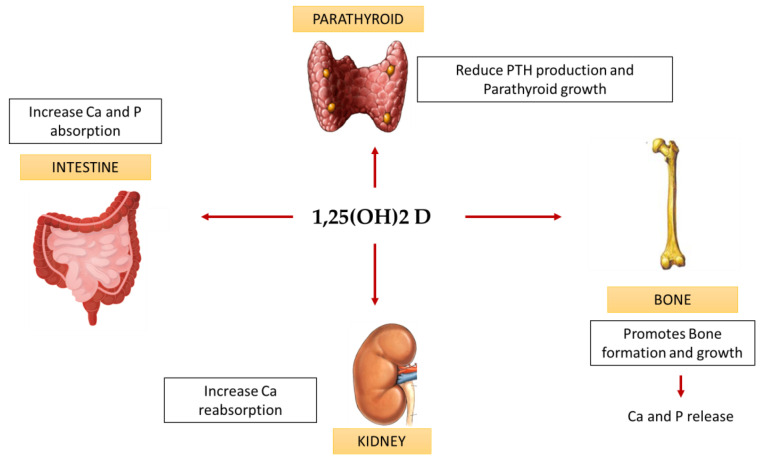
Figure 1
Figure 1
Systemic effect of vitamin D. Ca, calcium; P, phosphorus; PTH, parathyroid hormone.
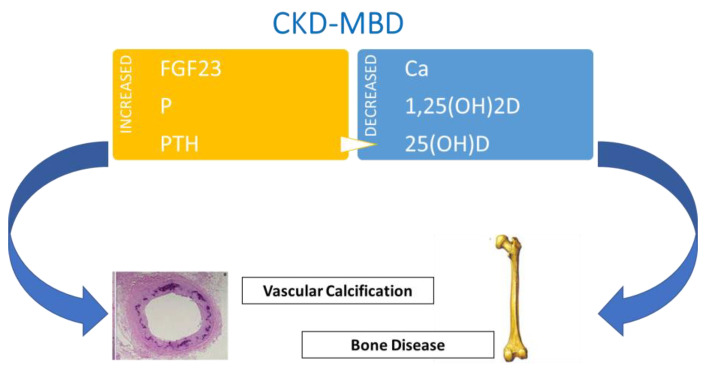
Figure 2
Figure 2
CKD-MBD pathogenesis and its main systemic effects. FGF23, fibroblast growth factor 23; P, phosphorus; PTH, parathyroid hormone; Ca, calcium.
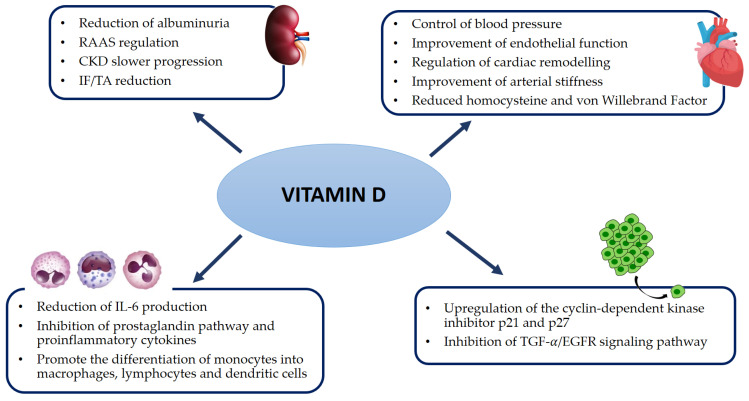
Figure 3
Figure 3
Pleiotropic effect of vitamin D. CKD, chronic kidney disease; EGFR, epidermal growth factor receptor; ESRD, end-stage renal disease; IF/TA, interstitial fibrosis/tubular atrophy; IL-6, interleukin 6; RAAS, renin-angiotensin-aldosterone system; TGF-α, transforming growth factor alpha.

References

    1. Heaney R.P. Vitamin D in Health and Disease. Clin. J. Am. Soc. Nephrol. 2008;3:1535–1541. doi: 10.2215/CJN.01160308. - DOI - PMC - PubMed
    1. Holick M.F. Vitamin D Status: Measurement, Interpretation, and Clinical Application. Ann. Epidemiol. 2009;19:73–78. doi: 10.1016/j.annepidem.2007.12.001. - DOI - PMC - PubMed
    1. Holick M.F. High Prevalence of Vitamin D Inadequacy and Implications for Health. Mayo Clin. Proc. 2006;81:353–373. doi: 10.4065/81.3.353. - DOI - PubMed
    1. Bouillon R., Carmeliet G., Verlinden L., van Etten E., Verstuyf A., Luderer H.F., Lieben L., Mathieu C., DeMay M. Vitamin D and Human Health: Lessons from Vitamin D Receptor Null Mice. Endocr. Rev. 2008;29:726–776. doi: 10.1210/er.2008-0004. - DOI - PMC - PubMed
    1. Jones G., Prosser D.E., Kaufmann M. Cytochrome P450-mediated metabolism of vitamin D. J. Lipid Res. 2014;55:13–31. doi: 10.1194/jlr.R031534. - DOI - PMC - PubMed