


Atopic Dermatitis: Striving for Reliable Biomarkers
- PMID: 36012878
- PMCID: PMC9410433
- DOI: 10.3390/jcm11164639
Atopic Dermatitis: Striving for Reliable Biomarkers
Abstract
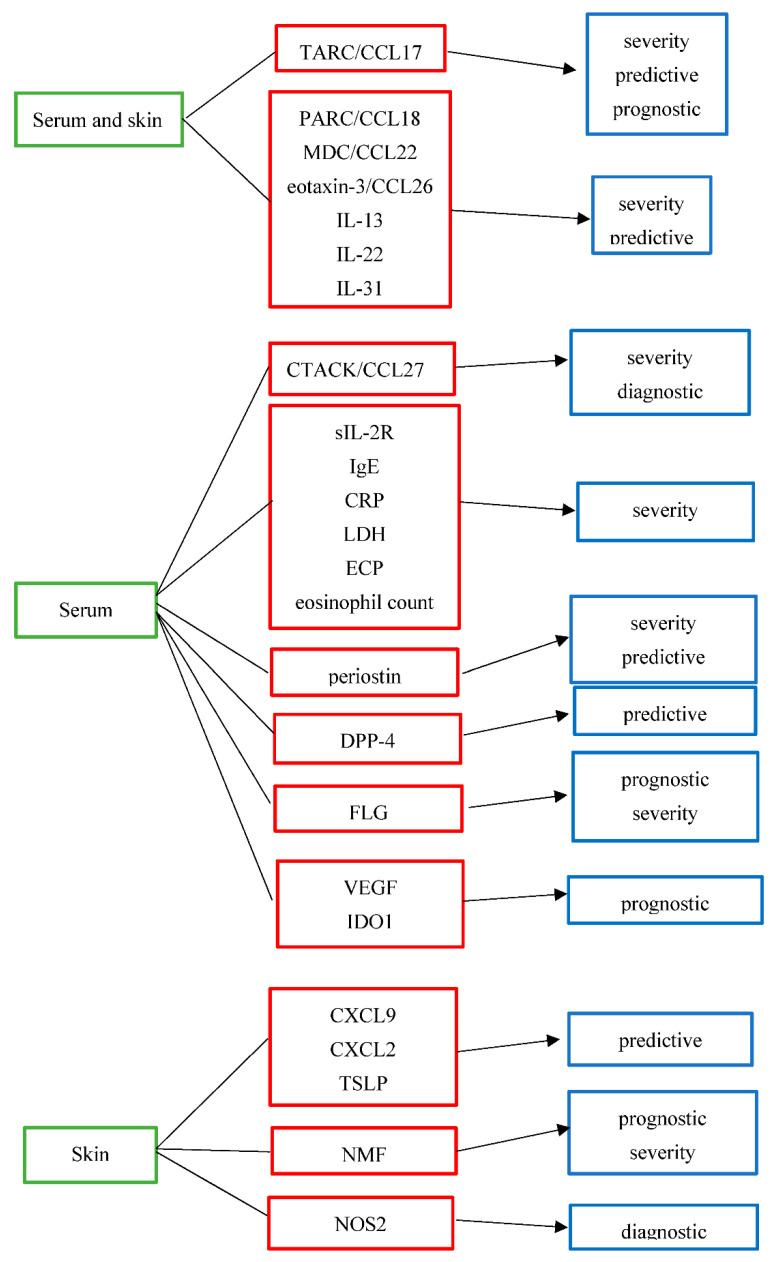
Atopic dermatitis (AD) is a highly heterogeneous inflammatory disease regarding both its pathophysiology and clinical manifestations. However, it is treated according to the "one-size-fits-all" approach, which may restrict response to treatment. Thus, there is an unmet need for the stratification of patients with AD into distinct endotypes and clinical phenotypes based on biomarkers that will contribute to the development of precision medicine in AD. The development of reliable biomarkers that may distinguish which patients with AD are most likely to benefit from specific targeted therapies is a complex procedure and to date none of the identified candidate biomarkers for AD has been validated for use in routine clinical practice. Reliable biomarkers in AD are expected to improve diagnosis, evaluate disease severity, predict the course of disease, the development of comorbidities, or the therapeutic response, resulting in effective and personalized treatment of AD. Among the studied AD potential biomarkers, thymus and activation-regulated chemokine/C-C motif ligand 17 (TARC/CCL17) has the greatest evidence-based support for becoming a reliable biomarker in AD correlated with disease severity in both children and adults. In this review, we present the most prominent candidate biomarkers in AD and their suggested use.
Keywords: CTACK/CCL27; IL-13; IL-22; MDC/CCL22; TARC/CCL17; atopic dermatitis; biomarkers; periostin; personalized treatment; precision medicine.
Conflict of interest statement
The authors declare no conflict of interest.
Figures
References
-
- Eichenfield L.F., Tom W.L., Chamlin S.L., Feldman S.R., Hanifin J.M., Simpson E.L., Berger T.G., Bergman J.N., Cohen D.E., Cooper K.D., et al. Guidelines of care for the management of atopic dermatitis: Section 1. Diagnosis and assessment of atopic dermatitis. J. Am. Acad. Dermatol. 2014;70:338–351. doi: 10.1016/j.jaad.2013.10.010. - DOI - PMC - PubMed
-
- Ziehfreund S., Tizek L., Hangel N., Fritzsche M., Weidinger S., Smith C., Bryce P., Greco D., Bogaard E., Flohr C., et al. Requirements and expectations of high-quality biomarkers for atopic dermatitis and psoriasis in 2021—A two-round Delphi survey among international experts. J. Eur. Acad. Dermatol. Venereol. 2022. Online ahead of print . - DOI - PubMed
-
- Werfel T., Allam J.-P., Biedermann T., Eyerich K., Gilles S., Guttman-Yassky E., Hoetzenecker W., Knol E., Simon H.-U., Wollenberg A., et al. Cellular and molecular immunologic mechanisms in patients with atopic dermatitis. J. Allergy Clin. Immunol. 2016;138:336–349. doi: 10.1016/j.jaci.2016.06.010. - DOI - PubMed
-
- Bakker D.S., Nierkens S., Knol E.F., Giovannone B., Delemarre E.M., van der Schaft J., van Wijk F., de Bruin-Weller M.S., Drylewicz J., Thijs J.L. Confirmation of multiple endotypes in atopic dermatitis based on serum biomarkers. J. Allergy Clin. Immunol. 2021;147:189–198. doi: 10.1016/j.jaci.2020.04.062. - DOI - PubMed
Publication types
LinkOut - more resources
Full Text Sources
Other Literature Sources
