


Peri-Implant Bone Loss and Overload: A Systematic Review Focusing on Occlusal Analysis through Digital and Analogic Methods
- PMID: 36013048
- PMCID: PMC9409652
- DOI: 10.3390/jcm11164812
Peri-Implant Bone Loss and Overload: A Systematic Review Focusing on Occlusal Analysis through Digital and Analogic Methods
Abstract
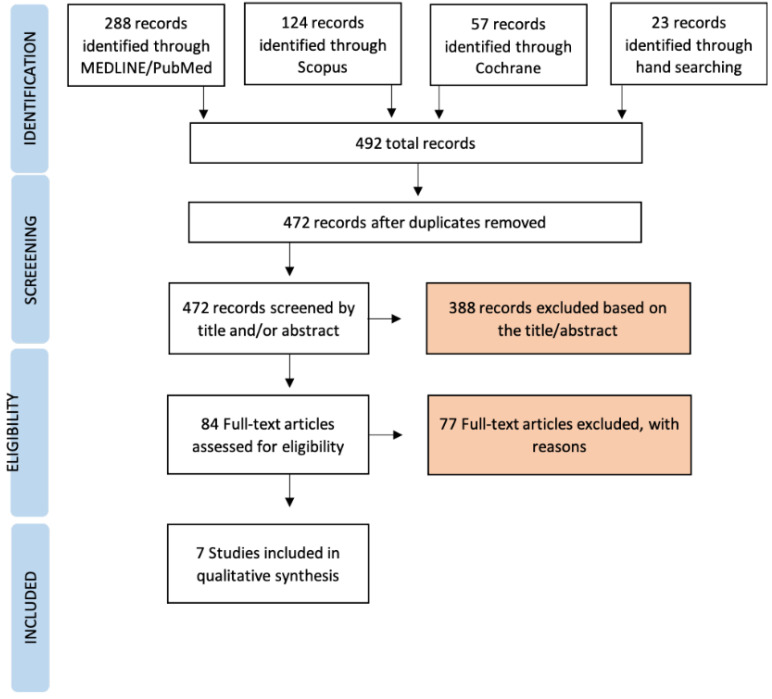
The present review aimed to assess the possible relationship between occlusal overload and peri-implant bone loss. In accordance with the PRISMA guidelines, the MEDLINE, Scopus, and Cochrane databases were searched from January 1985 up to and including December 2021. The search strategy applied was: (dental OR oral) AND implants AND (overload OR excessive load OR occlusal wear) AND (bone loss OR peri-implantitis OR failure). Clinical studies that reported quantitative analysis of occlusal loads through digital contacts and/or occlusal wear were included. The studies were screened for eligibility by two independent reviewers. The quality of the included studies was assessed using the Risk of Bias in Non-randomized Studies of Interventions (ROBINS-I) tool. In total, 492 studies were identified in the search during the initial screening. Of those, 84 were subjected to full-text evaluation, and 7 fulfilled the inclusion criteria (4 cohort studies, 2 cross-sectional, and 1 case-control). Only one study used a digital device to assess excessive occlusal forces. Four out of seven studies reported a positive correlation between the overload and the crestal bone loss. All of the included studies had moderate to serious overall risk of bias, according to the ROBINS-I tool. In conclusion, the reported data relating the occlusal analysis to the peri-implant bone level seem to reveal an association, which must be further investigated using new digital tools that can help to standardize the methodology.
Keywords: complications; dental implant; implant-supported restorations; marginal bone loss; occlusion; overloading.
Conflict of interest statement
The authors declare no conflict of interest.
Figures
Similar articles
-
Does traumatic occlusal forces lead to peri-implant bone loss? A systematic review.Braz Oral Res. 2019 Sep 30;33(suppl 1):e069. doi: 10.1590/1807-3107bor-2019.vol33.0069. eCollection 2019. Braz Oral Res. 2019. PMID: 31576953
-
Identifying occlusal overload and how to deal with it to avoid marginal bone loss around implants.Eur J Oral Implantol. 2012;5 Suppl:S91-103. Eur J Oral Implantol. 2012. PMID: 22834398 Review.
-
Impact of excessive occlusal load on successfully-osseointegrated dental implants: a literature review.J Investig Clin Dent. 2013 Aug;4(3):142-50. doi: 10.1111/jicd.12036. J Investig Clin Dent. 2013. PMID: 23918506 Review.
-
The influence of controlled occlusal overload on peri-implant tissue. Part 3: A histologic study in monkeys.Int J Oral Maxillofac Implants. 2000 May-Jun;15(3):425-31. Int J Oral Maxillofac Implants. 2000. PMID: 10874809
-
Repair of peri-implant bone loss after occlusal adjustment: a case report.J Am Dent Assoc. 2014 Oct;145(10):1058-62. doi: 10.14219/jada.2014.65. J Am Dent Assoc. 2014. PMID: 25270705
Cited by
-
Effect of the Abutment Rigidity on the Wear Resistance of a Lithium Disilicate Glass Ceramic: An In Vitro Study.J Funct Biomater. 2023 Jul 25;14(8):395. doi: 10.3390/jfb14080395. J Funct Biomater. 2023. PMID: 37623640 Free PMC article.
-
Bimaxillary fixed implant-supported zirconium oxide prosthesis therapy of an adolescent patient with non-syndromic oligodontia and two WNT10 variants: a case report.Ann Med Surg (Lond). 2024 Mar 19;86(5):3072-3081. doi: 10.1097/MS9.0000000000001936. eCollection 2024 May. Ann Med Surg (Lond). 2024. PMID: 38694351 Free PMC article.
-
Three-Dimensional Finite Element Analysis of Stress Distribution in Dental Implant Prosthesis and Surrounding Bone Using PEEK Abutments.Biomimetics (Basel). 2024 Aug 3;9(8):472. doi: 10.3390/biomimetics9080472. Biomimetics (Basel). 2024. PMID: 39194451 Free PMC article.
-
Mechanical behavior of hybrid custom implant abutments with various crown materials: a 3D finite element analysis.BMC Oral Health. 2025 Jul 5;25(1):1106. doi: 10.1186/s12903-025-06445-w. BMC Oral Health. 2025. PMID: 40618097 Free PMC article.
-
Effect of Crestal Position on Bone-Implant Stress Interface of Three-Implant Splinted Prostheses: A Finite Element Analysis.Materials (Basel). 2025 Jul 16;18(14):3344. doi: 10.3390/ma18143344. Materials (Basel). 2025. PMID: 40731554 Free PMC article.
References
-
- Perea C., Del Río J., Preciado A., Lynch C.D., Celemín A., Castillo-Oyagüe R. Validation of the ‘Quality of Life with Implant Prostheses (QoLIP-10)’ questionnaire for wearers of cement-retained implant-supported restorations. J. Dent. 2015;43:1021–1031. doi: 10.1016/j.jdent.2015.03.014. - DOI - PubMed
-
- Moraschini V., Poubel L.A.D.C., Ferreira V.F., Barboza E.D.S.P. Evaluation of survival and success rates of dental implants reported in longitudinal studies with a follow-up period of at least 10 years: A systematic review. Int. J. Oral Maxillofac. Surg. 2015;44:377–388. doi: 10.1016/j.ijom.2014.10.023. - DOI - PubMed
Publication types
LinkOut - more resources
Full Text Sources
