


A Device Strategy-Matched Comparison Analysis among Different Intermacs Profiles: A Single Center Experience
- PMID: 36013140
- PMCID: PMC9410490
- DOI: 10.3390/jcm11164901
A Device Strategy-Matched Comparison Analysis among Different Intermacs Profiles: A Single Center Experience
Abstract
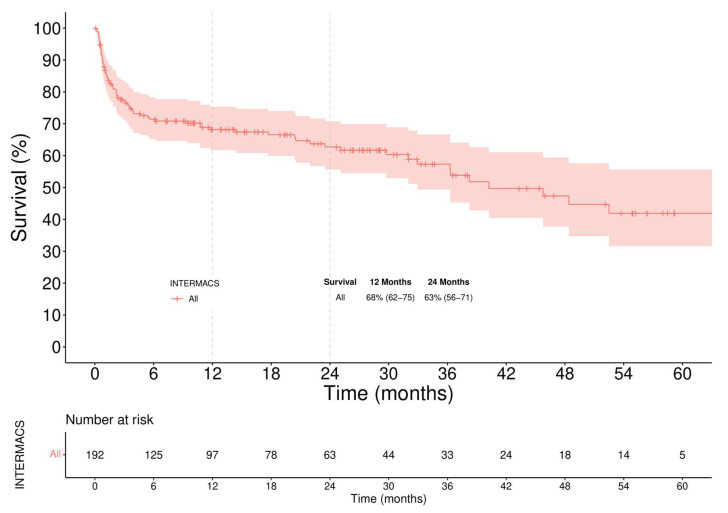
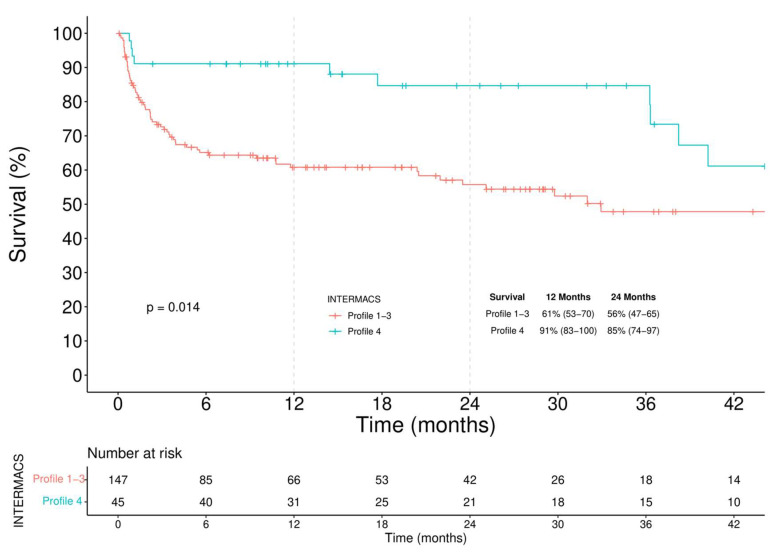
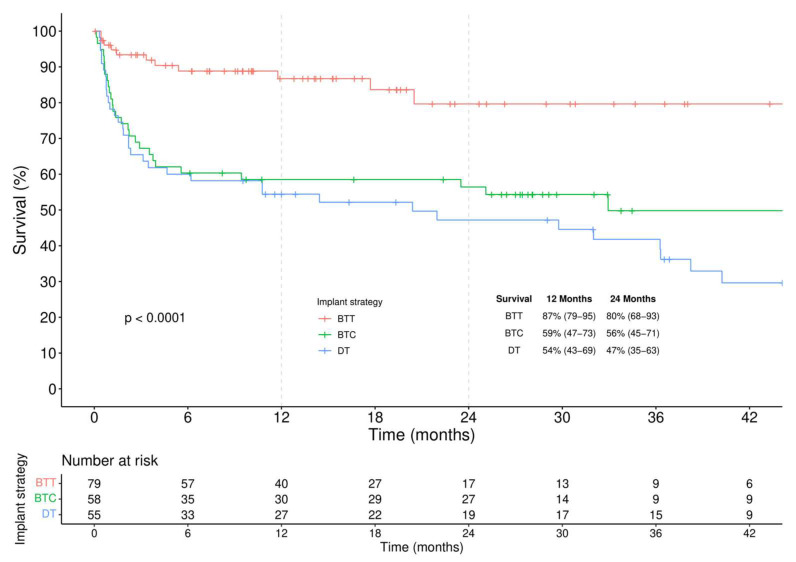
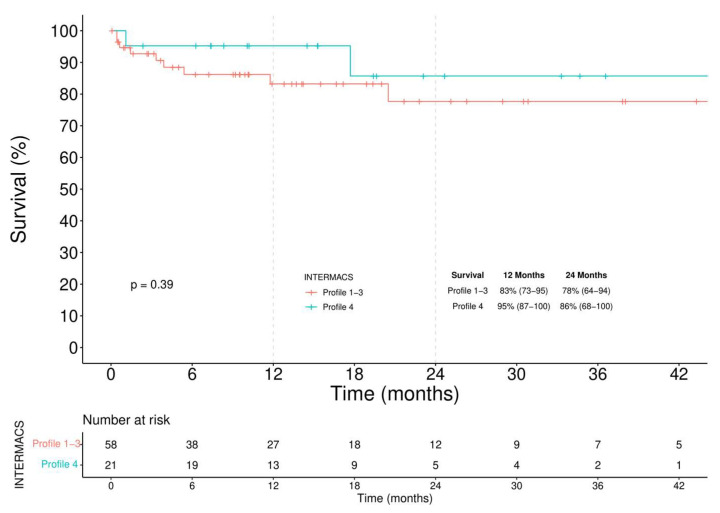
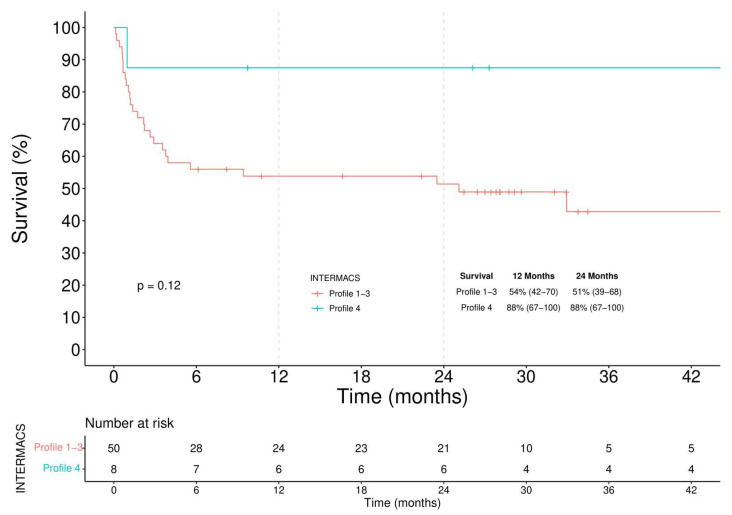
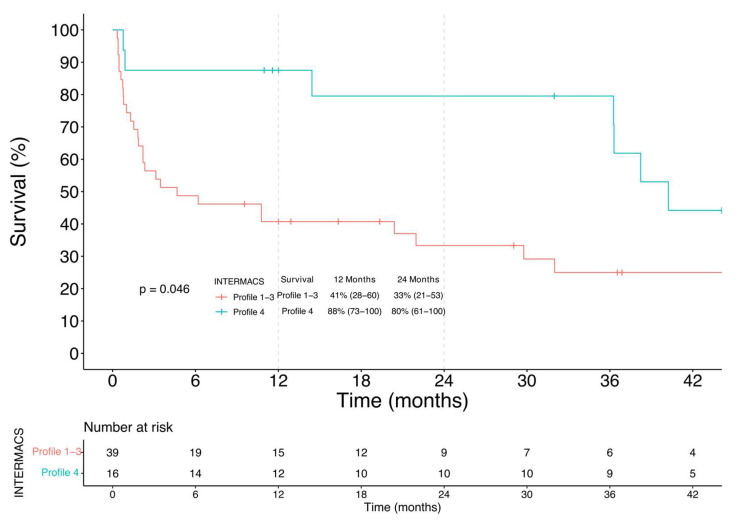
Background: The present study evaluates outcomes of LVAD patients, taking into account the device strategy and the INTERMACS profile. Methods: We included 192 LVAD-patients implanted between January 2012 and May 2021. The primary and secondary end-points were survival and major adverse events between Profiles 1-3 vs. Profile 4, depending on implantation strategies (Bridge-to-transplant-BTT; Bridge-to-candidacy-BTC; Destination-Therapy-DT). Results: The overall survival was 67% (61-75) at 12 months and 61% (54-70) at 24 months. Profile 4 patients showed significantly higher survival (p = 0.018). Incidences of acute right-ventricular-failure (RVF) (p = 0.046), right-ventricular-assist-device (RVAD) implantation (p = 0.015), and continuous-venovenous-hemofiltration (CVVH) (p = 0.006) were higher in Profile 1-3 patients, as well as a longer intensive care unit stays (p = 0.050) and in-hospital-mortality (p = 0.012). Twelve-month and 24-month survival rates were higher in the BTT rather than in BTC (log-rank = 0.410; log-rank = 0.120) and in DT groups (log-rank = 0.046). In the BTT group, Profile 1-3 patients had a higher need for RVAD support (p = 0.042). Conclusions: LVAD implantation in elective patients was associated with better survival and lower complications incidence. LVAD implantation in BTC patients has to be considered before their conditions deteriorate. DT should be addressed to elective patients in order to guarantee acceptable results.
Keywords: device strategy; heart failure; left ventricular assist device; mechanical circulatory support.
Conflict of interest statement
All authors have no conflict of interest or financial conflict to disclose.
Figures
References
-
- Ponikowski P., Voors A.A., Anker S.D., Bueno H., Cleland J.G., Coats A.J., Falk V., González-Juanatey J.R., Ve H., Jankpwska E.A., et al. 2016 ESC Guidelines for the diagnosis and treatment of acute and chronic heart failure: The Task Force for the diagnosis and treatment of acute and chronic heart failure of the European Society of Cardiology (ESC) Eur. Heart J. 2016;37:2129–2200. doi: 10.1093/eurheartj/ehw128. - DOI - PubMed
-
- Yancy C.W., Jessup M., Bozkurt B., Butler J., Casey D.E., Jr., Drazner M.H., Fonarow G.C., Geraci S.A., Horwich T., Januzzi J.L., et al. American Heart Association Task Force on Practice Guidelines. 2013 ACCF/AHA guideline for the management of heart failure: A report of the American College of Cardiology Foundation/American Heart Association Task Force on practice guidelines. Circulation. 2013;128:e240–e327. doi: 10.1161/CIR.0b013e31829e8776. - DOI - PubMed
-
- Crespo-Leiro M.G., Metra M., Lund L.H., Milicic D., Costanzo M.R., Filippatos G., Tsui S., Barge-Caballero E., De Jonge N., Frigerio M., et al. Advanced heart failure: A position statement of the Heart Failure Association of the European Society of Cardiology: Advanced heart failure: HFA position statement. Eur. J. Heart Fail. 2018;20:1505–1535. doi: 10.1002/ejhf.1236. - DOI - PubMed
-
- Rose E.A., Gelijns A.C., Moskowitz A.J., Heitjan D.F., Stevenson L.W., Dembitsky W., Long J.W., Ascheim D.D., Tierney A.R., Levitan R.G., et al. Long-Term Use of a Left Ventricular Assist Device for End-Stage Heart Failure. N. Engl. J. Med. 2001;345:1435–1443. doi: 10.1056/NEJMoa012175. - DOI - PubMed
LinkOut - more resources
Full Text Sources
