. 2022 Aug 15;10(8):1651.
doi: 10.3390/microorganisms10081651.

Babesia, Theileria, Plasmodium and Hemoglobin

Affiliations

Babesia, Theileria, Plasmodium and Hemoglobin

Daniel Sojka et al. Microorganisms. .

Abstract

The Propagation of Plasmodium spp. and Babesia/Theileria spp. vertebrate blood stages relies on the mediated acquisition of nutrients available within the host's red blood cell (RBC). The cellular processes of uptake, trafficking and metabolic processing of host RBC proteins are thus crucial for the intraerythrocytic development of these parasites. In contrast to malarial Plasmodia, the molecular mechanisms of uptake and processing of the major RBC cytoplasmic protein hemoglobin remain widely unexplored in intraerythrocytic Babesia/Theileria species. In the paper, we thus provide an updated comparison of the intraerythrocytic stage feeding mechanisms of these two distantly related groups of parasitic Apicomplexa. As the associated metabolic pathways including proteolytic degradation and networks facilitating heme homeostasis represent attractive targets for diverse antimalarials, and alterations in these pathways underpin several mechanisms of malaria drug resistance, our ambition is to highlight some fundamental differences resulting in different implications for parasite management with the potential for novel interventions against Babesia/Theileria infections.

Keywords: Babesia; Plasmodium; Theileria; babesiosis; hemoglobin; malaria; piroplasmida; piroplasmosis.


Conflict of interest statement

The authors declare no conflict of interest.

Figures
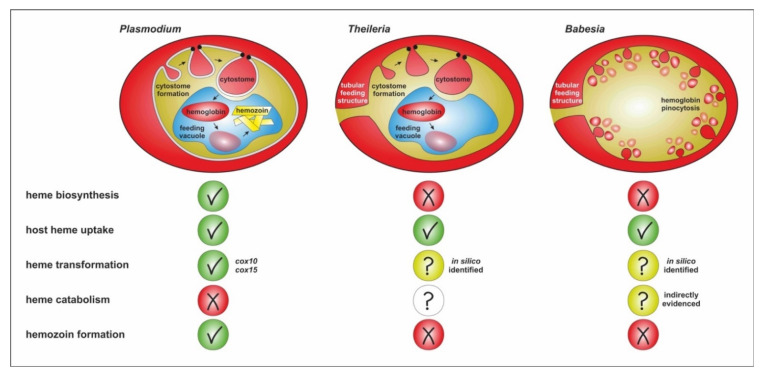
Figure 1
Figure 1
Schematic depiction of the major cellular differences of Plasmodium, Theileria and Babesia trophozoites uptaking and processing host RBC cytosol proteins, including the utilization and detoxification of resulting heme molecules. The heme transformation pathway has been functionally proven only in Plasmodium, but the direct homologues cox10 and cox15 genes (cox = cytochrome c oxidase) that encode the key enzymes of this pathway have been determined from the Babesia/Theileria genomes. Heme catabolism pathway is to date only indirectly evidenced in Babesia by the presence of a gene encoding a heme oxygenase-like homologue in the genome and the identification of higher carboxyhemoglobin fractions in dogs suffering from severe babesiosis [49].

References

    1. Florin-Christensen M., Schnittger L. Piroplasmids and ticks: A long-lasting intimate relationship. Front. Biosci. 2009;14:3064–3073. doi: 10.2741/3435. - DOI - PubMed
    1. Jalovecka M., Sojka D., Ascencio M., Schnittger L. Babesia life cycle–when phylogeny meets biology. Trends Parasitol. 2019;35:356–368. doi: 10.1016/j.pt.2019.01.007. - DOI - PubMed
    1. Sevilla E., González L.M., Luque D., Gray J., Montero E. Kinetics of the invasion and egress processes of Babesia divergens, observed by time-lapse video microscopy. Sci. Rep. 2018;35:14116. doi: 10.1038/s41598-018-32349-7. - DOI - PMC - PubMed
    1. Yabsley M.J., Shock B.C. Natural history of zoonotic Babesia: Role of wildlife reservoirs. Int. J. Parasitol. Parasites Wildl. 2013;2:18–31. doi: 10.1016/j.ijppaw.2012.11.003. - DOI - PMC - PubMed
    1. Bock R., Jackson L., de Vos A., Jorgensen W. Babesiosis of cattle. Parasitology. 2004;129((Suppl. S1)):S247–S269. doi: 10.1017/S0031182004005190. - DOI - PubMed
