


Spatio-Temporal Patterns of Ticks and Molecular Survey of Anaplasma marginale, with Notes on Their Phylogeny
- PMID: 36014081
- PMCID: PMC9413622
- DOI: 10.3390/microorganisms10081663
Spatio-Temporal Patterns of Ticks and Molecular Survey of Anaplasma marginale, with Notes on Their Phylogeny
Abstract
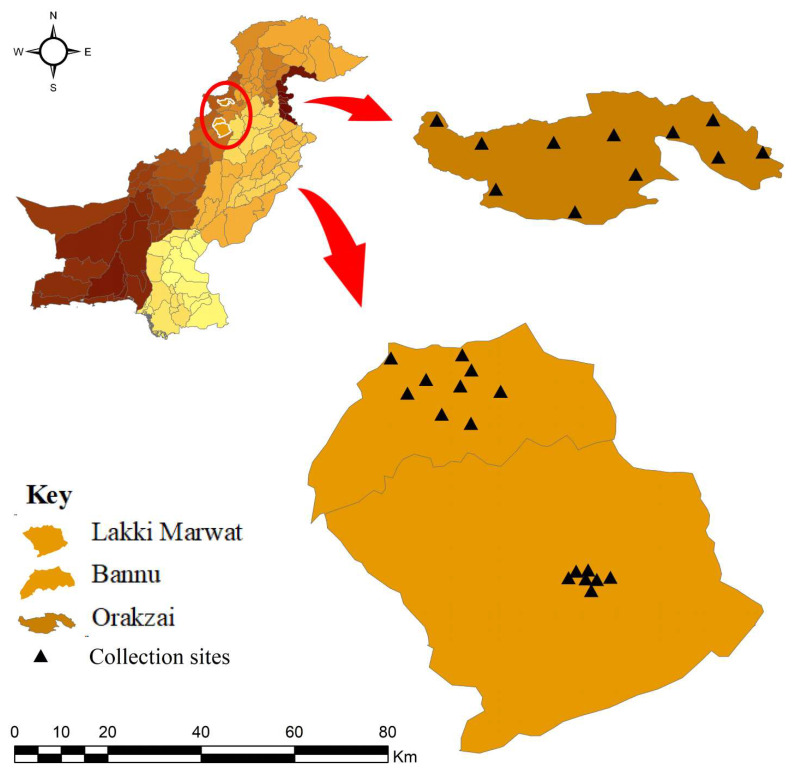
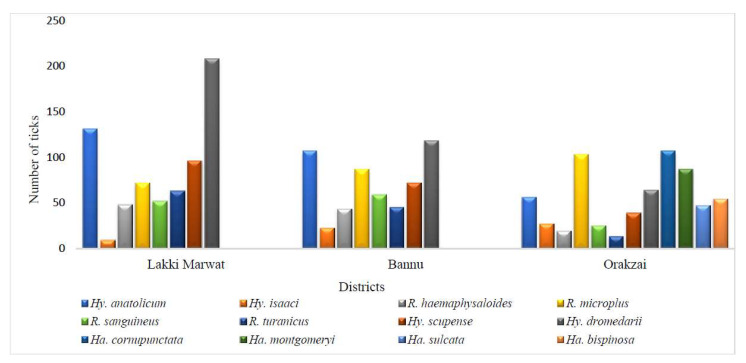
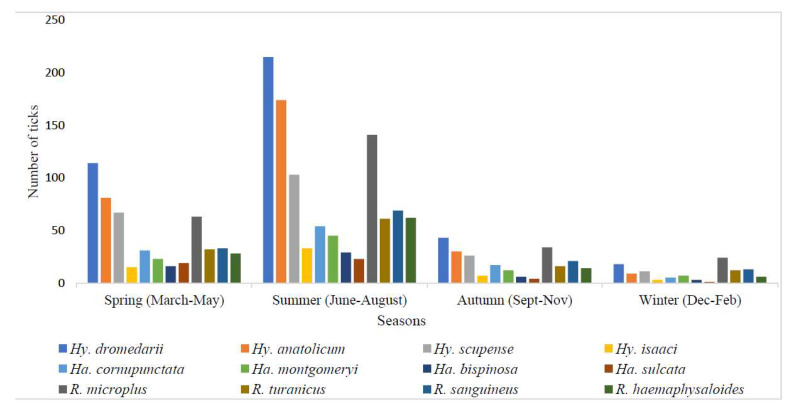
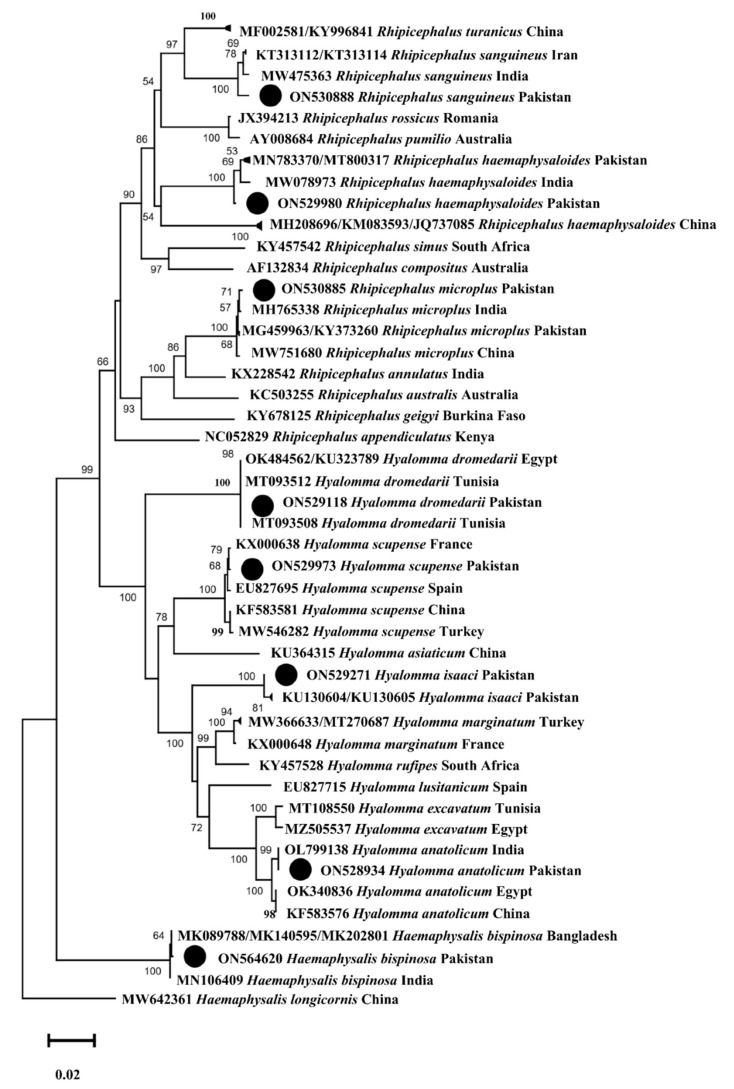
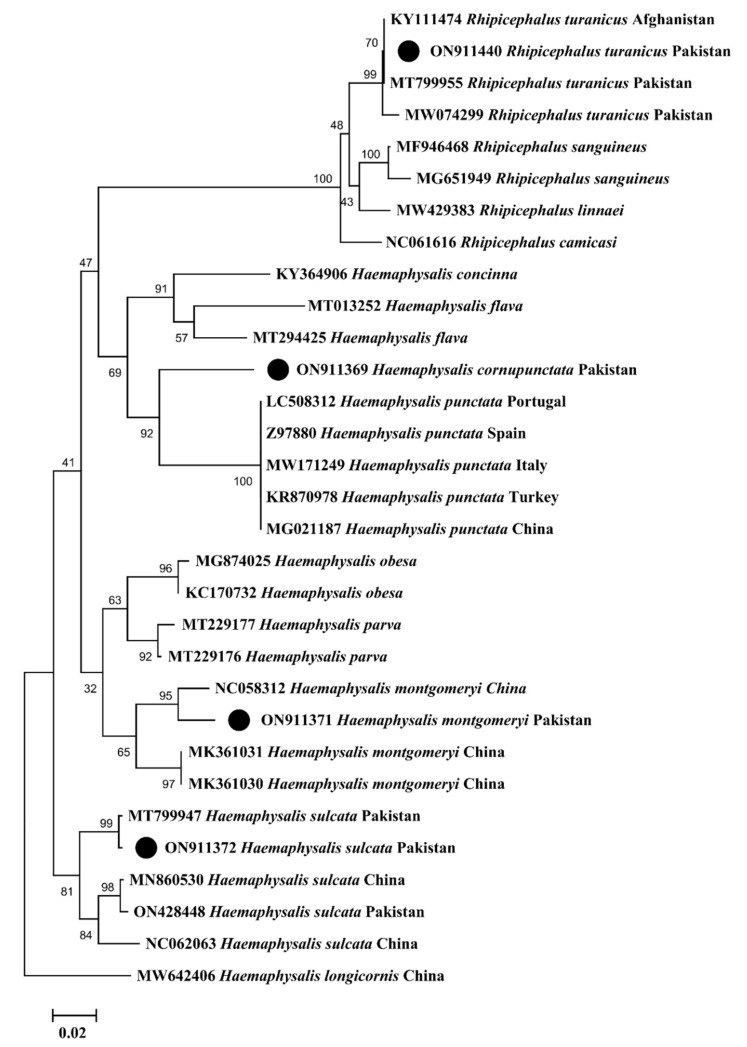
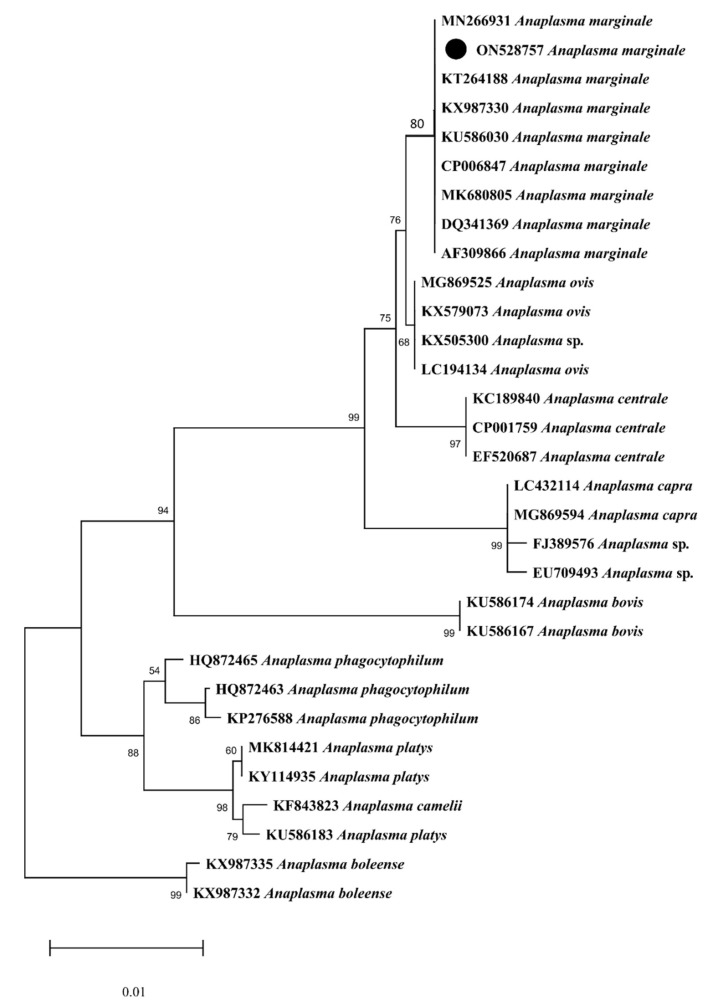
Hard ticks (Ixodida: Ixodidae) are medically important ectoparasites that feed on all classes of terrestrial vertebrates. Recently, we molecularly characterized hard ticks and associated Anaplasma spp. in the northern and central regions of Khyber Pakhtunkhwa (KP), Pakistan; however, this knowledge was missing in the southern regions. This study aimed to investigate tick prevalence, host range, genetic diversity, and molecular survey of Anaplasma spp. in a wide range of tick species in two distinct physiographic regions of southern KP. A total of 1873 hard ticks were randomly collected from 443/837 hosts (cattle, Asian water buffaloes, horses, goats, sheep, dogs, and camels) in Lakki Marwat, Bannu, and Orakzai districts of KP. Overall, 12 tick species were morphologically identified, among which Hyalomma dromedarii was the most prevalent species (390/1873, 20.9%), followed by Hy. anatolicum (294, 15.7%), Rhipicephalus microplus (262, 14%), Hy. scupense (207, 11.1%), R. sanguineus (136, 7.3%), R. turanicus (121, 6.5%), Haemaphysalis cornupunctata (107, 5.7%), R. haemaphysaloides (110, 5.9%), Ha. montgomeryi (87, 4.6%), Hy. isaaci (58, 3.1%), Ha. bispinosa (54, 2.9%), and Ha. sulcata (47, 2.5%). The extracted DNA from a subset of each tick species was subjected to PCR to amplify cox1 or 16S rRNA sequences of ticks and 16S rRNA sequences of Anaplasma spp. The tick cox1 sequences showed 99-100% identities with the sequences of the same species, whereas 16S rRNA sequences of R. turanicus, Ha. montgomeryi and Ha. sulcata showed 97-100% identities with the corresponding species. The 16S rRNA sequence of Ha. cornupunctata showed 92% identity with the species from the same subgenus, such as Ha. punctata. The 16S rRNA sequence of Anaplasma spp. showed 100% identity with Anaplasma marginale. Moreover, 54 ticks were found positive for A. marginale with a total infection rate of 17.2%. The highest infection rate was recorded in Hy. dromedarii (31.1%) and the lowest in each R. haemaphysaloides and R. sanguineus (20%). All the cox1 or 16S rRNA sequences in phylogenetic trees clustered with the same species, except Ha. cornupunctata, which clustered with the Ha. (Aboimisalis) punctata. In this study, Ha. cornupunctata was reported for the first time at the molecular level. The genetic characterization of ixodid ticks and molecular detection of associated A. marginale will assist in the epidemiological surveillance of these parasites in the region.
Keywords: Anaplasma marginale; Pakistan; hard ticks; phylogeny; surveillance.
Conflict of interest statement
The authors declare no conflict of interest.
Figures
References
-
- Sonenshine D.E., Roe R.M. Biology of Ticks. Volume 2 Oxford University Press; Oxford, UK: 2013.
-
- Ali A., Khan M.A., Zahid H., Yaseen P.M., Qayash Khan M., Nawab J., Ur Rehman Z., Ateeq M., Khan S., Ibrahim M. Seasonal dynamics, record of ticks infesting humans, wild and domestic animals, and molecular phylogeny of Rhipicephalus microplus in Khyber Pakhtunkhwa Pakistan. Front. Physiol. 2019;10:793. doi: 10.3389/fphys.2019.00793. - DOI - PMC - PubMed
-
- Eckstein D., Künzel V., Schäfer L. Global Climate Risk Index 2021. Who Suffers Most from Extreme Weather Events. Germanwatch; Bonn, Germany: 2021. pp. 2000–2019.
Grants and funding
LinkOut - more resources
Full Text Sources
Miscellaneous
