


The Association between Gut Microbiome Diversity and Composition and Heat Tolerance in Cattle
- PMID: 36014088
- PMCID: PMC9414853
- DOI: 10.3390/microorganisms10081672
The Association between Gut Microbiome Diversity and Composition and Heat Tolerance in Cattle
Abstract
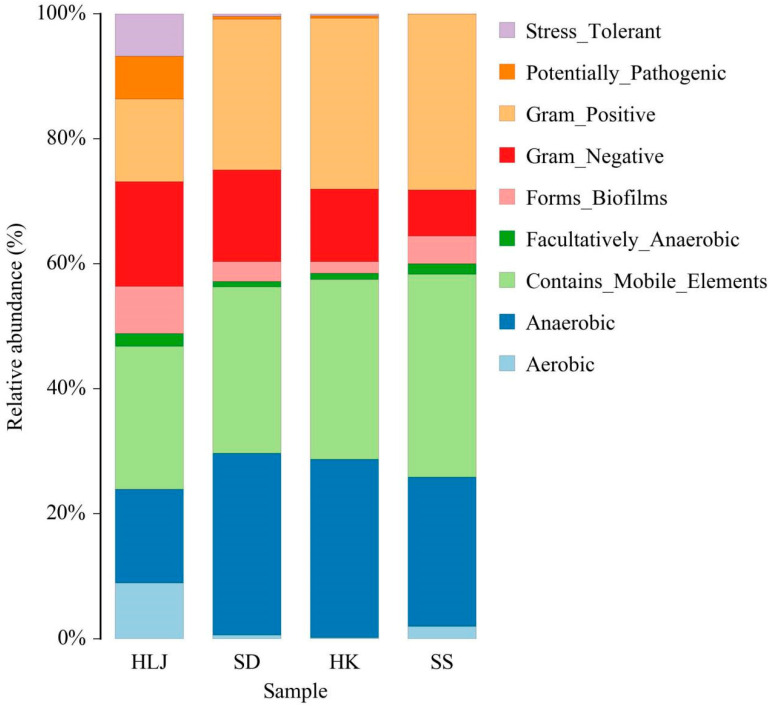
Cattle are raised around the world and are frequently exposed to heat stress, whether in tropical countries or in regions with temperate climates. It is universally acknowledged that compared to those in temperate areas, the cattle breeds developed in tropical and subtropical areas have better heat tolerance. However, the underlying mechanism of heat tolerance has not been fully studied, especially from the perspective of intestinal microbiomics. The present study collected fecal samples of cattle from four representative climatic regions of China, namely, the mesotemperate (HLJ), warm temperate (SD), subtropical (HK), and tropical (SS) regions. Then, the feces were analyzed using high-throughput 16S rRNA sequencing. The results showed that with increasing climatic temperature from HLJ to SS, the abundance of Firmicutes increased, accompanied by an increasing Firmicutes to Bacteroidota ratio. Proteobacteria showed a trend of reduction from HLJ to SS. Patescibacteria, Chloroflexi, and Actinobacteriota were particularly highest in SS for adapting to the tropical environment. The microbial phenotype in the tropics was characterized by an increase in Gram-positive bacteria and a decrease in Gram-negative bacteria, aerobic bacteria, and the forming of_biofilms. Consistently, the functional abundances of organismal systems and metabolism were decreased to reduce the material and energy demands in a hot environment. Genetic information processing and information storage and processing may be how gut flora deals with hot conditions. The present study revealed the differences in the structure and function of gut microbes of cattle from mesotemperate to tropical climates and provided an important reference for future research on the mechanism of heat tolerance regulated by the gut microbiota and a potential microbiota-based target to alleviate heat stress.
Keywords: cattle; fecal microbiome; heat tolerance; regional climates.
Conflict of interest statement
The authors declare no conflict of interest.
Figures


References
-
- De Rensis F., Marconi P., Capelli T., Gatti F., Facciolongo F., Franzini S., Scaramuzzi R.J. Fertility in postpartum dairy cows in winter or summer following estrus synchronization and fixed time AI after the induction of an LH surge with GnRH or hCG. Theriogenology. 2002;58:1675–1687. - PubMed
-
- Mishra S.R. Significance of molecular chaperones and micro RNAs in acquisition of thermo-tolerance in dairy cattle. Anim. Biotechnol. 2020;29:1–11. - PubMed
-
- Correia Sales G.F., Carvalho B.F., Schwan R.F., de Figueiredo Vilela L., Moreno Meneses J.A., Gionbelli M.P., da Silva Ávila C.L. Heat stress influence the microbiota and organic acids concentration in beef cattle rumen. J. Therm. Biol. 2021;97:102897. - PubMed
Grants and funding
- N.A/Hainan Innovation Center for Academician of Jin Ningyi
- ZY2022HN09/Special Funding Projects for Local Science and Technology Development Guided by the Central Committee
- 322QN24/Youth project of Hainan Natural Science Foundation
- KYQD(ZR)-22006/research start-up project of high-level talent introduction in Hainan University
- N.A/Hainan Innovation Center for Academician of Zhang Yong
LinkOut - more resources
Full Text Sources
Medical
