Review
. 2022 Aug 16;14(16):3351.
doi: 10.3390/nu14163351.

Vitamin D-Mediated Regulation of Intestinal Calcium Absorption

Affiliations
Review

Vitamin D-Mediated Regulation of Intestinal Calcium Absorption

James C Fleet. Nutrients. .

Abstract

Vitamin D is a critical regulator of calcium and bone homeostasis. While vitamin D has multiple effects on bone and calcium metabolism, the regulation of intestinal calcium (Ca) absorption efficiency is a critical function for vitamin D. This is necessary for optimal bone mineralization during growth, the protection of bone in adults, and the prevention of osteoporosis. Intestinal Ca absorption is regulated by 1,25 dihydroxyvitamin D (1,25(OH)2 D), a hormone that activates gene transcription following binding to the intestinal vitamin D receptor (VDR). When dietary Ca intake is low, Ca absorption follows a vitamin-D-regulated, saturable pathway, but when dietary Ca intake is high, Ca absorption is predominately through a paracellular diffusion pathway. Deletion of genes that mediate vitamin D action (i.e., VDR) or production (CYP27B1) eliminates basal Ca absorption and prevents the adaptation of mice to low-Ca diets. Various physiologic or disease states modify vitamin-D-regulated intestinal absorption of Ca (enhanced during late pregnancy, reduced due to menopause and aging).

Keywords: absorption; diet; diffusion; homeostasis; intestine; parathyroid hormone; transcellular.


Conflict of interest statement

The authors have no conflict to declare.

Figures
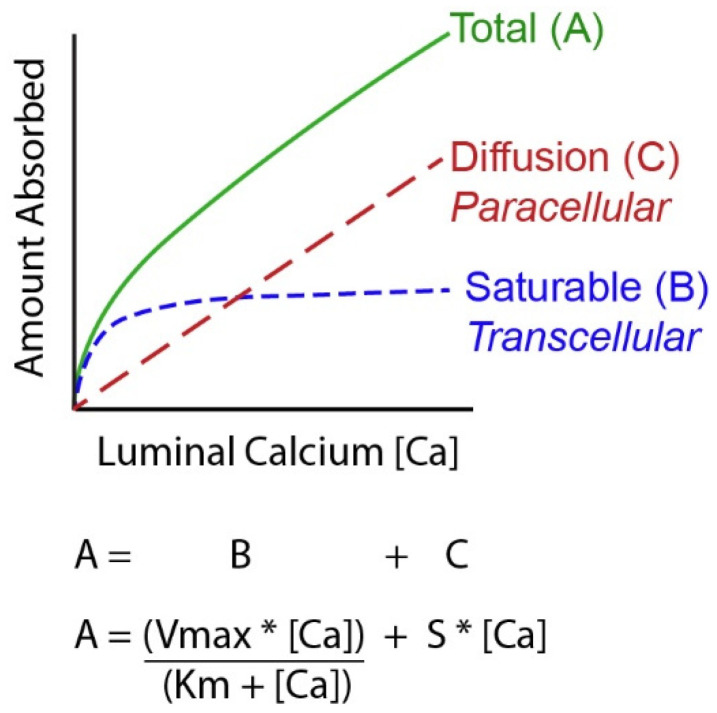
Figure 1
Figure 1
A Mathematical model of intestinal calcium (Ca) absorption. By studying Ca absorption over a range of luminal Ca levels it has been shown that the total amount of Ca absorbed across the intestinal barrier can be described as a curvilinear function. Total transport (A) is the sum of a saturable component (likely transcellular, B) that can be defined by the Michaelis–Menten equation and a diffusional process (C) that is defined by a straight line. [Ca] = luminal Ca concentration; S = the slope of the diffusional component; Vmax = the maximum transport rate seen for the saturable transport component; Km = the luminal concentration of the mineral at ½ the Vmax.
Figure 2
Figure 2
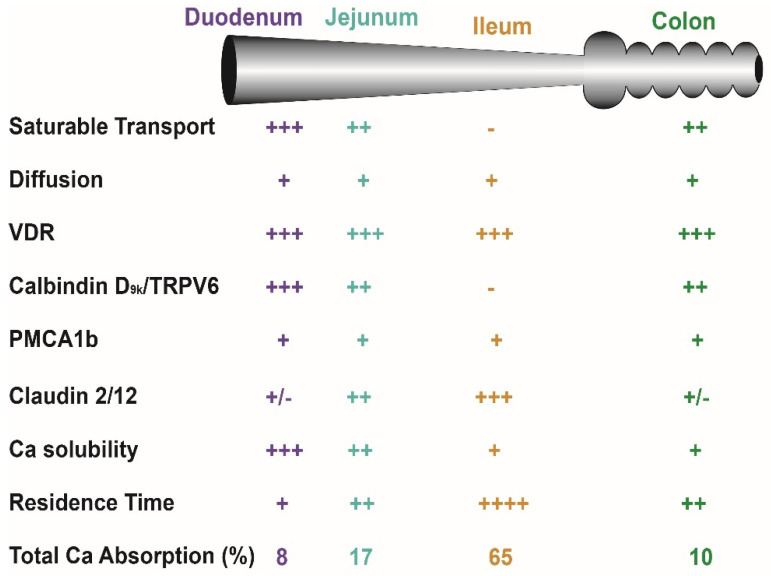
Critical factors that influence intestinal calcium (Ca) absorption. Many factors influence net Ca absorption and distinct Ca absorption mechanisms used in various intestinal segments. See Bronner and Pansu [38] for a discussion of solubility and transit time as factors affecting Ca absorption. The number of “+” signs reflects the magnitude of the parameter across tissues while a “-” sign indicates that the parameter is absent in a segment.
Figure 3
Figure 3
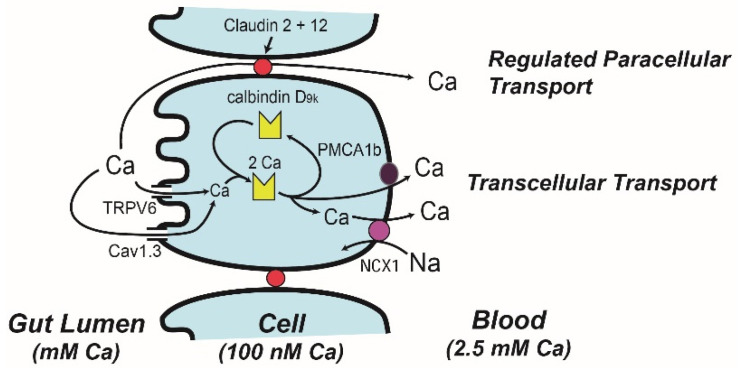
A Model describing intestinal calcium (Ca) absorption. The transcellular absorption pathway is described by the facilitated diffusion model while a regulated paracellular transport mechanisms mediated by claudin 2 and claudin 12 provides selectivity for Ca movement through the tight junction complex. For details of how vitamin D regulates various aspects of these models refer to the text.

References

    1. Nicolaysen R. Studies upon the mode of action of vitamin D. III. the influence of vitamin D on the absorption of calcium and phosphorus in the rat. Biochem. J. 1937;37:122–129. doi: 10.1042/bj0310122. - DOI - PMC - PubMed
    1. Pansu D., Bellaton C., Roche C., Bronner F. Duodenal and ileal calcium absorption in the rat and effects of vitamin D. Am. J. Physiol. 1983;244:G695–G700. doi: 10.1152/ajpgi.1983.244.6.G695. - DOI - PubMed
    1. Sheikh M.S., Ramirez A., Emmett M., Santa A.C., Schiller L.R., Fordtran J.S. Role of vitamin D-dependent and vitamin D-independent mechanisms in absorption of food calcium. J. Clin. Investig. 1988;81:126–132. doi: 10.1172/JCI113283. - DOI - PMC - PubMed
    1. Holick M.F., Schnoes H.K., DeLuca H.F., Suda T., Cousins R.J. Isolation and identification of 1,25-dihydroxycholecalciferol. A metabolite of vitamin D active in intestine. Biochemistry. 1971;10:2799–2804. - PubMed
    1. Norman A.W., Myrtle J.F., Midgett R.J., Nowicki H.G., Williams V., Popjak G. 1,25-dihydroxycholecalciferol: Identification of the proposed active form of vitamin D3 in the intestine. Science. 1971;173:51–54. doi: 10.1126/science.173.3991.51. - DOI - PubMed