. 2022 Aug 17;14(16):3378.
doi: 10.3390/nu14163378.

Artificial Diets Based on Selective Amino Acid Restriction versus Capecitabine in Mice with Metastatic Colon Cancer

Affiliations

Artificial Diets Based on Selective Amino Acid Restriction versus Capecitabine in Mice with Metastatic Colon Cancer

Julio José Jiménez-Alonso et al. Nutrients. .

Abstract

New therapies are needed to improve the low survival rates of patients with metastatic colon cancer. Evidence suggests that amino acid (AA) restriction can be used to target the altered metabolism of cancer cells. In this work, we evaluated the therapeutic potential of selective AA restriction in colon cancer. After observing anticancer activity in vitro, we prepared several artificial diets and evaluated their anticancer activity in two challenging animal models of metastatic colon cancer. These models were established by injecting CT26.WT murine colon cancer cells in the peritoneum (peritoneal dissemination) or in the tail vein (pulmonary metastases) of immunocompetent BALB/cAnNRj mice. Capecitabine, which is a first-line treatment for patients with metastatic colon cancer, was also evaluated in these models. Mice fed diet TC1 (a diet lacking 10 AAs) and diet TC5 (a diet with 6% casein, 5% glutamine, and 2.5% leucine) lived longer than untreated mice in both models; several mice survived the treatment. Diet TC5 was better than several cycles of capecitabine in both cancer models. Cysteine supplementation blocked the activity of diets TC1 and TC5, but cysteine restriction was not sufficient for activity. Our results indicated that artificial diets based on selective AA restriction have therapeutic potential for colon cancer.

Keywords: amino acids; anticancer activity; cancer metabolism; colorectal cancer; cysteine; glutamine; leucine; metastasis; selective amino acid restriction therapy.


Conflict of interest statement

J.M. Calderón-Montaño, V. Jiménez-González, and M. López-Lázaro have shares in AMINOVITA, S.L. The funders had no role in the design of the study; in the collection, analyses, or interpretation of data; in the writing of the manuscript; or in the decision to publish the results.

Figures

Figure 1
Figure 1
Anticancer activity of selective AA restriction. Representative photographs at 20× magnification are shown. The detailed composition of M0 (a) and M1 (b) are shown in Table 1.
Figure 2
Figure 2
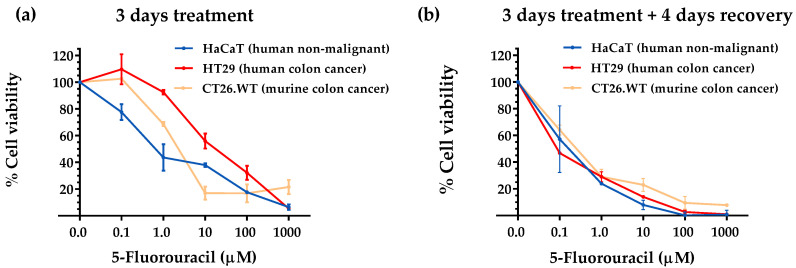
Cell viability of HaCaT, HT29, and CT26.WT cells treated with 5-FU. (a) Cell viability after 3 days of 5-FU treatment. (b) Cell viability after 3 days of 5-FU treatment followed by 4 days of recovery in DMEM. Cell viability was estimated with an MTT assay. All data are expressed as percentages relative to controls.
Figure 3
Figure 3
Anticancer activity of diets TC1, TC2, TC3, TC4, and capecitabine in mice with colon cancer (CT26.WT murine colon cancer cells inoculated in the peritoneum of immunocompetent BALB/c mice; peritoneal dissemination model). (a) Survival of the untreated mice (control), the mice treated with diet TC1 (normal diet was replaced by the TC1 diet for 6 weeks), and the mice treated with oral capecitabine (450 mg/kg/day, 7/7 schedule, 3 cycles). (b) Mice body weights (mean percentage ± SEM) relative to the body weights at the beginning of the treatments (day 4). (c) Comparison of survival of the mice fed with diets TC1, TC2, TC3, and TC4 over 6 weeks. The p-values were calculated with the GBW test; * indicates p < 0.05, and ** indicates p < 0.01. n.s. means no significance.
Figure 4
Figure 4
Anticancer activity of diet TC1 and capecitabine in mice with colon cancer (lung metastasis model; CT26.WT murine colon cancer cells inoculated in the tail vein of immunocompetent BALB/c mice). (a) Survival of the mice with colon cancer left untreated (control), treated with diet TC1 (6 weeks), or treated with capecitabine (450 mg/kg/day, 7/7 schedule, 3 cycles). (b) Body weights (mean percentage ± SEM) relative to the body weights at the beginning of treatments (day 4). The p-values were calculated with the GBW test. n.s. means no significance.
Figure 5
Figure 5
Anticancer effect of diet TC5 and capecitabine in mice with colon cancer (peritoneal dissemination model; CT26.WT murine colon cancer cells inoculated in the peritoneum of immunocompetent BALB/c mice). (a) Survival of the mice left untreated (control), treated with diet TC5 (normal diet was replaced by diet TC5 for 6 weeks), with diet TC6, or with oral capecitabine (450 mg/kg/day, 7/7 schedule, 3 cycles). (b) Body weights (mean percentage ± SEM) relative to the body weights at the start of the treatments (day 4). The p-values were calculated with the GBW test; * indicates p < 0.05, and ** indicates p < 0.01. n.s. means no significance.
Figure 6
Figure 6
Anticancer activity of diets TC5, TC6, TC7, TC8, and capecitabine in mice with colon cancer (lung metastasis model; CT26.WT murine colon cancer cells inoculated in the tail vein of immunocompetent BALB/c mice). (a) Survival of the mice with colon cancer left untreated (control), treated with diet TC5 (6 weeks), or treated with capecitabine (450 mg/kg/day, 7/7 schedule, 3 cycles). (b) Body weights (mean percentage ± SEM) relative to the body weights of the mice at the beginning of treatment (day 4). (c) Comparison of survival of the mice fed for 6 weeks with diets TC5, TC6, TC7, and TC8. The p-values were calculated with the GBW test; ** indicates p < 0.01. n.s. means no significance.

References

    1. Ferlay J., Colombet M., Soerjomataram I., Parkin D.M., Piñeros M., Znaor A., Bray F. Cancer Statistics for the Year 2020: An Overview. Int. J. Cancer. 2021;149:778–789. doi: 10.1002/ijc.33588. - DOI - PubMed
    1. National Cancer Institute Cancer Stat Facts: Colorectal Cancer. [(accessed on 15 March 2022)]; Available online: https://seer.cancer.gov/statfacts/html/colorect.html.
    1. National Cancer Institute Colon and Rectum Stage Distribution of SEER Incidence Cases, 2010–2019. [(accessed on 15 March 2022)]; Available online: https://seer.cancer.gov/explorer/application.html?site=20&data_type=1&gr....
    1. Riihimäki M., Hemminki A., Sundquist J., Hemminki K. Patterns of Metastasis in Colon and Rectal Cancer. Sci. Rep. 2016;6:29765. doi: 10.1038/srep29765. - DOI - PMC - PubMed
    1. American Society Of Clinical Oncology Colorectal Cancer: Types of Treatment|Cancer.Net. [(accessed on 16 March 2022)]. Available online: https://www.cancer.net/cancer-types/colorectal-cancer/types-treatment.

LinkOut - more resources