


The Mutual Relationship among Cardiovascular Diseases and COVID-19: Focus on Micronutrients Imbalance
- PMID: 36014944
- PMCID: PMC9416353
- DOI: 10.3390/nu14163439
The Mutual Relationship among Cardiovascular Diseases and COVID-19: Focus on Micronutrients Imbalance
Abstract
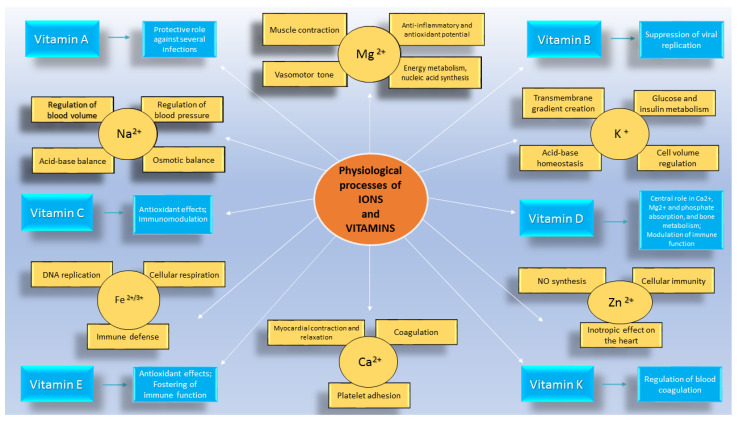
Micronutrients are ions and vitamins humbly required by the human body. They play a main role in several physiological mechanisms and their imbalance is strongly associated with potentially-fatal complications. Micronutrient imbalance is associated with many cardiovascular diseases, such as arrythmias, heart failure, and ischemic heart disease. It has been also observed in coronavirus disease 2019 (COVID-19), particularly in most severe patients. The relationship between cardiovascular diseases and COVID-19 is mutual: the latter triggers cardiovascular disease onset and worsening while patients with previous cardiovascular disease may develop a more severe form of COVID-19. In addition to the well-known pathophysiological mechanisms binding COVID-19 and cardiovascular diseases together, increasing importance is being given to the impact of micronutrient alterations, often present during COVID-19 and able to affect the balance responsible for a good functioning of the cardiovascular system. In particular, hypokalemia, hypomagnesemia, hyponatremia, and hypocalcemia are strongly associated with worse outcome, while vitamin A and D deficiency are associated with thromboembolic events in COVID-19. Thus, considering how frequent the cardiovascular involvement is in patients with COVID-19, and how it majorly affects their prognosis, this manuscript provides a comprehensive review on the role of micronutrient imbalance in the interconnection between COVID-19 and cardiovascular diseases.
Keywords: COVID-19; cardiovascular diseases; ions; micronutrients; nutrition; vitamins.
Conflict of interest statement
The authors declare no conflict of interest.
Figures
References
-
- Vest A.R., Chan M., Deswal A., Givertz M.M., Lekavich C., Lennie T., Litwin S.E., Parsly L., Rodgers J.E., Rich M.W., et al. Nutrition, Obesity, and Cachexia in Patients With Heart Failure: A Consensus Statement from the Heart Failure Society of America Scientific Statements Committee. J. Card. Fail. 2019;25:380–400. doi: 10.1016/j.cardfail.2019.03.007. - DOI - PubMed
-
- Bozkurt B., Aguilar D., Deswal A., Dunbar S.B., Francis G.S., Horwich T., American Heart Association Heart Failure and Transplantation Committee of the Council on Clinical Cardiology. Council on Cardiovascular Surgery and Anesthesia. Council on Cardiovascular and Stroke Nursing. Council on Hypertension et al. Contributory risk and management of comorbidities of hypertension, obesity, diabetes mellitus, hyperlipidemia, and metabolic syndrome in chronic heart failure: A scientific statement from the American Heart Association. Circulation. 2016;134:e535–e578. doi: 10.1161/CIR.0000000000000450. - DOI - PubMed
-
- Maestrini V., Birtolo L.I., Francone M., Galardo G., Galea N., Severino P., Alessandri F., Colaiacomo M.C., Cundari G., Chimenti C., et al. Cardiac involvement in consecutive unselected hospitalized COVID-19 population: In-hospital evaluation and one-year follow-up. Int. J. Cardiol. 2021;339:235–242. doi: 10.1016/j.ijcard.2021.06.056. - DOI - PMC - PubMed
Publication types
MeSH terms
Substances
LinkOut - more resources
Full Text Sources
Medical
