


Association of Different Malnutrition Parameters and Clinical Outcomes among COVID-19 Patients: An Observational Study
- PMID: 36014955
- PMCID: PMC9413005
- DOI: 10.3390/nu14163449
Association of Different Malnutrition Parameters and Clinical Outcomes among COVID-19 Patients: An Observational Study
Abstract
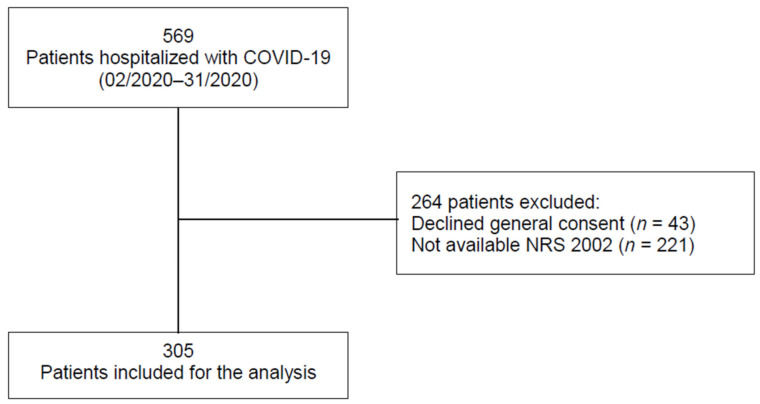
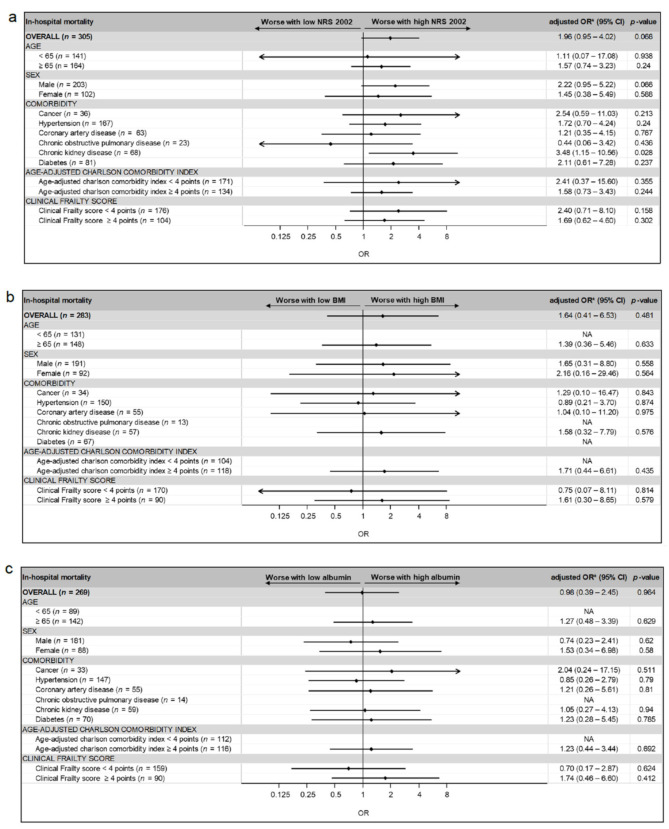
Background: Malnutrition is highly prevalent in medical inpatients and may also negatively influence clinical outcomes of patients hospitalized with COVID-19. We analyzed the prognostic implication of different malnutrition parameters with respect to adverse clinical outcomes in patients hospitalized with COVID-19. Methods: In this observational study, consecutively hospitalized adult patients with confirmed COVID-19 at the Cantonal Hospital Aarau (Switzerland) were included between February and December 2020. The association between Nutritional Risk Screening 2002 (NRS 2002) on admission, body mass index, and admission albumin levels with in-hospital mortality and secondary endpoints was studied by using multivariable regression analyses. Results: Our analysis included 305 patients (median age of 66 years, 66.6% male) with a median NRS 2002-score of 2.0 (IQR 1.0, 3.0) points. Overall, 44 patients (14.4%) died during hospitalization. A step-wise increase in mortality risk with a higher nutritional risk was observed. When compared to patients with no risk for malnutrition (NRS 2002 < 3 points), patients with a moderate (NRS 2002 3−4 points) or high risk for malnutrition (NRS 2002 ≥ 5 points) had a two-fold and five-fold increase in risk, respectively (10.5% vs. 22.7% vs. 50.0%, p < 0.001). The increased risk for mortality was also confirmed in a regression analysis adjusted for gender, age, and comorbidities (odds ratio for high risk for malnutrition 4.68, 95% CI 1.18 to 18.64, p = 0.029 compared to patients with no risk for malnutrition). Conclusions: In patients with COVID-19, the risk for malnutrition was a risk factor for in-hospital mortality. Future studies should investigate the role of nutritional treatment in this patient population.
Keywords: COVID-19; albumin; body mass index; in-hospital outcomes; nutritional risk screening 2002.
Conflict of interest statement
P.S. and B.M. received research support paid to the Institution from Thermofisher, bioMerieux, Roche Diagnostics, Nestle Health Services, and Abbott Nutrition. All other authors reported no conflict of interest.
Figures
References
-
- Felder S., Braun N., Stanga Z., Kulkarni P., Faessler L., Kutz A., Steiner D., Laukemann S., Haubitz S., Huber A., et al. Unraveling the link between malnutrition and adverse clinical outcomes: Association of acute and chronic malnutrition measures with blood biomarkers from different pathophysiological states. Ann. Nutr. Metab. 2016;68:164–172. doi: 10.1159/000444096. - DOI - PubMed
-
- Felder S., Lechtenboehmer C., Bally M., Fehr R., Deiss M., Faessler L., Kutz A., Steiner D., Rast A.C., Laukemann S., et al. Association of nutritional risk and adverse medical outcomes across different medical inpatient populations. Nutrition. 2015;31:1385–1393. doi: 10.1016/j.nut.2015.06.007. - DOI - PubMed
-
- Hersberger L., Bargetzi L., Bargetzi A., Tribolet P., Fehr R., Baechli V., Geiser M., Deiss M., Gomes F., Kutz A., et al. Nutritional risk screening (nrs 2002) is a strong and modifiable predictor risk score for short-term and long-term clinical outcomes: Secondary analysis of a prospective randomised trial. Clin. Nutr. 2020;39:2720–2729. doi: 10.1016/j.clnu.2019.11.041. - DOI - PubMed
Publication types
MeSH terms
Grants and funding
LinkOut - more resources
Full Text Sources
Medical
