Review
. 2022 Aug 10;14(8):1663.
doi: 10.3390/pharmaceutics14081663.

Honey: An Advanced Antimicrobial and Wound Healing Biomaterial for Tissue Engineering Applications

Affiliations
Review

Honey: An Advanced Antimicrobial and Wound Healing Biomaterial for Tissue Engineering Applications

Joel Yupanqui Mieles et al. Pharmaceutics. .

Abstract

Honey was used in traditional medicine to treat wounds until the advent of modern medicine. The rising global antibiotic resistance has forced the development of novel therapies as alternatives to combat infections. Consequently, honey is experiencing a resurgence in evaluation for antimicrobial and wound healing applications. A range of both Gram-positive and Gram-negative bacteria, including antibiotic-resistant strains and biofilms, are inhibited by honey. Furthermore, susceptibility to antibiotics can be restored when used synergistically with honey. Honey's antimicrobial activity also includes antifungal and antiviral properties, and in most varieties of honey, its activity is attributed to the enzymatic generation of hydrogen peroxide, a reactive oxygen species. Non-peroxide factors include low water activity, acidity, phenolic content, defensin-1, and methylglyoxal (Leptospermum honeys). Honey has also been widely explored as a tissue-regenerative agent. It can contribute to all stages of wound healing, and thus has been used in direct application and in dressings. The difficulty of the sustained delivery of honey's active ingredients to the wound site has driven the development of tissue engineering approaches (e.g., electrospinning and hydrogels). This review presents the most in-depth and up-to-date comprehensive overview of honey's antimicrobial and wound healing properties, commercial and medical uses, and its growing experimental use in tissue-engineered scaffolds.

Keywords: antibiotic resistance; antimicrobial; honey; hydrogen peroxide; tissue engineering; wound healing.


Conflict of interest statement

The authors declare no conflict of interest. The funders had no role in the design of the study; in the collection, analyses, or interpretation of data; in the writing of the manuscript; or in the decision to publish the results.

Figures
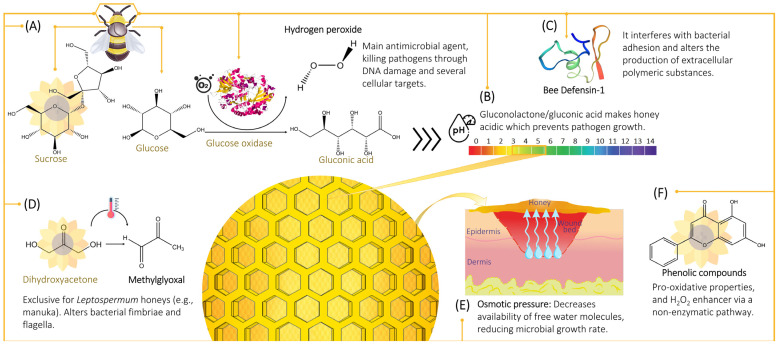
Figure 1
Figure 1
Key antimicrobial components of honey. (A) Sucrose from flowers is broken down by the bee into glucose and fructose. The bee’s hypopharyngeal glands secrete GOx. Glucose is then oxidised by the oxidised form of GOx, which results in the production of gluconolactone/gluconic acid and H2O2. Most of honey’s antimicrobial activity comes from H2O2, killing pathogens through DNA damage and several cellular targets. (B) Honey is acidic with an average pH of 3.91 (ranges between 3.4 to 6.1), which makes it powerful against microbial strains with an optimum pH of growth around 7. Acidity predominantly arises from gluconolactone/gluconic acid. (C) Bee Def-1 is an antibacterial peptide originating in the bee’s hypopharyngeal gland. It acts by interfering with bacterial adhesion to a surface, or in the early biofilm stage by inhibiting the growth of attached cells; and by altering the production of extracellular polymeric substances. (D) MGO is generated in honey during storage by the non-enzymatic conversion of dihydroxyacetone, a saccharide found in high concentrations in the nectar of Leptospermum flowers. The antimicrobial activity of MGO is attributed to alterations in bacterial fimbriae and flagella, which obstruct the bacterium’s adherence and motility. (E) Honey is a super-saturated solution of sugars. The strong interaction between these sugars with water molecules prevents the abundance of free water molecules (low water activity) available for microbes to grow. (F) The combination of different phenols act as an enhancer of honey’s antimicrobial efficacy. In alkaline conditions (pH 7.0–8.0), polyphenols can display pro-oxidative properties, inhibiting microbial growth by accelerating hydroxyl radical formation and oxidative strand breakage in DNA. They could also support the production of considerable amounts of H2O2 via a non-enzymatic pathway.
Figure 2
Figure 2
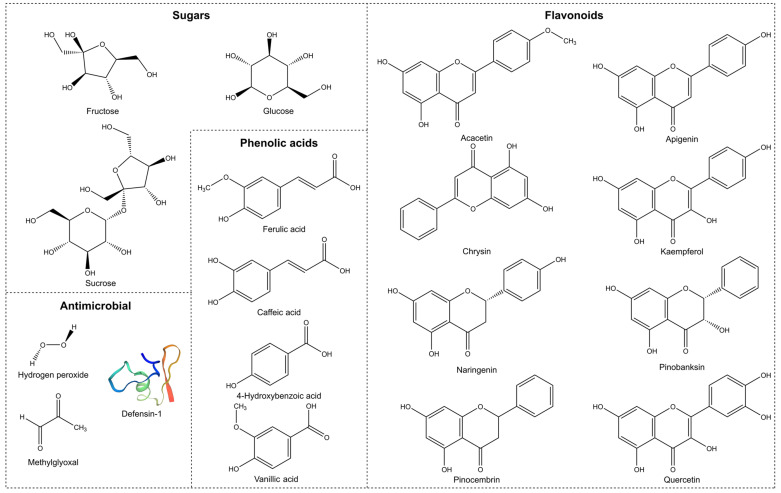
Compounds that can contribute to the overall antimicrobial properties of honey, including H2O2, def-1 (Swissmodel, P17722) [35], MGO (Leptospermum honeys only), flavonoids, phenolic acids, and sugars.
Figure 3
Figure 3
Schematic representation of the enzymatic reaction between glucose oxidase and glucose to produce H2O2 and gluconic acid.
Figure 4
Figure 4
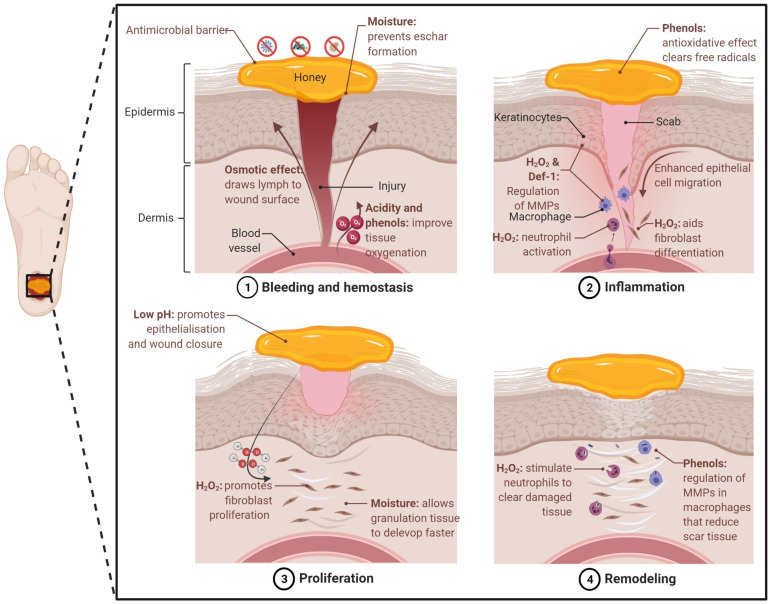
Key factors of honey that contribute to wound healing across all four healing phases. Created with BioRender.com (accessed on 23 February 2022).
Figure 5
Figure 5
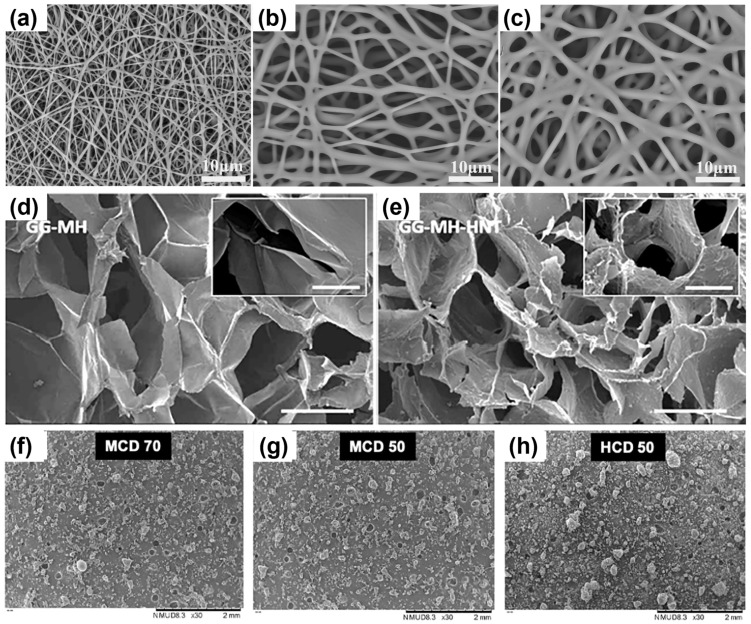
Honey-containing scaffolds. Scanning electron microscopy images of electrospun fibres containing (a) 0%, (b) 30%, and (c) 70% manuka honey [212]; (d) gellan gum hydrogels with 2% manuka honey and (e) reinforced with clay halloysite nanotubes [240]; and freeze-dried powders using methylated-β-cyclodextrin and (f) 70% or (g) 50% SurgihoneyRO™ and (h) (2-hydroxypropyl)-β-cyclodextrin with 50% SurgihoneyRO™ [254]. Reproduced with permission from Elsevier.

References

    1. Majno G. The healing hand. Man and wound in the ancient world. Med. Hist. 1975;20:461.
    1. Roope L.S.J., Smith R.D., Pouwels K.B., Buchanan J., Abel L., Eibich P., Butler C.C., Tan P.S., Walker A.S., Robotham J.V., et al. The challenge of antimicrobial resistance: What economics can contribute. Science. 2019;364:eaau4679. doi: 10.1126/science.aau4679. - DOI - PubMed
    1. Nathan C., Cars O. Antibiotic Resistance—Problems, Progress, and Prospects. N. Engl. J. Med. 2014;371:1761–1763. doi: 10.1056/NEJMp1408040. - DOI - PubMed
    1. Nathan C. Resisting antimicrobial resistance. Nat. Rev. Microbiol. 2020;18:259–260. doi: 10.1038/s41579-020-0348-5. - DOI - PubMed
    1. Soroye P., Newbold T., Kerr J. Climate change contributes to widespread declines among bumble bees across continents. Science. 2020;367:685–688. doi: 10.1126/science.aax8591. - DOI - PubMed

LinkOut - more resources