


Spatial Dispersal of Epstein-Barr Virus in South America Reveals an African American Variant in Brazilian Lymphomas
- PMID: 36016384
- PMCID: PMC9412316
- DOI: 10.3390/v14081762
Spatial Dispersal of Epstein-Barr Virus in South America Reveals an African American Variant in Brazilian Lymphomas
Abstract
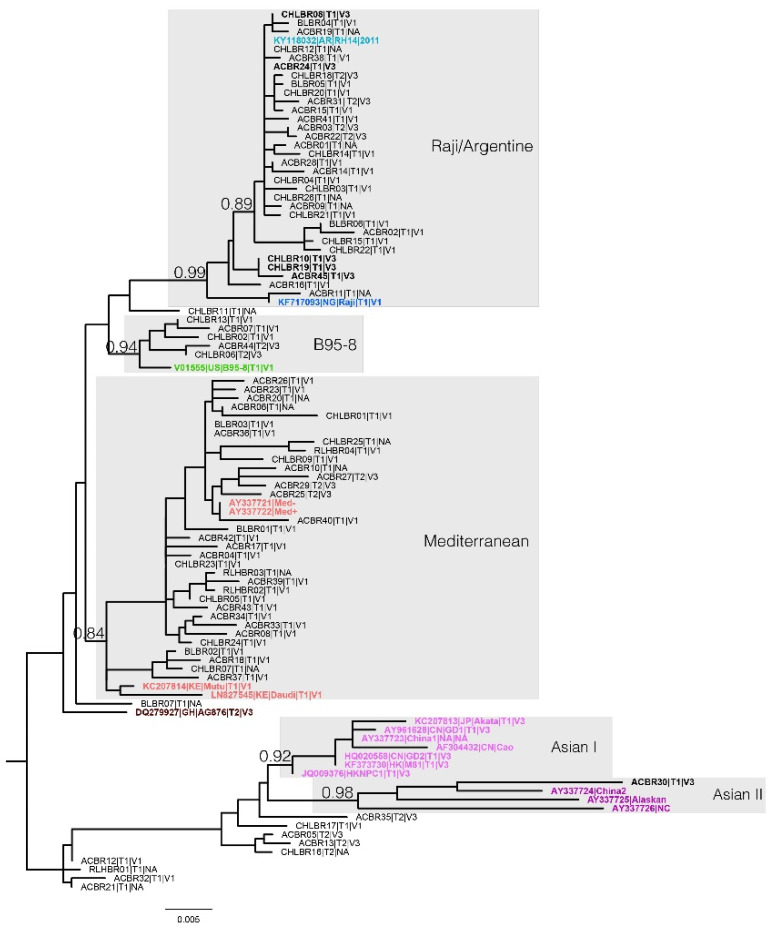
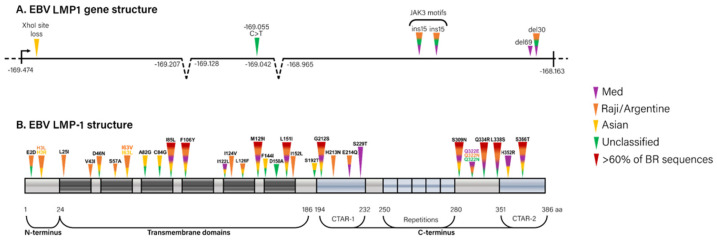
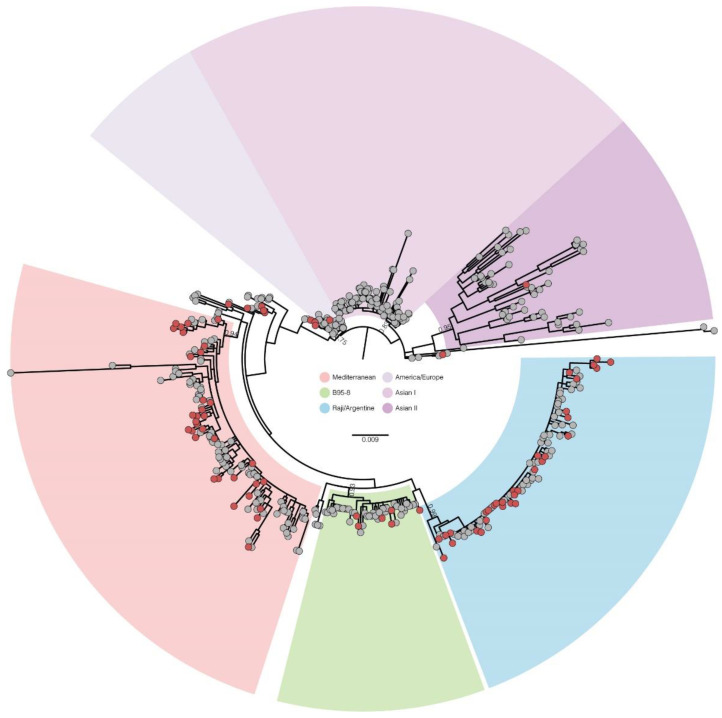
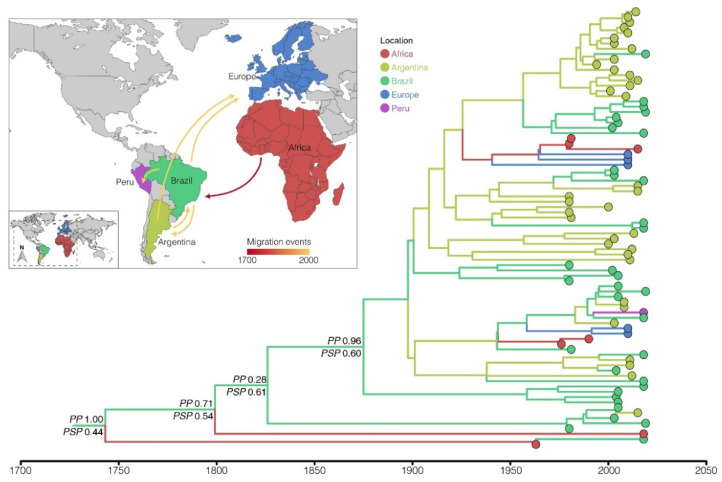
Epstein−Barr virus (EBV) is a saliva-borne ɣ-herpesvirus associated with benign and malignant lymphoproliferation. EBV-mediated tumorigenic mechanisms are not fully understood and may be related to viral genetic variations. In this work, we characterize the genetic diversity of EBV from Brazil, assessing 82 samples derived from saliva from asymptomatic carriers (n = 45), biopsies of benign reactive hyperplasia (n = 4), and lymphomas (n = 33). Phylogenetic and phylogeographic analysis of the entire coding region of the LMP-1 was performed. Additionally, type 1/type 2 distinction by the EBNA3C gene and Zp variants were evaluated. Our results revealed a high diversity of EBV in Brazil, with the co-circulation of four main clades, described here as: Mediterranean (40.2%, n = 33), Raji/Argentine (39%, n = 32), B95-8 (6.1%, n = 5), and Asian II (1.2%, n = 1). The Raji/Argentine and Mediterranean clades were the most prevalent in South America (45% and 28%, respectively). The Raji/Argentine clade was associated with polymorphisms I124V/I152L, del30 bp, and ins15 bp (p < 0.0001, to all clades) and with a high haplotype diversity related to EBV type and Zp variants. We found that a Raji/Argentine subclade spread primarily from Brazil and later to other South American countries. Although no LMP1 variant has been directly associated with disease, the Raji/Argentine clade was predominantly clustered with lymphomas (61%) and the Mediterranean clade with non-malignant cases (59%) (p = 0.1). These data highlight the high genetic diversity of EBV circulating in Brazil, calling attention to a Raji-related variant with great recombination potential in Brazilian lymphomas.
Keywords: EBV diversity; Epstein–Barr virus; LMP-1; South America; phylogeography.
Conflict of interest statement
The authors declare no conflict of interest.
Figures
References
-
- Chabay P.A., Barros M.H.M., Hassan R., De Matteo E., Rey G., Carrico M.K., Renault I.Z., Preciado M.V. Pediatric Hodgkin Lymphoma in 2 South American Series: A Distinctive Epidemiologic Pattern and Lack of Association of Epstein-Barr Virus with Clinical Outcome. J. Pediatr. Hematol. 2008;30:285–291. doi: 10.1097/MPH.0b013e3181647bc3. - DOI - PubMed
-
- Hassan R., Klumb C.E., Felisbino F.E., Guiretti D.M., White L.R., Stefanoff C.G., Barros M.H.M., Seuánez H.N., Zalcberg I.R. Clinical and Demographic Characteristics of Epstein-Barr Virus-Associated Childhood Burkitt’s Lymphoma in Southeastern Brazil: Epidemiological Insights from an Intermediate Risk Region. Haematologica. 2008;93:780–783. doi: 10.3324/haematol.12424. - DOI - PubMed
-
- Martín P., Krsnik I., Navarro B., Provencio M., García J.F., Bellas C., Vilches C., Gómez-Lozano N. HLA Allele E*01:01 Is Associated with a Reduced Risk of EBV-Related Classical Hodgkin Lymphoma Independently of HLA-A*01/*02. PLoS ONE. 2015;10:e0135512. doi: 10.1371/journal.pone.0135512. - DOI - PMC - PubMed
Publication types
MeSH terms
Substances
LinkOut - more resources
Full Text Sources
Medical
