Review
. 2022 Aug 9:13:971032.
doi: 10.3389/fphar.2022.971032. eCollection 2022.

Traditional Chinese herbs and natural products in hyperuricemia-induced chronic kidney disease

Affiliations
Review

Traditional Chinese herbs and natural products in hyperuricemia-induced chronic kidney disease

Letian Yang et al. Front Pharmacol. .

Abstract

Hyperuricemia is a common biochemical disorder, which resulted from both excessive uric acid (UA) production and/or absolute or relative impairment of urinary UA excretion. Growing evidence has indicated that hyperuricemia is an independent risk factor for the development and progression of chronic kidney disease (CKD), causing hyperuricemia-induced CKD (hyperuricemic nephropathy, HN). The therapeutic strategy of HN is managing hyperuricemia and protecting kidney function. Adverse effects of commercial drugs make persistent treatment of HN challenging. Traditional Chinese medicine (TCM) has exact efficacy in lowering serum UA without serious adverse effects. In addition, TCM is widely applied for the treatment of CKD. This review aimed to provide an overview of efficacy and mechanisms of traditional Chinese herbs and natural products in hyperuricemia-induced CKD.

Keywords: chronic kidney disease; herbal medicine; hyperuricemia; hyperuricemic nephropathy; natural product.


Conflict of interest statement

The authors declare that the research was conducted in the absence of any commercial or financial relationships that could be construed as a potential conflict of interest.

Figures
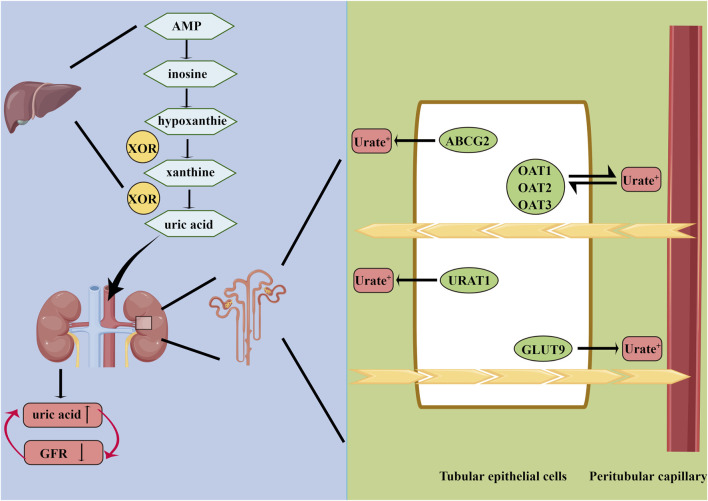
FIGURE 1
FIGURE 1
Summary of uric acid metabolism. AMP, adenosine monophosphate; XOR, xanthine oxidoreductase; GLUT9, glucose transporter 9; OAT1, organic anion transporter 1; ABCG2, ATP-binding cassette superfamily G member 2; URAT1, urate anion transporter 1; OAT3, organic anion transporter 3; GFR, glomerular filtration rate.

References

    1. Bach M. H., Simkin P. A. (2014). Uricosuric drugs: The once and future therapy for hyperuricemia? Curr. Opin. Rheumatol. 26 (2), 169–175. 10.1097/BOR.0000000000000035 - DOI - PubMed
    1. Baldwin W., McRae S., Marek G., Wymer D., Pannu V., Baylis C., et al. (2011). Hyperuricemia as a mediator of the proinflammatory endocrine imbalance in the adipose tissue in a murine model of the metabolic syndrome. Diabetes 60 (4), 1258–1269. 10.2337/db10-0916 - DOI - PMC - PubMed
    1. Bao Y., Li H., Li Q. Y., Li Y., Li F., Zhang C. F., et al. (2018). Therapeutic effects of Smilax glabra and Bolbostemma paniculatum on rheumatoid arthritis using a rat paw edema model. Biomed. Pharmacother. = Biomedecine Pharmacother. 108, 309–315. 10.1016/j.biopha.2018.09.004 - DOI - PubMed
    1. Battelli M. G., Polito L., Bortolotti M., Bolognesi A. (2016). Xanthine oxidoreductase in drug metabolism: Beyond a role as a detoxifying enzyme. Curr. Med. Chem. 23 (35), 4027–4036. 10.2174/0929867323666160725091915 - DOI - PMC - PubMed
    1. Becker M. A., Schumacher H. R., Espinoza L. R., Wells A. F., MacDonald P., Lloyd E., et al. (2010). The urate-lowering efficacy and safety of febuxostat in the treatment of the hyperuricemia of gout: The CONFIRMS trial. Arthritis Res. Ther. 12 (2), R63. 10.1186/ar2978 - DOI - PMC - PubMed

LinkOut - more resources
