


PROSPECT: 4- and 6-year follow-up of a randomised trial of surgery for vaginal prolapse
- PMID: 36018353
- PMCID: PMC9834125
- DOI: 10.1007/s00192-022-05308-0
PROSPECT: 4- and 6-year follow-up of a randomised trial of surgery for vaginal prolapse
Abstract
Introduction and hypothesis: Our aim was to compare the mid-term results of native tissue, biological xenograft and polypropylene mesh surgery for women with vaginal wall prolapse.
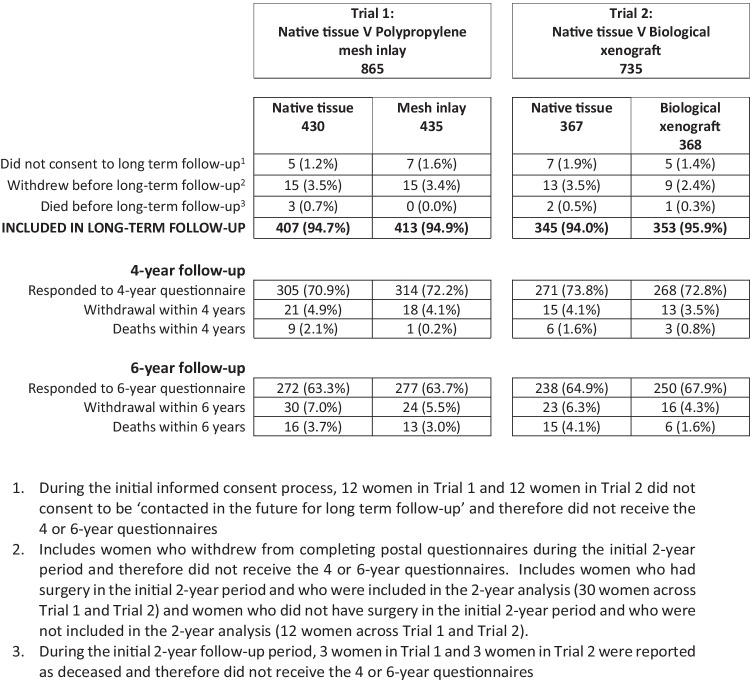
Methods: A total of 1348 women undergoing primary transvaginal repair of an anterior and/or posterior prolapse were recruited between January 2010 and August 2013 from 35 UK centres. They were randomised by remote allocation to native tissue surgery, biological xenograft or polypropylene mesh. We performed both 4- and 6-year follow-up using validated patient-reported outcome measures.
Results: At 4 and 6 years post-operation, there was no clinically important difference in Pelvic Organ Prolapse Symptom Score for any of the treatments. Using a strict composite outcome to assess functional cure at 6 years, we found no difference in cure among the three types of surgery. Half the women were cured at 6 years but only 10.3 to 12% of women had undergone further surgery for prolapse. However, 8.4% of women in the mesh group had undergone further surgery for mesh complications. There was no difference in the incidence of chronic pain or dyspareunia between groups.
Conclusions: At the mid-term outcome of 6 years, there is no benefit from augmenting primary prolapse repairs with polypropylene mesh inlays or biological xenografts. There was no evidence that polypropylene mesh inlays caused greater pain or dyspareunia than native tissue repairs.
Keywords: Polypropylene mesh; Prolapse; Randomised trial; Xenograft.
© 2022. The Author(s).
Conflict of interest statement
Professor Freeman reports previous (not in the last 5-years) speaker fees for Astellas and Pfizer. All other authors declare that they have no conflict of interest.
Mary Kilonzo is the current Health Economics Editor of the Cochrane Incontinence Group.
Professor Norrie declares grants from University of Aberdeen and grants from University of Edinburgh during the conduct of the study and membership of the following NIHR boards: Efficacy and Mechanism Evaluation (EME) Board; CPR decision-making committee; HTA Commissioning Board; HTA Commissioning Sub-Board (EOI); HTA Funding Boards Policy Group; HTA General Board; HTA Post-Board funding teleconference; NIHR CTU Standing Advisory Committee; NIHR HTA & EME Editorial Board; Pre-exposure Prophylaxis Impact Review Panel.
References
-
- Allegre L, Callewaert G, Alonso S, Cornille A, Fernandez H, Eglin G, et al. Long-term outcomes of a randomized controlled trial comparing trans-obturator vaginal mesh with native tissue repair in the treatment of anterior vaginal wall prolapse. Int Urogynecol J. 2020;31(4):745–753. doi: 10.1007/s00192-019-04073-x. - DOI - PubMed
-
- Olsen AL, Smith VJ, Bergstrom JO, Colling JC, Clark AL. Epidemiology of surgically managed pelvic organ prolapse and urinary incontinence. Obstet Gynecol 1997 APR. 1997;89(4):501–506. - PubMed
-
- The Department of Economic and Social Affairs of the United Nations. World Population Ageing. 2017; Available at: https://www.un.org/en/development/desa/population/publications/pdf/agein.... Accessed 22 June, 2021.
-
- Leeson G. The impact of mortality development on the number of centenarians in England and Wales. J Pop Research. 2017;34:1–15. doi: 10.1007/s12546-016-9178-8. - DOI
Publication types
MeSH terms
Substances
Grants and funding
LinkOut - more resources
Full Text Sources
Medical
