Concordance of SARS-CoV-2 Results in Self-collected Nasal Swabs vs Swabs Collected by Health Care Workers in Children and Adolescents
- PMID: 36018570
- PMCID: PMC9419070
- DOI: 10.1001/jama.2022.14877
Concordance of SARS-CoV-2 Results in Self-collected Nasal Swabs vs Swabs Collected by Health Care Workers in Children and Adolescents
Abstract
Importance: Despite the expansion of SARS-CoV-2 testing, available tests have not received Emergency Use Authorization for performance with self-collected anterior nares (nasal) swabs from children younger than 14 years because the effect of pediatric self-swabbing on SARS-CoV-2 test sensitivity is unknown.
Objective: To characterize the ability of school-aged children to self-collect nasal swabs for SARS-CoV-2 testing compared with collection by health care workers.
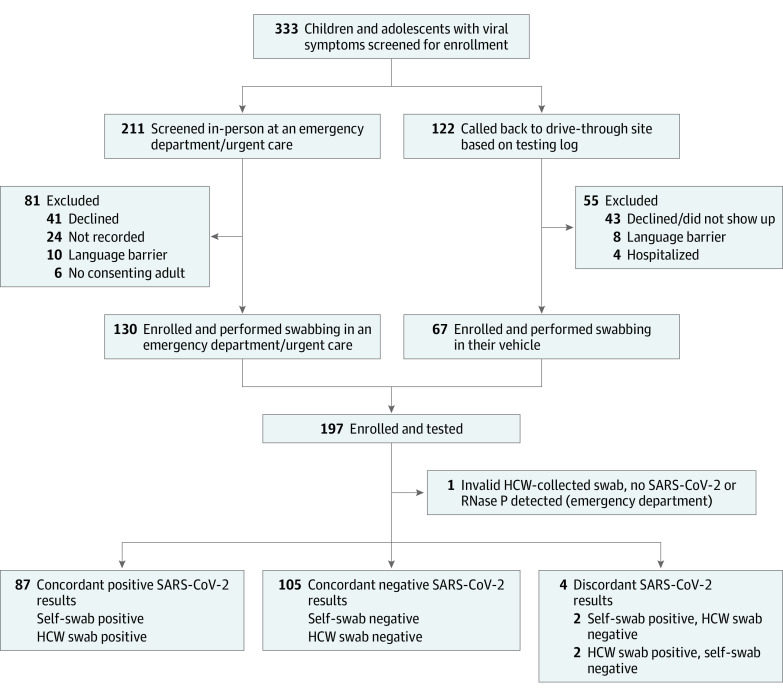
Design, setting, and participants: Cross-sectional study of 197 symptomatic children and adolescents aged 4 to 14 years old. Individuals were recruited based on results of testing in the Children's Healthcare of Atlanta system from July to August 2021.
Exposures: Children and adolescents were given instructional material consisting of a short instructional video and a handout with written and visual steps for self-swab collection. Participants first provided a self-collected nasal swab. Health care workers then collected a second specimen.
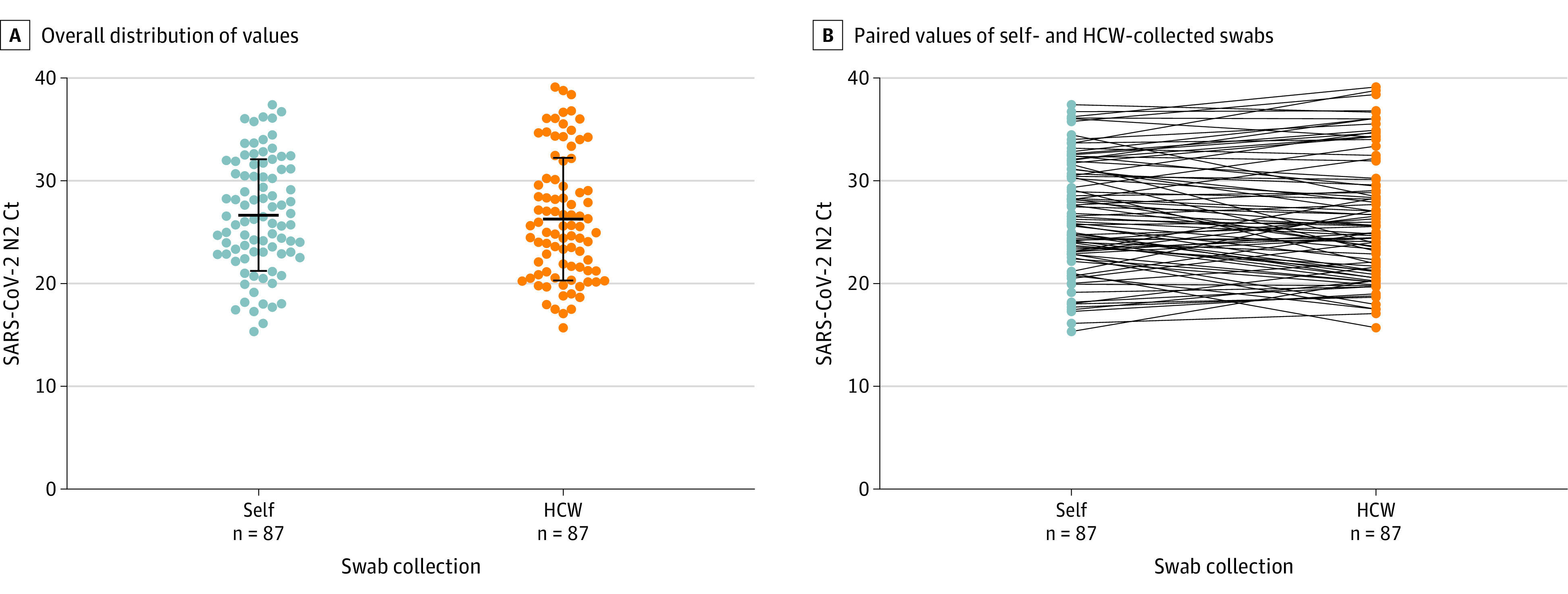
Main outcomes and measures: The primary outcome was SARS-CoV-2 detection and relative quantitation by cycle threshold (Ct) in self- vs health care worker-collected nasal swabs when tested with a real-time reverse transcriptase-polymerase chain reaction test with Emergency Use Authorization.
Results: Among the study participants, 108 of 194 (55.7%) were male and the median age was 9 years (IQR, 6-11). Of the 196 participants, 87 (44.4%) tested positive for SARS-CoV-2 and 105 (53.6%) tested negative by both self- and health care worker-collected swabs. Two children tested positive by self- or health care worker-collected swab alone; 1 child had an invalid health care worker swab. Compared with health care worker-collected swabs, self-collected swabs had 97.8% (95% CI, 94.7%-100.0%) and 98.1% (95% CI, 95.6%-100.0%) positive and negative percent agreement, respectively, and SARS-CoV-2 Ct values did not differ significantly between groups (mean [SD] Ct, self-swab: 26.7 [5.4] vs health care worker swab: 26.3 [6.0]; P = .65).
Conclusions and relevance: After hearing and seeing simple instructional materials, children and adolescents aged 4 to 14 years self-collected nasal swabs that closely agreed on SARS-CoV-2 detection with swabs collected by health care workers.
Conflict of interest statement
Figures
Comment in
-
Self-sampling for SARS-CoV-2 Detection in Children.JAMA. 2022 Sep 13;328(10):929-930. doi: 10.1001/jama.2022.15225. JAMA. 2022. PMID: 36018595 No abstract available.
-
SARS-CoV-2 Results in Self-collected Nasal Swabs vs Swabs Collected by Health Care Workers in Children and Adolescents.JAMA. 2023 Feb 7;329(5):424-425. doi: 10.1001/jama.2022.21596. JAMA. 2023. PMID: 36749340 No abstract available.
References
-
- Centers for Disease Control and Prevention . Real-time RT-PCR panel for detection 2019-novel coronavirus, instructions for use. Accessed September 1, 2021. https://stacks.cdc.gov/view/cdc/84526
Publication types
MeSH terms
Grants and funding
LinkOut - more resources
Full Text Sources
Medical
Miscellaneous