


Advance Care Planning in Serious Illness: A Narrative Review
- PMID: 36028176
- PMCID: PMC9884468
- DOI: 10.1016/j.jpainsymman.2022.08.012
Advance Care Planning in Serious Illness: A Narrative Review
Abstract
Context: Advance care planning (ACP) intends to support person-centered medical decision-making by eliciting patient preferences. Research has not identified significant associations between ACP and goal-concordant end-of-life care, leading to justified scientific debate regarding ACP utility.
Objective: To delineate ACP's potential benefits and missed opportunities and identify an evidence-informed, clinically relevant path ahead for ACP in serious illness.
Methods: We conducted a narrative review merging the best available ACP empirical data, grey literature, and emergent scholarly discourse using a snowball search of PubMed, Medline, and Google Scholar (2000-2022). Findings were informed by our team's interprofessional clinical and research expertise in serious illness care.
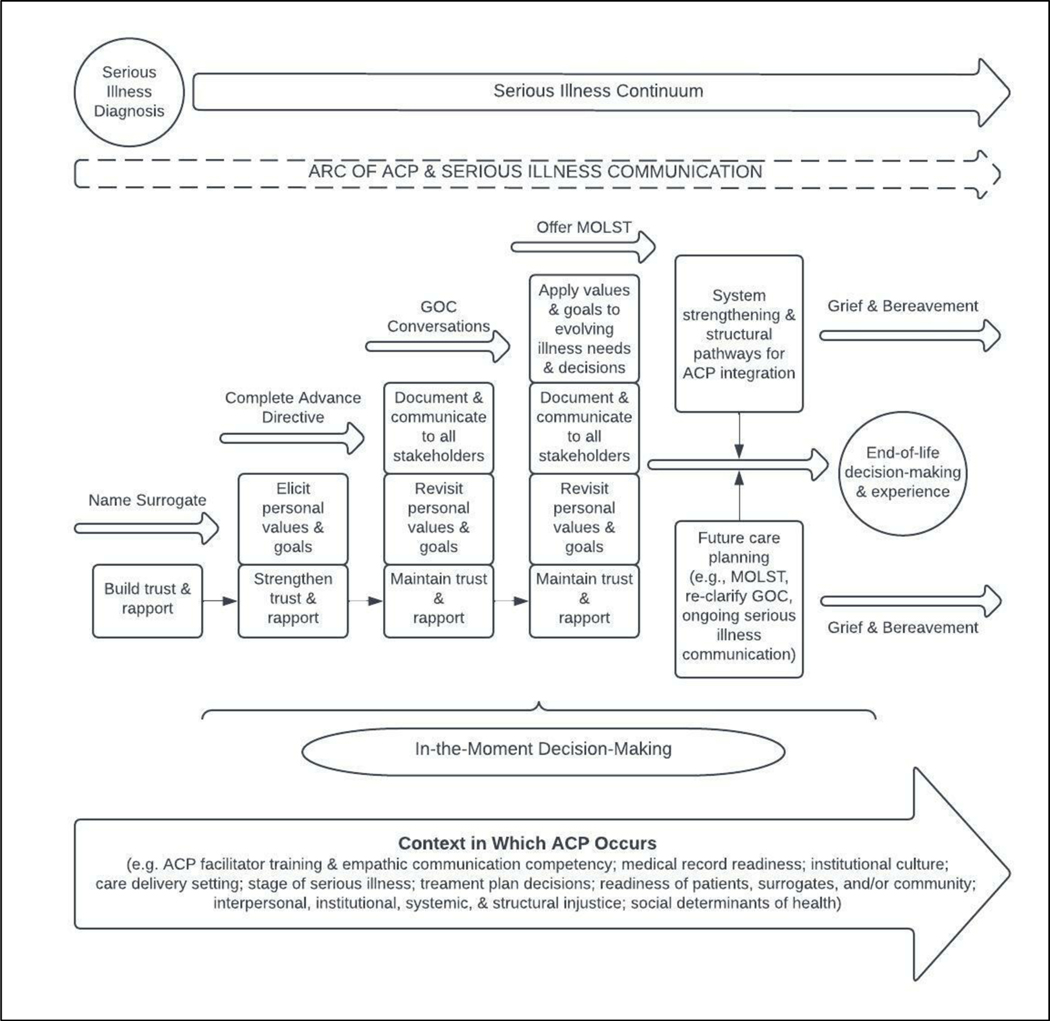
Results: Early ACP practices were largely tied to mandated document completion, potentially failing to capture the holistic preferences of patients and surrogates. ACP models focused on serious illness communication rather than documentation show promising patient and clinician results. Ideally, ACP would lead to goal-concordant care even amid the unpredictability of serious illness trajectories. But ACP might also provide a false sense of security that patients' wishes will be honored and revisited at end-of-life. An iterative, 'building block' framework to integrate ACP throughout serious illness is provided alongside clinical practice, research, and policy recommendations.
Conclusions: We advocate a balanced approach to ACP, recognizing empirical deficits while acknowledging potential benefits and ethical imperatives (e.g., fostering clinician-patient trust and shared decision-making). We support prioritizing patient/surrogate-centered outcomes with more robust measures to account for interpersonal clinician-patient variables that likely inform ACP efficacy and may better evaluate information gleaned during serious illness encounters.
Keywords: Advance care planning; advance directives; communication; end-of-life; goal-concordant care; palliative care; patient-centered care; serious illness.
Copyright © 2022 American Academy of Hospice and Palliative Medicine. Published by Elsevier Inc. All rights reserved.
Conflict of interest statement
Disclosure/Conflict of Interest Statement:
All authors are members of the Cambia Health Foundation Sojourns Scholars Leadership Development Program Advance Care Planning Special Interest Group. The views expressed in this manuscript rest solely with the authors and do not reflect the views, opinions, position, or endorsement of Cambia Health Foundation. These authors have no other conflicts of interest to disclose.
Figures
Comment in
-
Response to Advance Care Planning in Serious Illness: A Narrative Review.J Pain Symptom Manage. 2023 Jun;65(6):e767-e768. doi: 10.1016/j.jpainsymman.2023.02.318. J Pain Symptom Manage. 2023. PMID: 37179102 No abstract available.
References
Publication types
MeSH terms
Grants and funding
LinkOut - more resources
Full Text Sources
