Gut microbiota mediate vascular dysfunction in a murine model of sleep apnoea: effect of probiotics
- PMID: 36028255
- PMCID: PMC11556237
- DOI: 10.1183/13993003.00002-2022
Gut microbiota mediate vascular dysfunction in a murine model of sleep apnoea: effect of probiotics
Erratum in
-
"Gut microbiota mediate vascular dysfunction in a murine model of sleep apnoea: effect of probiotics." M. Badran, A. Khalyfa, A.C. Ericsson, C. Puech, Z. McAdams, S.B. Bender and D. Gozal. Eur Respir J 2023; 61: 2200002.Eur Respir J. 2023 Apr 27;61(4):2250002. doi: 10.1183/13993003.50002-2022. Print 2023 Apr. Eur Respir J. 2023. PMID: 37105588 No abstract available.
Abstract
Background: Obstructive sleep apnoea (OSA) is a chronic prevalent condition characterised by intermittent hypoxia (IH), and is associated with endothelial dysfunction and coronary artery disease (CAD). OSA can induce major changes in gut microbiome diversity and composition, which in turn may induce the emergence of OSA-associated morbidities. However, the causal effects of IH-induced gut microbiome changes on the vasculature remain unexplored. Our objective was to assess if vascular dysfunction induced by IH is mediated through gut microbiome changes.
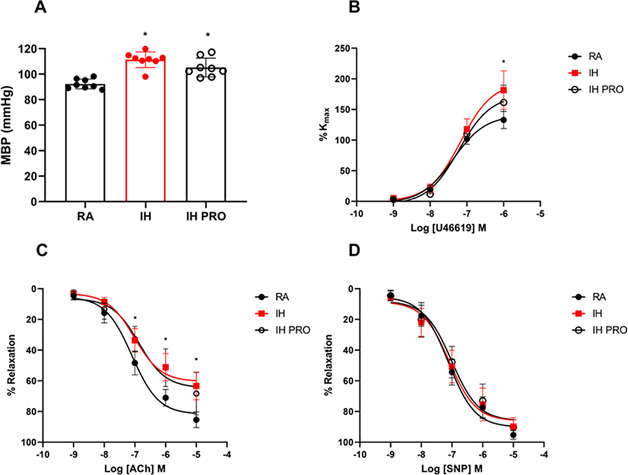
Methods: Faecal microbiota transplantation (FMT) was conducted on C57BL/6J naïve mice for 6 weeks to receive either IH or room air (RA) faecal slurry with or without probiotics (VSL#3). In addition to 16S rRNA amplicon sequencing of their gut microbiome, FMT recipients underwent arterial blood pressure and coronary artery and aorta function testing, and their trimethylamine N-oxide (TMAO) and plasma acetate levels were determined. Finally, C57BL/6J mice were exposed to IH, IH treated with VSL#3 or RA for 6 weeks, and arterial blood pressure and coronary artery function assessed.
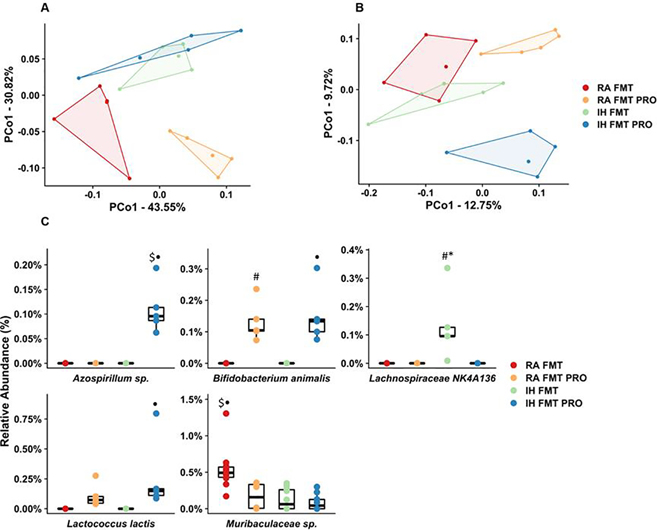
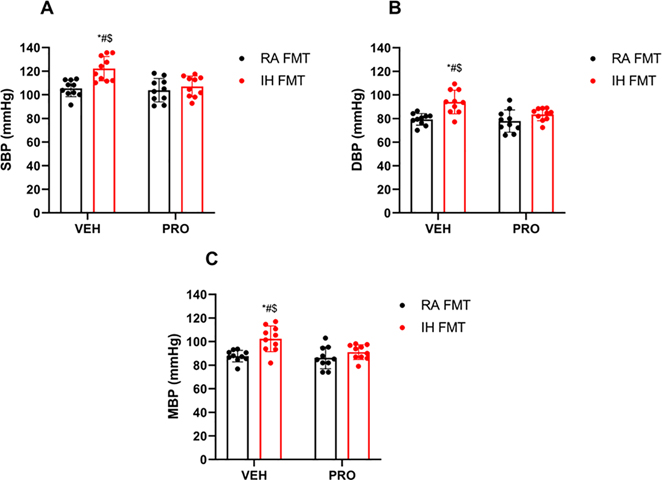
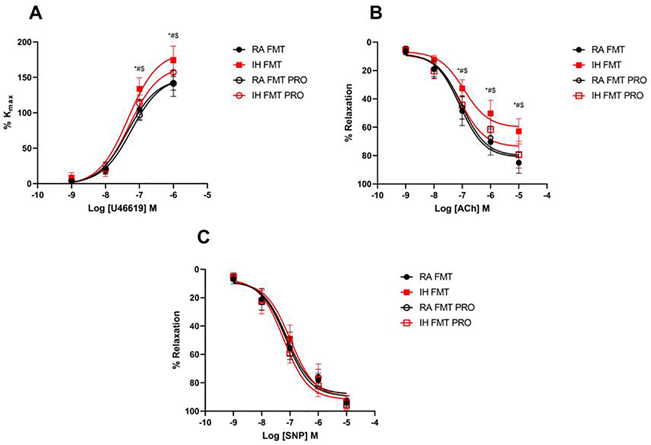
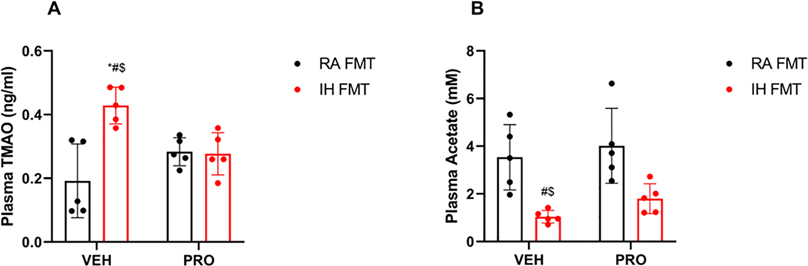
Results: Gut microbiome taxonomic profiles correctly segregated IH from RA in FMT mice and the normalising effect of probiotics emerged. Furthermore, IH-FMT mice exhibited increased arterial blood pressure and TMAO levels, and impairments in aortic and coronary artery function (p<0.05) that were abrogated by probiotic administration. Lastly, treatment with VSL#3 under IH conditions did not attenuate elevations in arterial blood pressure or CAD.
Conclusions: Gut microbiome alterations induced by chronic IH underlie, at least partially, the typical cardiovascular disturbances of sleep apnoea and can be mitigated by concurrent administration of probiotics.
Copyright ©The authors 2023. For reproduction rights and permissions contact permissions@ersnet.org.
Conflict of interest statement
Conflict of interest: All authors declare no conflicts of interest.
Figures
Comment in
-
Gut check: assessing the role of the gut microbiota in the adverse cardiovascular effects of obstructive sleep apnoea.Eur Respir J. 2023 Jan 19;61(1):2201974. doi: 10.1183/13993003.01974-2022. Print 2023 Jan. Eur Respir J. 2023. PMID: 36657778 No abstract available.
References
-
- Benjafield A V, Ayas NT, Eastwood PR, Heinzer R, Ip MSM, Morrell MJ, Nunez CM, Patel SR, Penzel T, Pépin JLD, Peppard PE, Sinha S, Tufik S, Valentine K, Malhotra A, M, et al. Estimation of the global prevalence and burden of obstructive sleep apnoea: a literature-based analysis. Lancet. Respir. Med. 2019; 7: 687–698 Available from: https://pubmed.ncbi.nlm.nih.gov/31300334/. - PMC - PubMed
-
- Badran M, Yassin BA, Fox N, Laher I, Ayas N. Epidemiology of Sleep Disturbances and Cardiovascular Consequences. Can. J. Cardiol. 2015; 7: p. 873–879 Available from: https://pubmed.ncbi.nlm.nih.gov/26037823/. - PubMed
-
- Badran M, Ayas N, Laher I. Cardiovascular complications of sleep apnea: Role of oxidative stress. Oxid. Med. Cell. Longev. 2014; 2: 985285 Available from: https://pubmed.ncbi.nlm.nih.gov/24734153/. - PMC - PubMed
-
- Badran M, Ayas N, Laher I. Insights into obstructive sleep apnea research. Sleep Med. 2014; 5: p. 485–495 Available from: https://pubmed.ncbi.nlm.nih.gov/24824769/. - PubMed
-
- Javaheri S, Barbe F, Campos-Rodriguez F, Dempsey JA, Khayat R, Javaheri S, Malhotra A, Martinez-Garcia MA, Mehra R, Pack AI, Polotsky VY, Redline S, Somers VK. Sleep Apnea: Types, Mechanisms, and Clinical Cardiovascular Consequences J. Am. Coll. Cardiol. p. 841–858 Available from: https://pubmed.ncbi.nlm.nih.gov/28209226/. - PMC - PubMed
Publication types
MeSH terms
Substances
Grants and funding
LinkOut - more resources
Full Text Sources
Medical
Miscellaneous