Review
. 2022 Oct:154:113522.
doi: 10.1016/j.biopha.2022.113522. Epub 2022 Aug 15.

Omicron variant (B.1.1.529) and its sublineages: What do we know so far amid the emergence of recombinant variants of SARS-CoV-2?

Affiliations
Review

Omicron variant (B.1.1.529) and its sublineages: What do we know so far amid the emergence of recombinant variants of SARS-CoV-2?

Manish Dhawan et al. Biomed Pharmacother. 2022 Oct.

Abstract

Since the start of the COVID-19 pandemic, numerous variants of SARS-CoV-2 have been reported worldwide. The advent of variants of concern (VOCs) raises severe concerns amid the serious containment efforts against COVID-19 that include physical measures, pharmacological repurposing, immunization, and genomic/community surveillance. Omicron variant (B.1.1.529) has been identified as a highly modified, contagious, and crucial variant among the five VOCs of SARS-CoV-2. The increased affinity of the spike protein (S-protein), and host receptor, angiotensin converting enzyme-2 (ACE-2), due to a higher number of mutations in the receptor-binding domain (RBD) of the S-protein has been proposed as the primary reason for the decreased efficacy of majorly available vaccines against the Omicron variant and the increased transmissible nature of the Omicron variant. Because of its significant competitive advantage, the Omicron variant and its sublineages swiftly surpassed other variants to become the dominant circulating lineages in a number of nations. The Omicron variant has been identified as a prevalent strain in the United Kingdom and South Africa. Furthermore, the emergence of recombinant variants through the conjunction of the Omicron variant with other variants or by the mixing of the Omicron variant's sublineages/subvariants poses a major threat to humanity. This raises various issues and hazards regarding the Omicron variant and its sublineages, such as an Omicron variant breakout in susceptible populations among fully vaccinated persons. As a result, understanding the features and genetic implications of this variant is crucial. Hence, we explained in depth the evolution and features of the Omicron variant and analyzed the repercussions of spike mutations on infectiousness, dissemination ability, viral entry mechanism, and immune evasion. We also presented a viewpoint on feasible strategies for precluding and counteracting any future catastrophic emergence and spread of the omicron variant and its sublineages that could result in a detrimental wave of COVID-19 cases.

Keywords: COVID-19; Omicron; Pandemic; Sublineages; Vaccine effectiveness; Variants.


Conflict of interest statement

Conflict of interest statement The authors declare that they have no known competing financial interests or personal relationships that could have appeared to influence the work reported in this paper.

Figures

ga1
Graphical abstract
Fig. 1
Fig. 1
The figure represents the global dominance and geographical distribution of the Omicron variant and its sublineages as compared to the other VOCs. The prevalence of the Omicron variant and subvariants/sublineages and their circulation among the countries has been linked to the emergence of novel recombinant variants.
Fig. 2
Fig. 2
The figure represents the major differences among the sublineages of the Omicron variant. The unique mutations in the sublineages can be associated with the varying levels of transmissibility and severity of the disease. It is important to notice that the recently emerged BA.4 and BA.5 sublineages can lead to another wave of COVID-19 cases due to increased transmissibility and escape to the immune response.
Fig. 3
Fig. 3
The figure shows the emerging lineages of the SARS-CoV-2’s Omicron variant, which are distinct due to the presence of specific mutations. The emergence of these subvariants or sublineages is based on the genome sampled from November 2021 to June 2022.
Fig. 4
Fig. 4
Phylogenetic analysis of the Omicron variant. It shows the distinct evolution of the BA.1 lineage and other sublineages from other VOCs.
Fig. 5
Fig. 5
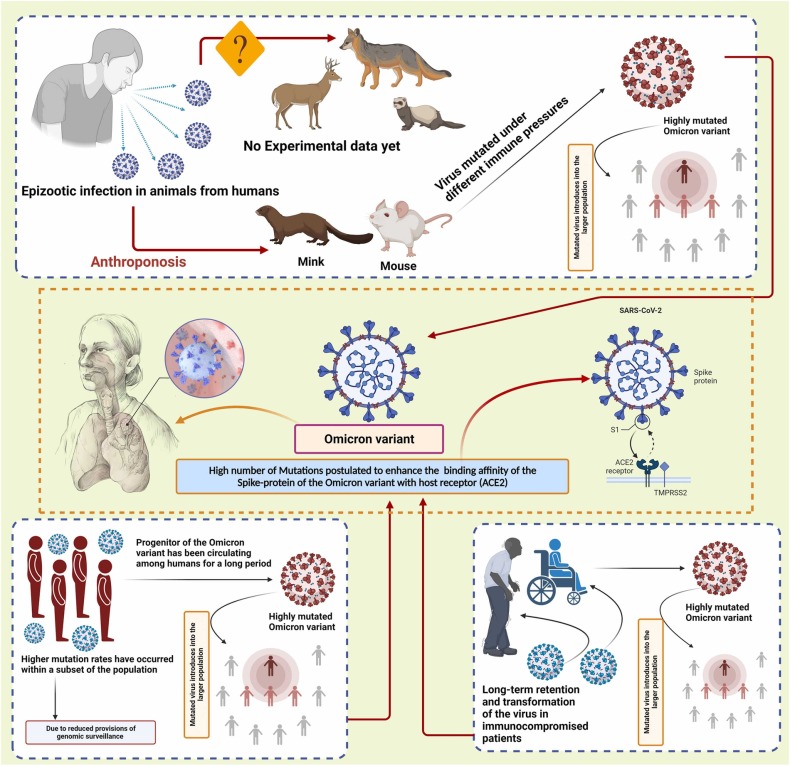
The figure shows all the possible theories behind the emergence of the Omicron variant.
Fig. 6
Fig. 6
The representation of mutations in the RBD of Omicron variant's spike protein (A) showing the mutations in the Spike protein, especially in the RBD of the S-protein [Adapted from Viana et al. [259]]. (B) Cryo-EM map of the Omicron variant's spike protein (C) Cryo-EM structure of Omicron spike protein indicating the key mutations (D) Two orientations of the highly mutated RBD (receptor binding domain) of the S-protein [Adapted from Mannar et al. [63]].
Fig. 7
Fig. 7
The figure represents the locations of the mutations in the S-protein of the Omicron variant used by various mAbs such as casirivimab, imdevimab, bamlanivimab, etesevimab, and sotrovimab to target the SARS-CoV-2. (RBD, gray; epitope targeted by the antibody, blue; Omicron-specific mutations within the epitope, red; Omicron-specific mutations outside the epitope, orange) [Adapted from Hoffmann et al. [173]]. However, the changes among these regions are associated with the resistance toward the mAbs , .
Fig. 8
Fig. 8
The representation of preventive measures to contain the possible deleterious consequences associated with the Omicron variant.

References

    1. Harvey W.T., Carabelli A.M., Jackson B., Gupta R.K., Thomson E.C., Harrison E.M., Ludden C., Reeve R., Rambaut A., Peacock S.J., Robertson D.L. SARS-CoV-2 variants, spike mutations and immune escape. Nat. Rev. Microbiol. 2021;19:409–424. doi: 10.1038/s41579-021-00573-0. - DOI - PMC - PubMed
    1. Dhawan M., Priyanka, Choudhary O.P. Omicron SARS-CoV-2 variant: reasons of emergence and lessons learnt. Int. J. Surg. 2022;97 doi: 10.1016/j.ijsu.2021.106198. - DOI - PMC - PubMed
    1. Islam F., Dhawan M., Mitra S., Bin Emran T. Assessing the risks associated with the emergence of Florona and possible preventive measures. J. Med. Virol. 2022 doi: 10.1002/jmv.27830. - DOI - PubMed
    1. Islam F., Dhawan M., Nafady M.H., Bin Emran T., Mitra S., Choudhary O.P., Akter A. Understanding the omicron variant (B.1.1.529) of SARS-CoV-2: mutational impacts, concerns, and the possible solutions. Ann. Med. Surg. 2022;78 doi: 10.1016/j.amsu.2022.103737. - DOI - PMC - PubMed
    1. Islam F., Dhawan M., Mitra S., Bin Emran T. Florona: an emerging threat posing alarming risks to global public health and possible containment measures. Int. J. Surg. 2022;101 doi: 10.1016/j.ijsu.2022.106625. - DOI - PMC - PubMed

Supplementary concepts